
Mere Existence Of Joint Family Not Enough To Prove All Properties Are Joint: Supreme Court
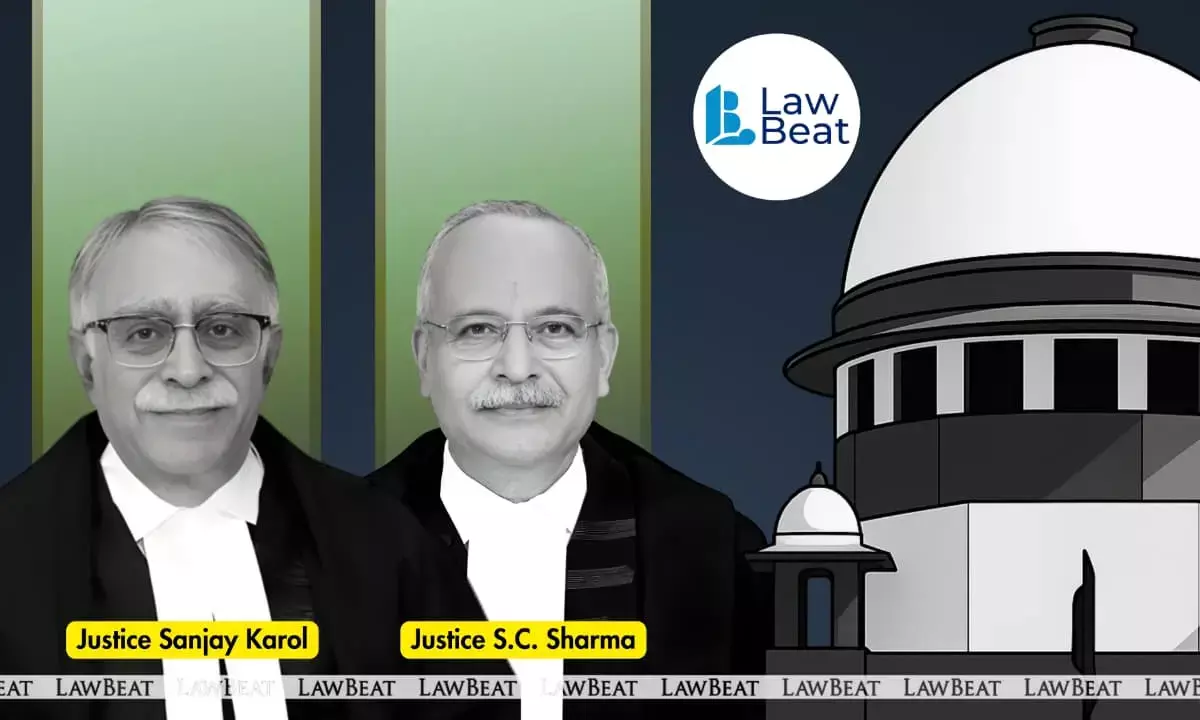
Supreme Court rules that mere existence of a joint Hindu family does not make all properties joint family property
The Supreme Court has clarified that merely proving the existence of a joint Hindu family does not automatically mean that all properties owned by its members are joint family properties. However, if it is shown that ancestral properties existed and were generating income, and that new properties were acquired during the continuation of the joint family, then the burden shifts to the person claiming that those properties were self-acquired.
A bench of Justices Sanjay Karol and Satish Chandra Sharma explained that Hindu law does not require other coparceners to precisely prove the exact source of funds for every property purchased by the Karta. If properties are bought during the existence of a joint family, and there is evidence that ancestral properties were yielding income, then properties purchased in the name of the Karta are generally treated as joint family properties unless proven otherwise.
Court also said that separate enjoyment of certain portions of land, installation of irrigation facilities, or even taking loans individually, do not by themselves amount to a legal partition. For a partition to be recognised in law, there must be a clear and unmistakable intention to separate from the joint family. In the absence of any declaration or conduct showing such intention, the family is presumed to continue as a joint family.
The observations came while deciding appeals filed by Dorairaj in a long-standing family dispute over partition and transfer of agricultural lands in and around Perambalur Taluk in Tiruchirappalli District. The dispute involved 79 immovable properties, mainly agricultural lands, detailed in the plaint with survey numbers, extent and boundaries. The main issues throughout the litigation were the nature of these properties, whether certain transfers were binding on the coparcenary, and the validity of a Will said to have been executed shortly before the death of the family patriarch.
After examining the record, the Supreme Court held that the high court had correctly appreciated the pleadings and evidence and properly applied the settled principles governing partition of joint Hindu family property. The Apex Court agreed that the mere existence of some independent income would not automatically rule out the possibility that joint family income also contributed to the acquisitions.
The Supreme Court noted that the high court had rightly found no clear proof of partition. All the sale documents described the interests transferred as undivided shares, there was no revenue mutation showing division, and there was no separate repayment of loans. In such circumstances, and without any clear intention to sever the joint status, the conclusion that the joint family continued was justified.
On the issue of the Will, the high court had found several suspicious circumstances. The testator, who usually signed documents, had put only a thumb impression on this Will. It was allegedly executed just 72 hours before his death. It was written by a close relative instead of a professional scribe, and there were doubts about whether the scribe was even present, as he was said to be on election duty at the time. The high court also noted that the trial court’s rejection of the Will had not been challenged at the appropriate stage and had therefore become final.
The Supreme Court agreed, observing that a party cannot take inconsistent stands at different stages of litigation.
Holding that the high court’s judgment was well-reasoned and supported by the evidence on record, the Supreme Court upheld the impugned judgment.
Case Title: Dorairaj Vs Doraisamy (Dead) Thr LRs & Ors
Bench: Justices Sanjay Karol Vs Satish Chandra Sharma
Date of Judgment: February 05, 2026