
NCSC Cannot Act Like A Court Or Order Payment Of Service Arrears: Supreme Court
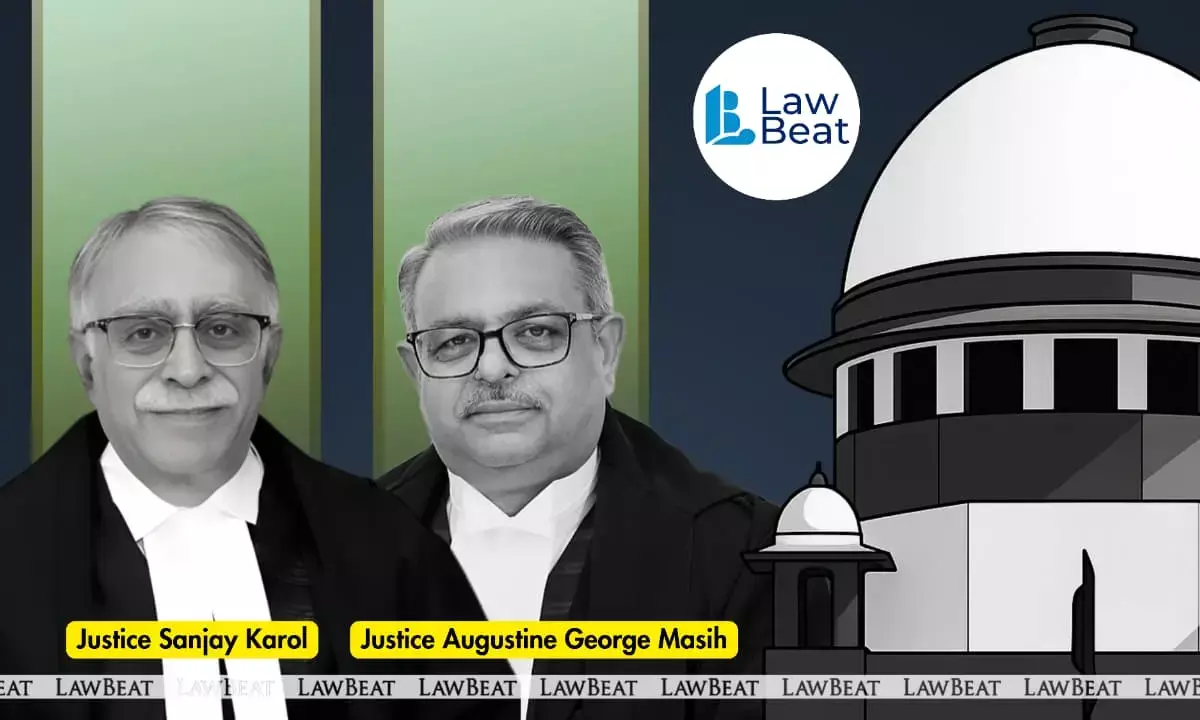
Supreme Court limits NCSC powers, bars orders directing arrears payment.
The Supreme Court has held that the National Commission for Scheduled Castes (NCSC) and other constitutional bodies set up under Articles 338A and 338B, though created with a socially beneficent purpose, cannot take over adjudicatory functions or direct payment of arrears to an employee.
A Bench of Justices Sanjay Karol and Augustine George Masih emphasized that the powers entrusted to the NCSC are limited in nature. The powers available to the NCSC are those of a civil court for receiving evidence, examining witnesses and other specified functions.
“The Legislature has prescribed a role that is recommendatory and advisory, but certainly not adjudicatory,” the Bench declared.
Court made the observations while dealing with an appeal filed by Mumbai Port Authority, which challenged directions issued by the NCSC in a service matter. The Supreme Court examined whether the NCSC can pass orders in respect of service matters and whether such directions are directory or mandatory.
Case background
As per the facts of the case, Madhavi K Chandorkar, a member of the Scheduled Caste, was employed by Mumbai Port Authority as a typist-cum-computer clerk on July 9, 1997. She was promoted to Stenographer Grade-I in 2002.
However, following a change in rules, she was demoted on September 11, 2020, notionally with effect from April 19, 2007 to November 30, 2016, from Grade-I to Grade-II.
Aggrieved by the demotion, Chandorkar approached the NCSC. After hearing both parties, the NCSC passed an order on October 23, 2024.
Among other directions, the NCSC ordered that the reservation roster be prepared as per Department of Personnel and Training (DoPT) guidelines. It also directed that promotion to the post of stenographer and subsequently to the post of PA to HOD be given as per the rules of reservation.
The NCSC further directed the authorities to implement its order and pay arrears within 30 days.
Mumbai Port Authority challenged the NCSC's order before the Bombay High Court, leading to the judgment which was subsequently challenged before the Supreme Court.
What are the NCSC's powers under the Constitution?
The Supreme Court said the NCSC, established under Article 338 of the Constitution, has been given specific and limited powers.
The NCSC itself contended in its written submissions that clause (b) of sub-article (5), which casts upon it a duty to inquire into specific complaints regarding deprivation of rights and safeguards, has two parts: enquiry and safeguarding.
The Supreme Court, however, was particularly concerned with whether these powers allowed the NCSC to direct the appellant to pay arrears within a specified period.
“We are of the considered view that the division bench fell in error in holding that the directions issued by NCSC in its order of October 23, 2024 were within the scope of powers provided under the Constitution,” the Bench held.
Also Read| Supreme Court cites "changing times" to allow SC certificate for girl based on mother's caste
Court pointed out that the Constitution is categorical about the civil court powers extended to the NCSC.
“The word used is ‘namely’ whereunder certain powers have been enumerated. That indicates the limited scope of the powers granted to it. It is therefore clear that while it has powers to requisition documents and receive evidence it does not have the power to make an order in furtherance of that evidence,” the Bench said.
“In other words, NCSC can record a factual finding and then ask the concerned Government, either the Centre or the State to act thereupon,” it added.
Court said it was difficult to accept the NCSC's submission in view of the explicit language of Article 338.
“It certainly does not confer adjudicatory power, at best recommendatory in nature. The power provided is to inquire into the deprivation of ‘rights and safeguards’ of the Scheduled Castes. The use of the word ‘and’ indicates that rights and safeguards are to be read together as a bundle,” the Bench said.
NCSC can monitor safeguards, but cannot adjudicate service disputes
Court also noted that sub-clause (a) gives the NCSC the power to investigate and monitor all matters regarding safeguards provided for Scheduled Castes under the Constitution or any other law.
It said this shows that providing safeguards is a function of the Legislature, while the role of the NCSC is to monitor whether the true intent of those safeguards is being implemented and met on the ground.
Sub-clause (d) provides that the Commission will present annual or other reports, as it may deem fit, to the President regarding the working of such safeguards.
This, the Court said, implies that safeguards include recommendations made to the State or Union Government in furtherance of the Commission's functions.
The Supreme Court relied on its earlier decisions in All India Indian Overseas Bank SC and ST Employees' Welfare Association v. Union of India (1996), Collector v. Ajit Jogi (2011) and Bhabani Prasad Jena v. Orissa State Commission for Women (2010).
“The powers entrusted to NCSC are limited in nature. Clearly NCSC and its other compatriots under Articles 338A and 338B are Constitutional Bodies with a socially beneficent purpose but quite apparently, the Legislature has prescribed a role that is recommendatory and advisory, but certainly not adjudicatory. They are not meant to be bodies taking over adjudicatory functions,” the Bench said.
Setting aside the Bombay High Court's judgment and allowing the appeal, the Supreme Court held that the directions issued by the NCSC insofar as they related to payment of arrears were contrary to the provisions of the Constitution and were therefore non-est in law.
Case Title: Mumbai Port Authority Vs National Commission for Scheduled Caste & Ors
Bench: Justices Sanjay Karol and Augustine George Masih
Date of Judgment: July 28, 2026