
Non-Signatory Can Be Bound by Arbitration Based on Conduct, Role in Transaction: Supreme Court
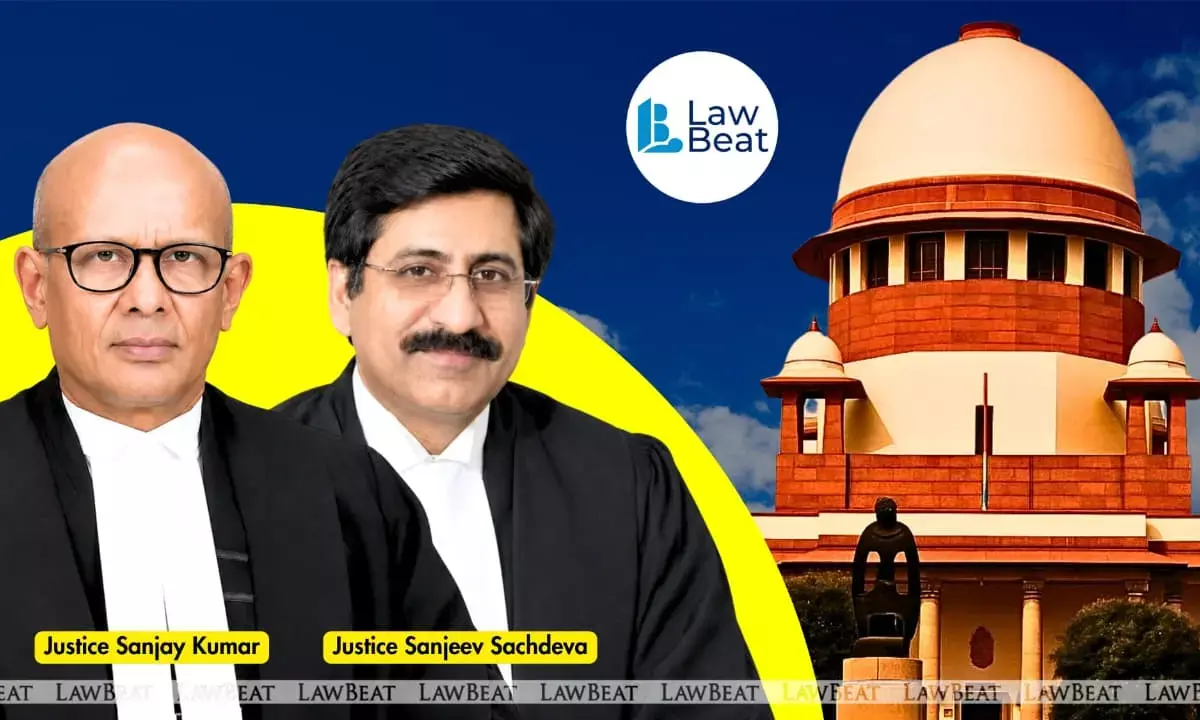
Supreme Court on when non-signatories can face arbitration.
The Supreme Court has held that a person who has not signed an arbitration agreement can still be bound by it if their conduct, role and involvement in the underlying transaction indicate an intention to be bound by its terms.
A Bench of Justices Sanjay Kumar and Sanjeev Sachdeva said courts must consider factors such as the mutual intention of the parties, the relationship between the signatories and non-signatories, the commonality of the subject matter and whether the transaction is composite in nature.
Court was dealing with an appeal filed by KKH Finvest Pvt Ltd and another concerning Ashiesh Shukla, who was not a signatory to the Memorandum of Settlement (MoS) but had entered into a separate Share Purchase Agreement as part of the same transaction.
When can a non-signatory be bound by an arbitration agreement?
The Supreme Court held that merely not signing an arbitration agreement does not by itself keep a person outside its scope, if their conduct and substantive involvement in the transaction show that they were intended to be bound by its terms.
The Bench particularly emphasised that agreements executed simultaneously as part of a single commercial objective, where the performance of one is dependent upon the other, must be read together as a composite transaction.
“An exclusionary clause in one agreement should not be interpreted in isolation to negate the participation of a party whose role is fundamental to the completion of the main underlying settlement,” the Bench said.
In the case at hand, KKH Finvest, which was engaged in investment, consultancy, development and promotion of business activities of companies, intended to take over Sensorise Digital Services Pvt Ltd and its sister concern, Sensorise Smart Solutions Pvt Ltd.
The parties entered into a Memorandum of Settlement on May 9, 2022. KKH Finvest was described as the ‘buyer’, while Sensorise Digital Services, Sensorise Smart Solutions and their promoters, Sharad Arora and Rajeev Arora, were parties to the MoS.
Shukla was not a signatory to the MoS. However, the ‘List of consultants/employee shareholders’ identified him as a shareholder holding 1,480 shares, constituting a 0.05% shareholding.
On the same day, Shukla executed a separate Share Purchase Agreement, in which he was described as the seller.
The issue before the Supreme Court was whether Shukla, who had been arrayed as respondent No. 6 in the arbitration petition before the high court, could also be bound by the clauses of the May 9, 2022 MoS and therefore be treated as a party to the arbitration proceedings initiated under it.
The Supreme Court found that Shukla had committed himself under the Share Purchase Agreement to sell his shares and comply with the terms of the MoS.
The Bench referred to its decisions in Cox and Kings Limited v. SAP India Private Limited and another (2024) and Oil and Natural Gas Corporation Limited v. Discovery Enterprises Private Limited and another (2022).
“It is clear that the performance of his obligations by Shukla under his Share Purchase Agreement was fundamental to the completion of the obligations spelt out in the MoS,” the Bench said.
Court noted that Shukla was a shareholder in his own right and, unless he transferred his shares, the MoS would inevitably remain incomplete.
It therefore found no real distinction between Shukla and Ajay Nandy, Abhishek Batra, Prasun Nigam and Achin Jain, who had also been held to be veritable parties to the agreement.
The Supreme Court held that the distinction drawn by the high court's single judge between these similarly situated persons was not supported by the facts and was unsustainable in view of the similar agreements executed by all of them.
What did the Supreme Court ultimately hold?
The Bench allowed the appeal and set aside the high court judgment dated October 21, 2024, to the extent that it concerned Shukla.
It held that Shukla was also a “veritable party” to the MoS and was therefore amenable to having his disputes referred to arbitration.
Court also directed that the disputes between KKH Finvest and Shukla be referred to the same arbitrator, Justice T.S. Thakur (Retired), former Chief Justice of India.
The disputes had arisen after execution of the MoS, following which KKH Finvest issued an Arbitration Invocation Notice on September 10, 2022, to the former promoters, Rajeev Arora and Sharad Arora. On KKH Finvest’s application under Section 11 of the Arbitration and Conciliation Act, 1996, the Delhi High Court had appointed Justice Thakur as the sole arbitrator on April 12, 2023.
Case Title: KKH Finvest Pvt. Ltd. and another Vs Ashiesh Shukla and others
Bench: Justices Sanjay Kumar and Sanjeev Sachdeva
Date of Judgment: August 5, 2026