
Party Claiming Tribal Custom Must Prove Its Existence, Applicability: Supreme Court
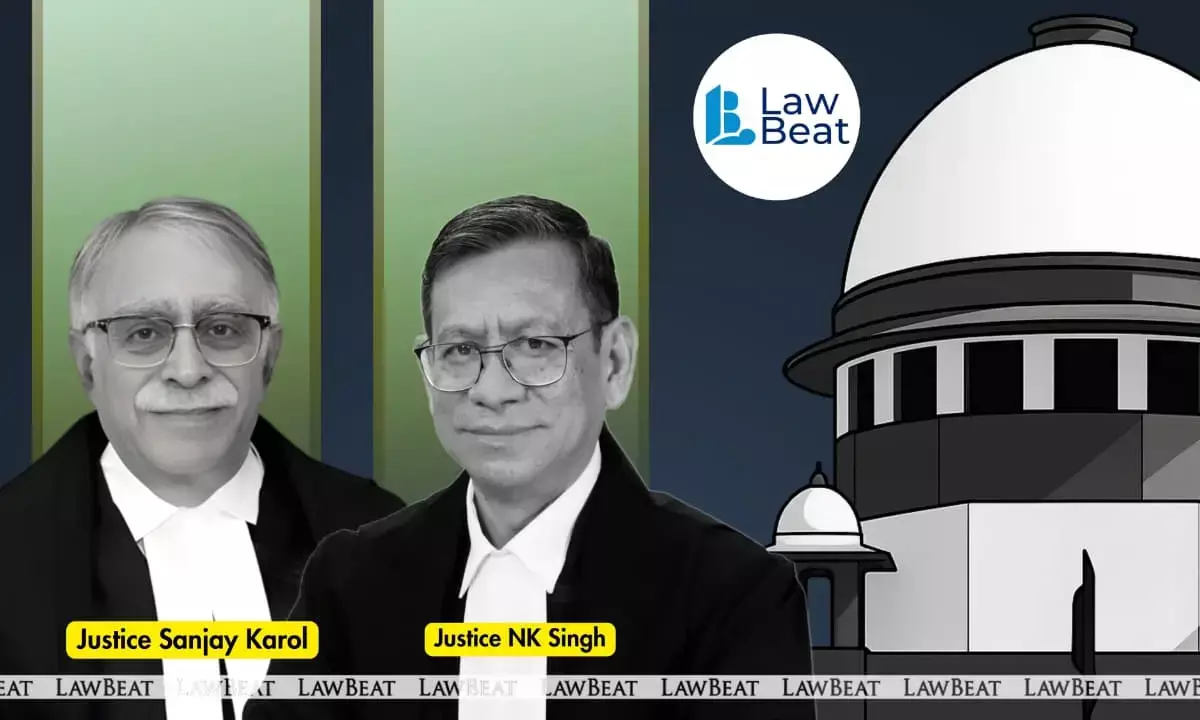
Supreme Court held that customary inheritance rights must be proved through evidence.
The Supreme Court has reiterated that the burden of proving a custom lies on the person asserting it, holding that a party must not only establish the existence of the custom but also show that he is governed by it.
Applying this principle, Court held that the alleged custom under the Oraon tribe in Jharkhand allowing a ghardamad (son-in-law) to inherit the property of his father-in-law had not been proved in the present case.
A Bench of Justices Sanjay Karol and N Kotiswar Singh said that for a custom to be binding, its long-standing usage must be established by showing its practice and prevalence.
How should a custom be proved in court?
Explaining the legal principles governing proof of customs, the Bench said a custom is ordinarily proved through general evidence given by members of the concerned tribe or family.
"If such a custom is supported by public record then it can be safely acted upon; custom must be certain and reasonable; not immoral or optional or opposed to public policy," the Bench observed.
Court further said that once judicial notice has been taken of a particular custom, it need not be independently proved in every subsequent proceeding.
"Another form of a custom acquiring the force of law is that the same be legally confirmed; or still further a statute may be passed on the basis of or in regulation of that custom transforming it into a statutory right. A custom once disallowed cannot, once again be revived," the Bench added.
It also pointed out that Section 48 of the Evidence Act, 1872 provides that the opinion of persons who are likely to know of the existence of a custom should be taken into account by courts.
The judgment came while allowing an appeal filed by Bejla Oraon against the Jharkhand High Court's June 10, 2024 judgment, which had upheld concurrent findings of the courts below dismissing his suit.
Why did the Supreme Court reject the claim based on the Oraon custom?
The dispute arose from competing claims over ancestral property belonging to one Sukhu Oraon.
Sukhu had three sons - Dhungru, Ledura and Bhoula. The plaintiff, who was Dhungru's second son and shared his grandfather's name, claimed ownership over the entire property left by Sukhu.
His claim was opposed by Bhoula's daughter Budhain and her husband Punai. Their case was that Ledura, who had no children, had taken Punai as his ghardamad, entitling him to inherit Ledura's property under the customary law governing the Oraon community.
It was undisputed between the parties that under the local custom applicable to them, daughters had no right of inheritance.
The defendants also relied on a partition deed dated February 27, 1975, claiming that after Bhoula's death, Budhain and Ledura had partitioned the properties between themselves. The plaintiff argued that since neither had title over the disputed property, the partition deed had no legal effect.
The Supreme Court observed that lease deeds do not confer title and that a valid partition can take place only between persons who already have shares in the property.
In the present case, only Ledura had a share. Therefore, there could be no valid partition between Ledura and Budhain. Consequently, the partition deed was irrelevant for determining title, Court held.
Referring to Sarat Chandra Roy's book The Oraons of Chotanagpur, the Bench said the civil court had misdirected itself. The text recognised inheritance by a ghardamad only where there was no male issue or adopted son and where the ghardamad had been duly adopted into the household by the last male owner or his widow.
Court found that there was nothing on record to show that Bhoula, Budhain's father, had any role in such adoption. Instead, the consistent case was that Ledura had adopted Punai.
Also Read| Anonymity should not be allowed under guise of religious practice: Delhi HC
"It is nowhere established that an uncle-in-law can adopt his niece's husband as his ghardamad within the prevalent customary law. Further, the alleged partition was between Budhain and Ledura with the necessary consequence that Ledura's portion went to Punai, but since Punai was actually the ghardamad of Bhola and not Ledura, is this even possible and permissible," the Bench observed.
The high court had held that since it was not established that there was any prohibition against adoption by an uncle-in-law, no adverse inference could be drawn.
Disagreeing, the Supreme Court said, "Those who allege a custom must be the one to prove it. Merely observing that the opposite to what has been alleged is not clearly stated, cannot be stated to be sufficient. To say the least, that is not the appropriate answer to a substantial question of law within the meaning of Section 100 CPC".
Taking a cumulative view, the Bench held that, apart from the accepted custom regarding a ghardamad inheriting his father-in-law's property, the specific custom relied upon by the defendants had not been proved.
Court reiterated that the recognised customary law applicable to the community provides that in the absence of a ghardamad or any other male heir directly related to the landowner, the nearest male agnate would inherit the property.
Accordingly, it set aside the judgments of the courts below and decreed the plaintiff's suit.
Case Title: Bejla Oraon Vs Kali Das Oraon & Ors
Bench: Justices Sanjay Karol and N Kotiswar Singh
Date of Judgment: July 9, 2026