
POCSO Act: Supreme Court Says Harsher Punishment Cannot Apply Retrospectively
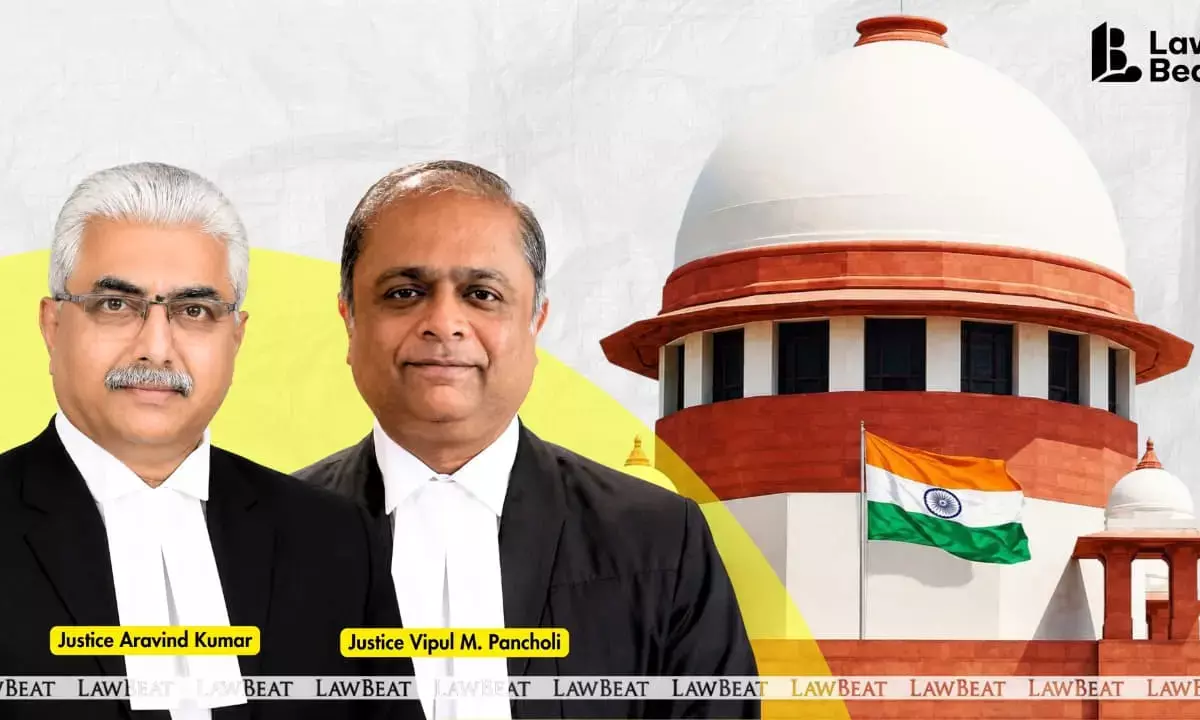
Supreme Court Restores Life Sentence, Bars Retrospective Harsher POCSO Punishment.
The Supreme Court has held that a person cannot be subjected to a higher punishment introduced by a law after the commission of an offence, reiterating that criminal laws imposing harsher penalties cannot operate retrospectively.
Court stressed that every person has a fundamental right to be convicted and punished only under the law that was in force when the offence was committed.
Court made the observation while holding that the 2019 amendment to the Protection of Children from Sexual Offences (POCSO) Act, which enhanced the minimum punishment for aggravated penetrative sexual assault from 10 years to 20 years, cannot be applied retrospectively to an offence committed in 2016.
A Bench of Justices Aravind Kumar and Vipul M Pancholi said the amendment operated prospectively from September 16, 2019, and applying the enhanced punishment to an offence committed before that date would violate the protection guaranteed under Article 20(1) of the Constitution. The provision provides for protection in respect of conviction for offences.
Why Did The Supreme Court Reject The 2019 POCSO Amendment’s Retrospective Application?
Court was dealing with an appeal filed by Balesh Kumar Kuraiti, who was convicted for aggravated penetrative sexual assault of a three-year-old girl on February 17, 2016.
Section 6 of the POCSO Act, as it stood in 2016, prescribed a minimum punishment of 10 years of rigorous imprisonment, which could extend to imprisonment for life, along with a fine.
The 2019 amendment enhanced the minimum punishment to 20 years of rigorous imprisonment. It also added that imprisonment for life would mean imprisonment for the remainder of the offender's natural life.
The Bench said the amendment was introduced to take stringent action against perpetrators of child sexual abuse, but "needless to say, it operated prospectively."
Court referred to Article 20(1) of the Constitution, which guarantees that a person can be convicted only for an act that was an offence under the law in force when it was committed.
"The invocation of Article 20(1) of the Constitution also makes it clear that every person has a fundamental right only to be convicted of an offence under the law that was in operation at the time of commission of the criminal act," the Bench said.
It added that the high court therefore erred in applying the punishment prescribed under the amended Section 6 of the POCSO Act.
The Supreme Court also relied on its 2025 judgment in Satauram Mandavi v. State of Chhattisgarh & Anr., where it had held that a court cannot impose a sentence that was not part of the statutory framework when the offence was committed.
Life Imprisonment Restored
The appellant was arrested on February 18, 2016, after the offence. The Additional Sessions Judge, Fast Track Court, Rajnandgaon, Chhattisgarh, framed charges under Section 376(2)(i) of the Indian Penal Code (IPC) [corresponding to Section 64(2)(i) of the Bharatiya Nyaya Sanhita (BNS), 2023] and Sections 6 and 8 of the POCSO Act.
The child, who was three years old at the time, testified before the trial court that the appellant had taken her on his lap and thrown her to the ground. She further stated that he bit her cheeks, took her to a place called Badi, threw her down and removed her undergarments.
Forensic Laboratory Reports also confirmed the presence of human sperm on the vaginal slide of the child.
"On perusal of the deposition of the child and the medical reports, we have no doubt in observing that the Appellant-Accused has indulged in such a criminal act, making it difficult for us to comprehend the unimaginable trauma endured by a child so young," the Bench said.
On April 18, 2017, the trial court convicted Kuraiti under Section 376(2)(i) of the IPC and Section 6 of the POCSO Act and sentenced him to life imprisonment with a fine of Rs 10,000.
The Chhattisgarh High Court, while upholding his conviction on February 14, 2024, reduced the sentence to 20 years of rigorous imprisonment for both offences. It did so by applying the 2019 amendment to Section 6 of the POCSO Act and Section 42 of the Act.
Kuraiti then approached the Supreme Court, challenging the imposition of the higher minimum punishment. The Supreme Court, however, had issued notice only on the limited question of the quantum of sentence.
The apex court found that the high court had "grossly erred" in reducing the sentence.
The Bench noted that the high court itself had acknowledged that the offence took place before the 2019 amendment, which increased the minimum sentence from 10 years to 20 years. Yet, it proceeded to impose the 20-year sentence.
"We are unable to comprehend the rationale of the sentence imposed by the high court," the Bench said, adding that its reasoning was not tenable in view of Article 20(1) of the Constitution.
The Supreme Court accordingly set aside the high court's judgment and restored the trial court's sentence.
Court sentenced Kuraiti to life imprisonment with a fine of Rs 10,000 under Section 6 of the POCSO Act, 2012, as it stood before the 2019 amendment.
It also imposed life imprisonment with a fine of Rs 10,000 under Section 376(2)(i) of the IPC.
However, Court clarified that the life sentences would not carry a stipulation that the imprisonment must continue until the natural death of the appellant.
POCSO And IPC: Which Provision Will Apply When Both Cover The Same Offence?
The Supreme Court also clarified that where an act or omission constitutes an offence under both the POCSO Act and the IPC [now BNS], the offender would be liable to punishment under the provision that provides for the punishment greater in degree.
The Bench further clarified that the question of fixing the number of years within the broad spectrum of imprisonment for life is a matter for the courts to decide. This includes determining whether the sentence should operate for the remainder of the offender's natural life.
Court thus reiterated the judiciary's discretionary power to determine the duration of imprisonment for life within the broad statutory framework.
Supreme Court Calls For Child-Friendly Justice In POCSO Cases
In its parting observations, the Bench said a child should grow up in an atmosphere of love, trust and security, but child sexual abuse can instead expose children to fear, mistrust and vulnerability.
Court observed that the trauma suffered by a child can affect emotional well-being, education, self-worth and the ability to lead a life of dignity. The damage, it said, extends beyond the individual victim to families, communities and the collective conscience of society.
"While no sentence can erase the pain inflicted upon a child, we hold the responsibility of holding offenders accountable, deterring such crimes and also reaffirming society's commitment to safeguarding its children," the Bench said.
It also stressed the need to ensure that child survivors receive timely psychological care, rehabilitation and a supportive environment to rebuild their lives.
"Every act of child sexual abuse is an assault upon humanity itself which aims at rule of law. It begins with safe homes that lead to the safer society," the Bench said.
Expressing concern for child victims, Court directed all appropriate authorities, including the police, to ensure that the legal process is less intimidating and more reassuring for children who are victims of such offences.
It emphasised that justice must be enforced in a timely and effective manner and that child victims must receive protection at all times.
Case Title: Balesh Kumar Kuraiti Vs State of Chhattisgarh
Bench: Justices Aravind Kumar and Vipul M Pancholi
Date of Judgment: August 12, 2026