
‘Relationships Cannot Be Restored by Judicial Orders’: Supreme Court Grants Divorce After 23-Year Separation
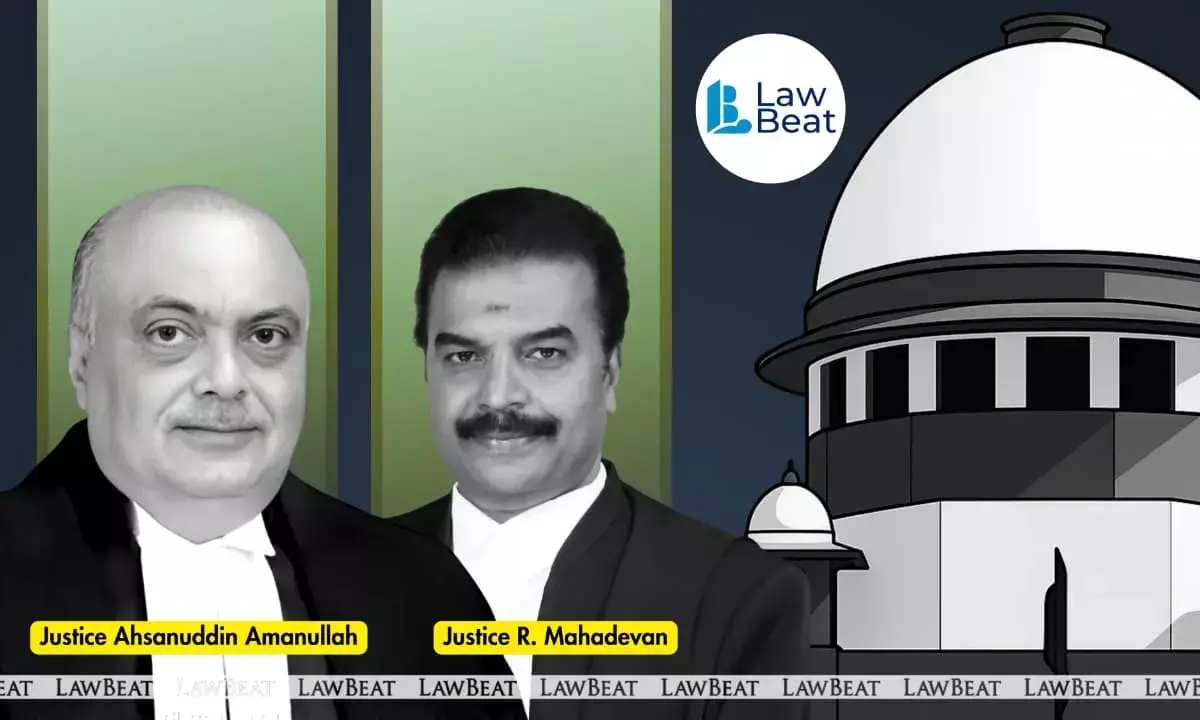
Supreme Court grants divorce citing irretrievable marital breakdown.
The Supreme Court has observed that when parties in a matrimonial dispute adopt completely rigid and inflexible positions, courts are left with no option but to take an objective decision, even if it may not be acceptable to either side.
"It is all the more so, for the reason that both the parties have a life ahead which it is for them to choose how they want to spend and forcing a relationship, that too of husband and wife, cannot be done by judicial proceedings," Court said.
A Bench of Justices Ahsanuddin Amanullah and R. Mahadevan made the observation while granting divorce to a man after finding that the couple had been living separately since 2003 and that there was no possibility of reconciliation.
The husband submitted that the respondent-wife had harassed him from the very beginning of the marriage. According to him, while they were living abroad, she made wild and scandalous allegations against him, ultimately resulting in the loss of his job and forcing him to return to India and live with his parents in Hyderabad.
He further stated that due to the continued harassment, the family sold its Hyderabad residence and shifted to Andhra Pradesh. Subsequently, his father passed away. The husband told the court that he was now living with his mother at his sister's house in Hyderabad, as he had no permanent residence of his own. He said the proceeds from the sale of the family home had been spent on his father's medical treatment.
Against this backdrop, the husband contended that he had realised there was no future in the marriage and wished to live the remainder of his life in peace.
He also submitted that after the separation, he had paid more than Rs 40 lakh towards the maintenance of the respondent-wife and their daughter. In addition, pursuant to an earlier order of the Supreme Court, Rs 68 lakh had been deposited with the court registry, which had grown to approximately Rs 75 lakh with accrued interest.
The Bench, however, asked whether the husband was seeking to be relieved of all responsibilities towards the daughter, who was not a party before the court.
In response, the husband stated that the daughter's rights against him, including rights in his estate or ancestral property, would remain unaffected. He also assured the court that he would contribute towards her marriage whenever it takes place.
Opposing the appeal, the wife argued that the allegations made by the husband were frivolous and fictitious and that no such incidents had occurred.
She also told the Court that she was strongly opposed to divorce, particularly because of societal pressure.
However, the Bench noted that when asked to explain the real differences between the parties, especially when their relationship clearly could not be restored through judicial orders, the wife failed to provide any satisfactory explanation.
"On a query of the court as to what were her real differences, when clearly relationships cannot be restored between the parties by passing of orders and the court was of the tentative opinion that the marriage has irretrievably broken down, the respondent-wife could not come up with any satisfactory explanation," Court observed.
The wife was also unwilling to accept the financial offer made by the husband as a permanent settlement in exchange for a decree of divorce.
"The court thus, was left in a peculiar situation where it had to take a call as to whether interference was required or not," the Bench said.
Taking what it described as a realistic view of the matter, Court concluded that the marriage was "dead for all practical purposes" and therefore deserved to be dissolved.
Exercising its powers under Article 142 of the Constitution, the Supreme Court granted a decree of divorce on the ground of irretrievable breakdown of marriage.
The divorce, however, was made subject to the husband paying Rs 60 lakh to the wife within two months.
Court also directed that the Rs 68 lakh lying with the registry, along with accrued interest, be released to the wife within two weeks after completion of the required formalities.
The Bench further recorded that the daughter would not be deprived of any rights arising from her status as the biological daughter of the appellant. It also noted the husband's undertaking that he would contribute towards her marriage expenses.
Court additionally quashed a criminal case pending between the parties in Hyderabad.
Case Title: Gopalakrishna Surapaneni Vs Anuradha Surpaneni Maiden
Bench: Justices Ahsanuddin Amanullah and R Mahadevan
Date of Judgment: May 27, 2026