
Section 37 NDPS Act Conditions Mandatory Before Bail in Commercial Quantity Cases: Supreme Court
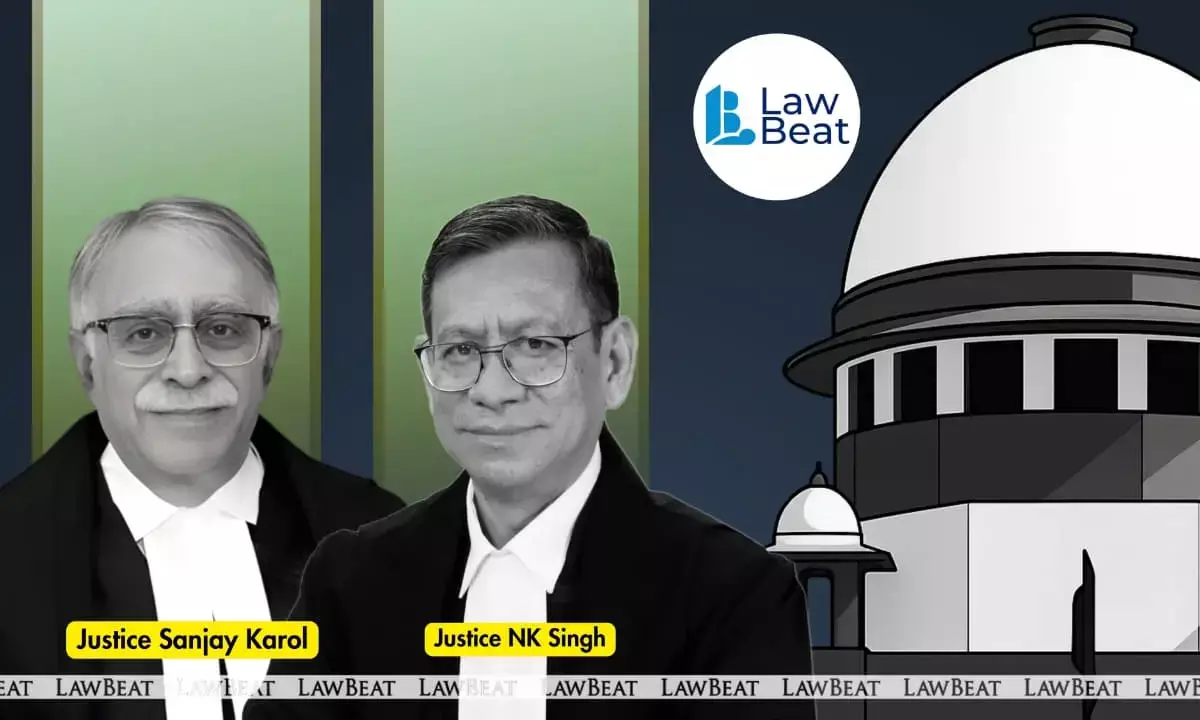
Supreme Court reiterates mandatory Section 37 NDPS Act safeguards while cancelling bail in a commercial quantity heroin case.
The Supreme Court has reiterated that in cases involving commercial quantity of narcotic drugs or psychotropic substances, courts must mandatorily examine the conditions laid down under Section 37 of the Narcotic Drugs and Psychotropic Substances (NDPS) Act, 1985 before granting bail.
A Bench of Justices Sanjay Karol and N. Kotiswar Singh said that although the Supreme Court has, on several occasions, recognised that prolonged incarceration can justify the grant of bail under Article 21 of the Constitution, the application of that principle is not uniform.
The Bench also observed that there is no settled legal standard on what constitutes "prolonged incarceration" for the purpose of granting bail.
Why did the Supreme Court set aside the High Court's bail order?
Court made the observations while allowing an appeal filed by the Punjab government against the Punjab and Haryana High Court's October 15, 2025 order granting regular bail to Balraj Singh alias Billa, who is accused of operating a drug trafficking network from inside a jail.
Setting aside the high court's order, the Bench held that compliance with Section 37 of the NDPS Act is mandatory in cases involving commercial quantity of narcotic drugs.
Section 37(1)(b)(ii) provides that where the Public Prosecutor opposes a bail plea, the court must be satisfied that there are reasonable grounds for believing that the accused is not guilty of the offence and is not likely to commit any offence while on bail.
"The consideration and reference to the twin conditions enumerated under Section 37 of the NDPS Act was mandatory," Court said.
The Bench noted that the issue of how constitutional courts should approach bail under special statutes where Article 21, prolonged incarceration and statutory restrictions intersect has recently been referred for consideration in Tasleem Ahmed v. State Govt. of NCT of Delhi (2026), arising out of the Delhi riots case.
However, Court declined to examine that issue further in the present case.
"We do not wish to deliberate on this issue further, save and except that in our view paramount consideration is nothing but interest of justice for all. Should there be any conflict between the sovereignty of country and personal liberty, undoubtedly, the former shall prevail, particularly, when a war is waged against the nation, be it in the form of supply of drugs, which vitally affects the national economy and health of the people," the Bench observed.
What was the case against the accused?
The case arose from an FIR registered on January 10, 2024, after police intercepted a vehicle carrying 1.465 kg of heroin, a commercial quantity under the NDPS Act.
According to the prosecution, co-accused persons disclosed during investigation that Balraj Singh, while lodged in Central Jail, Goindwal Sahib, had instructed them to collect the heroin from a canal area and store it for further supply. The investigation further alleged that he was operating a drug trafficking network from inside the jail using illegal mobile phones.
His application for bail was rejected by the special court. However, the Punjab and Haryana High Court later granted him regular bail.
While doing so, the high court observed that criminal antecedents alone could not be the sole basis for denying bail. It relied on the respondent's period of custody and the likelihood that the trial would take considerable time to conclude. The Supreme Court noted that the bail granted to the co-accused had already been set aside through separate orders.
Before the apex court, the Punjab government argued that the high court had ignored the statutory bar under Section 37 of the NDPS Act despite binding precedents, including State of Meghalaya v. Lalrintluanga Sailo (2024) and Union of India v. Ajay Kumar Singh (2023).
On the other hand, counsel for the respondent submitted that he had been falsely implicated, was not named in the FIR, no recovery had been made from him, and he had already spent one year and seven months in custody. The defence also pointed out that only two of the 24 prosecution witnesses had been examined, making an early conclusion of the trial unlikely.
SC on Section 37 NDPS Act and prolonged incarceration
The Supreme Court referred to its earlier decisions, including State of Meghalaya v. Lalrintluanga Sailo (2024), State by the Inspector of Police v. B. Ramu (2024) and Union of India v. Namdeo Ashruba Nakade (2025), all of which reaffirmed that satisfaction of the twin conditions under Section 37 is mandatory before granting bail in commercial quantity cases.
The Bench said these judgments consistently establish that courts cannot bypass the statutory requirements of Section 37 in such cases.
It noted that there was no dispute that the present case involved commercial quantity.
"In such a scenario, consideration and reference to the twin conditions enumerated under Section 37 of the NDPS Act was mandatory. Upon a bare perusal of the impugned order, it is evident that there has been no consideration at all by the High Court on the twin conditions. In such a scenario, the impugned order cannot be sustained in the eyes of law," the Bench held.
Court further found that the respondent had criminal antecedents involving similar offences under the NDPS Act. Therefore, it could not be said that he was not likely to commit such offences if released on bail, one of the mandatory requirements under Section 37.
The Bench also rejected the argument based on prolonged incarceration. It observed that the respondent had remained in custody for only one year and seven months, whereas the offence carries a maximum punishment of 20 years' imprisonment.
"Therefore, it cannot be said that he has suffered incarceration for a long period, warranting interference in view of Article 21 of the Constitution," Court said.
Accordingly, the Supreme Court allowed the Punjab government's appeal and set aside the high court's order granting bail.
Case Title: State of Punjab Vs Balraj Singh @ Billa
Bench: Justices Sanjay Karol and N Kotiswar Singh
Date of Judgment: June 2, 2026