
SET Must Match Subject For Higher Secondary School Teacher: Supreme Court
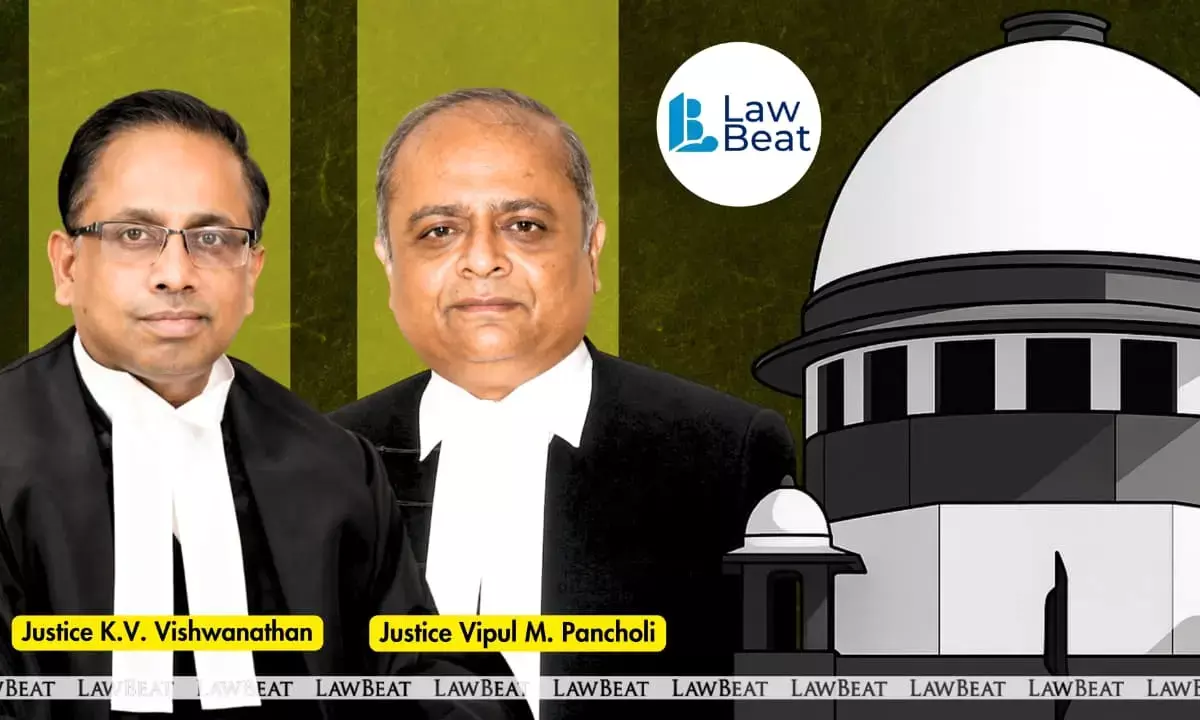
The Supreme Court rules that SET qualification must be in the same subject as the teaching post, upholding Kerala High Court decision in HSST appointment dispute.
The Supreme Court of India has held that a candidate must pass the State Eligibility Test (SET) in the same subject in which they seek appointment as a Higher Secondary School Teacher (HSST).
A Bench of Justices K V Vishwanathan and Vipul M Pancholi said that legal provisions cannot be read in isolation or based only on missing words, without considering their purpose and overall scheme. Court explained that the requirement of SET for Higher Secondary teachers is meant to ensure proper subject knowledge and teaching ability at that level, which is different from lower classes.
Court clarified that passing SET in an unrelated subject does not meet the eligibility criteria. It dismissed an appeal filed by one Zubair P, who had challenged a Kerala High Court judgment refusing approval to his appointment as HSST (Economics).
Zubair had earlier worked as an Upper Primary School Teacher and later as a High School Teacher before being appointed as HSST (Economics) in July 2021. At the time, he held degrees in Economics and a B.Ed., but his SET qualification was in Malayalam, not Economics.
His appointment was challenged by a woman teacher who also had degrees in Economics but, importantly, had cleared SET in Economics. She argued that Zubair did not meet the requirement under the Kerala Education Rules, as he neither had SET in the relevant subject nor had completed ten years of teaching experience to claim exemption.
Authorities accepted her objection and refused to approve Zubair’s appointment. While Zubair’s writ petition was dismissed, the high court allowed the woman teacher’s plea.
Before the Supreme Court, the main issue was whether the rules required SET specifically in the concerned subject, even though the wording did not explicitly say so. Zubair argued that since the rule did not mention “concerned subject,” SET in any subject should be sufficient.
Court rejected this argument. It noted that SET is conducted subject-wise and includes a paper testing knowledge in the candidate’s specialised subject at the postgraduate level. Therefore, it would not make sense to treat SET as subject-neutral.
Referring to the scheme of the SET, the Bench said, it transpired that the test consisted of two papers where Paper II was based on the subject of specialisation of the candidate at Post Graduate Level.
"Thus, it is not in dispute that SET is conducted subject-wise and it includes a paper testing postgraduate-level subject expertise, therefore, a candidate cannot qualify in SET without choosing a specific subject of specialisation. Hence, when SET qualification is itself subject-specific, it is immaterial whether or not Rule 6.2(24)(iii) of Chapter XXXII of the Rules provides for SET “in the concerned subject” or not,'' the Bench said.
Court held that the argument that the legislature decided to conduct SET examination for the post of HSST in order to ensure the academic and teaching standards in the Higher Secondary level and thus, the SET qualification must be in the same subject as that of the HSST post, was well-founded, as it was supported by the object and scheme of the test laid down in the prospectus as well.
The Bench said that accepting Zubair’s interpretation would lead to an unreasonable situation where someone qualified in one subject could teach a completely different subject, defeating the purpose of maintaining academic standards.
It held that a proper reading of the rules makes it clear that SET must correspond to the subject of the teaching post, even if the rule does not explicitly repeat those words.
"A purposive and contextual reading of Rule 6 of Chapter XXXII of the Rules compels the conclusion that the SET qualification must necessarily correspond to the subject of appointment, even if the Rule does not expressly reiterate the phrase “concerned subject” in clause (iii) of the said Rule,'' the Bench said.
Court also found that Zubair had not completed the required ten years of teaching service, falling short by a small margin, and therefore could not claim exemption from the SET requirement.
Upholding the high court’s decision, Court said the woman teacher, who met all eligibility conditions including SET in Economics, was entitled to be considered for the post with all benefits from June 1, 2021. It directed authorities to pass necessary orders within two months.
At the same time, Court clarified that no recovery would be made from Zubair for any salary already paid to him.
Also Read| Can Teachers Be Sacked for Not Clearing TET at Appointment? Supreme Court Says Not Always
Case Title: Zubair P Vs State of Kerala & Ors
Bench: Justices K V Vishwanathan and Vipul M Pancholi
Date of Judgment: February 13, 2026