
Spectrum Not an Insolvency Asset: Supreme Court Says Telecom Dues Cannot Be Restructured Under IBC
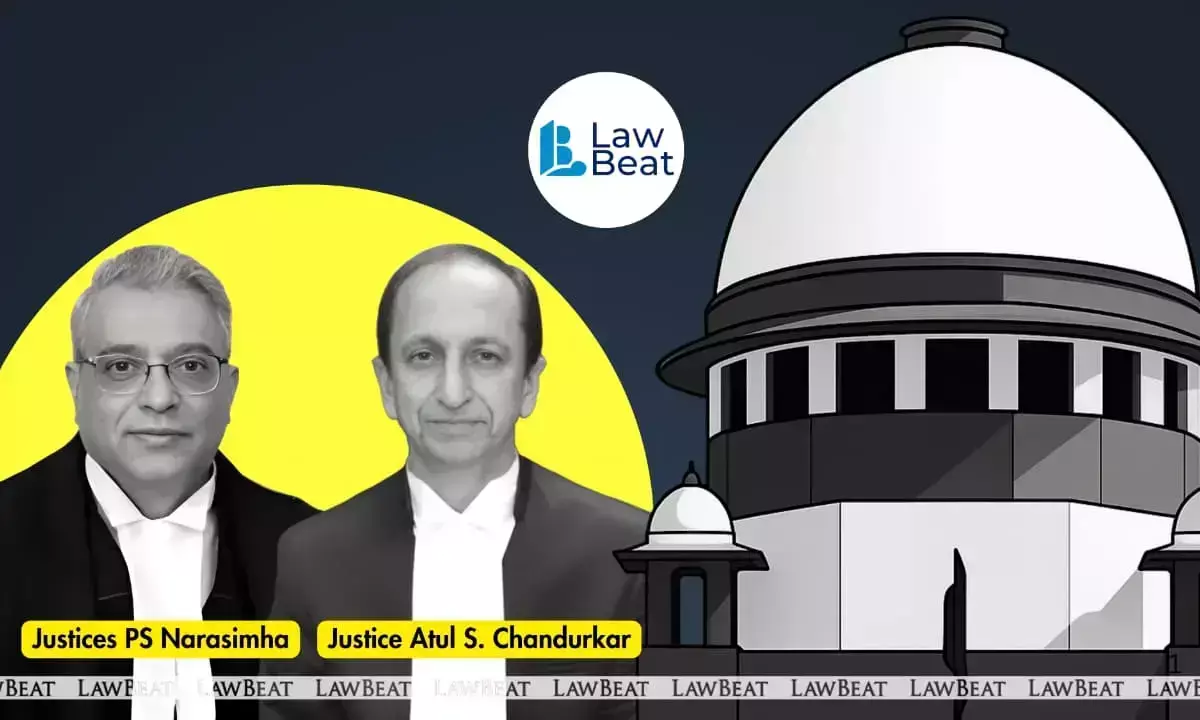
Supreme Court holds that telecom spectrum allocated to service providers cannot be treated as an asset under the Insolvency and Bankruptcy Code and remains under the regulatory control of the Union government
The Supreme Court has held that spectrum allocated to telecom service providers (TSPs) and shown in their books of account as an “asset” cannot be subjected to proceedings under Insolvency and Bankruptcy Code, 2016.
"Merely because spectrum can be treated as an “asset” on the basis of certain attributes, such as possession and usage, lease and assignment, claim and liability or credit and debt, the entirety of the telecom sector cannot be brought under the sweep of IBC,'' a bench of Justices P S Narasimha and Atul S Chandurkar said.
The court here dismissed a batch of civil appeals filed by the State Bank of India and others against corporate debtor M/s Aircel Group entities and RCom and RTL.
It examined the question whether telecom service providers (TSPs), called upon to pay the license dues by the Department of Telecommunication (DoT) can invoke moratorium on the basis of voluntary corporate insolvency resolution process under Insolvency and Bankruptcy Code, 2016 (IBC) for restructuring of their assets.
"The statutory regime under IBC cannot be permitted to make inroads into telecom sector and re-write and restructure the rights and liabilities arising out of administration, usage, and transfers of spectrum which operate under exclusive legal regime concerning telecommunications. The disharmony caused by applying IBC to the telecom sector which operates under a different legal regime was never intended by the Parliament,'' the bench said.
The court emphasized that the scope and ambit of IBC is to speed up the process providing for insolvency, and achieving maximisation of value of the asset of the entity undergoing CIRP. The focus is on the company. On the other hand, Telegraph Act, Wireless Telegraphy Act and TRAI Act forms a complete and exhaustive code for all matters relating to telecom sector. This includes declaration of the nature of the rights and liabilities arising out of holding and using spectrum.
The court noted the powers of the Union here included restructuring the telecom sector through policy decisions by introducing reforms, provisioning bailout packages for stabilizing the sector, prescribing conditions for grant of license, enabling treatment of spectrum as an asset in the books of account of TSP to raise loans, enable spectrum trading and power to prescribe consequence of failure to pay the dues and also the power to recover the dues.
The regulatory jurisdiction for telecommunication sector through TRAI extends to making recommendations to Union in the field enumerated in (i) to (viii) of Section 11(1)(a) of the TRAI Act and to discharge the functions as laid down in (i) to (ix) of Section 11(1)(b), it said.
"Taken together, the Union as the owner and trustee of spectrum on the one hand and TRAI as the regulator on the other, occupy the entire province of telecommunications,'' the bench held.
The court underscored, in the event of a conflict between two special acts, the dominant purpose of both statutes would have to be analyzed to ascertain which one should prevail over the other.
"When confronted with a situation where two statutory enactments appear to operate in conflict, this court is enjoined to interpret the concerned legislations in a manner that gives effect to both, to the extent such reconciliation is reasonably possible,'' the bench said.
The bench said, the IBC includes only those tangible or intangible assets within the insolvency framework over which the corporate debtor has ownership rights, including all rights and interests therein as recorded in the balance sheet.
"In conclusion, the framework of IBC is clear in excluding assets over which the corporate debtor has no ownership rights. Mere recognition of spectrum licensing rights as an intangible asset by TSPs in the financial statements is not conclusive of their ownership, as it only represents control over future economic benefits,'' the bench said.
Even assuming that licensing of spectrum rights is one among the bundle of rights, in the absence of transfer of title over the spectrum, no ownership rights are created in TSPs either in the spectrum or in its right to use as governed by licensing conditions. Hence, under the IBC framework, spectrum licensing rights is not a part of the pool of assets for insolvency or liquidation, the court declared.
The court said, the use, transfer or trading of spectrum is permissible only in strict conformity with the Guidelines, and any deviation would amount to a breach of licence conditions, the statute and its policy. The operation of the laws concerning telecommunications governing spectrum trading cannot be overridden or bypassed on the basis of an interpretation adopted to the expression “asset” and its treatment as also Section 238 of IBC.
"The Spectrum Trading Guidelines cannot be overridden or substituted by the insolvency resolution framework. Dues payable to the Licensor, which must be cleared prior to spectrum trading, cannot be relegated to treatment under a Resolution Plan,'' it said.
The court noted, while a licence and allocation of spectrum may, in abstract terms, constitute an intangible asset, it is always subject to the telecommunication laws of the nation, viz. the Telegraph Act, 1885, Wireless Telegraphy Act, 1993 and the TRAI Act, 1997, followed by the rules, regulations, guidelines including contractual obligations arising thereunder.
"A defaulting seller or buyer, failing to comply with the mandatory requirements of the Spectrum Trading Guidelines, cannot indirectly seek modification of telecom dues by applying for corporate insolvency resolution process,'' the bench said.
The court pointed out, applying the doctrine of public trust, recognized in M C Mehta Vs Kamal Nath (1997) this court held that spectrum as a natural resource of the nation is administered by the central government as a trustee.
As per facts of the matter, the Aircel Group entities - Aircel Limited, Aircel Cellular Limited and Dishnet Wireless Limited (the corporate debtors) - were granted telecom licences by the DoT under Unified Access Service Licences (UASL) pursuant to Licence Agreements in 2006.
Domestic lenders, including the State Bank of India, extended rupee term loan facilities aggregating to Rs 13,729 crores under a Rupee Loan Facility Agreement in 2014, followed by execution of Indentures of Mortgage in favour of the lenders. In spectrum auctions conducted by DoT during the years 2010, 2014, 2015 and 2016, the corporate debtor acquired rights to use spectrum in the 900 MHz, 1800 MHz and 2100 MHz bands upon payment of Rs 6,249.27 crores.
Corporate debtors failed to pay licence fee. When DoT attempted to recover these amounts, they invoked IBC by filing an application under Section 10 for voluntary corporate insolvency resolution process. The National Company Law Tribunal, Mumbai Bench admitted the petition.
A resolution plan submitted by UV Asset Reconstruction Company was approved by the CoC in 2019 and thereafter sanctioned by the NCLT by order in 2020.
Aggrieved, DoT assailed the NCLT order approving the resolution plan before the appellate tribunal, NCLAT, which held among others that the spectrum, being intangible asset of the Licensee/ TSPs/ TelCos/ Corporate Debtor, can be subjected to insolvency/liquidation proceedings and dues of central government/ DOT under the Licence fall within the ambit of operational dues under I&B Code.
Case Title: State Bank of India & Ors Vs Union of India
Bench: Justices P S Narasimha and Atul S Chandurkar
Date of Judgment: February 13, 2026