
Stray Cattle Accidents: Supreme Court Directs Centre, States To Frame Compensation Mechanism For Victims
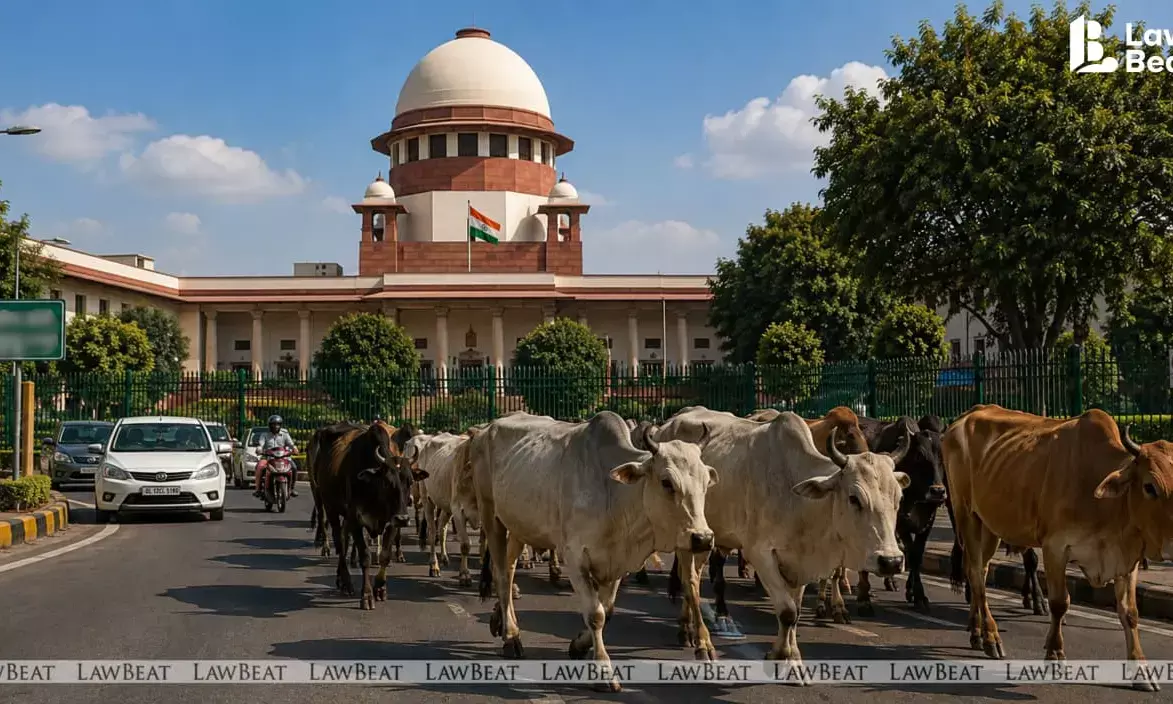
Supreme Court seeks accountability for cattle-related road accidents.
The Supreme Court has directed the Centre and States to develop a mechanism for payment of compensation in accidents caused by bovine/cattle, covering both pedestrians and motorists. It said owners who let go of cattle after the animals cease to serve a useful purpose should be held responsible and ensure their safe transfer to shelters.
A Bench of Justices Sanjay Karol and N Kotiswar Singh said accidents having a direct and proximate bovine cause are not few and far between. It directed all States that have enacted their own laws pertaining to cattle to take steps to ensure their complete and immediate implementation.
Mechanism for compensation in cattle-related accidents
Court ordered that necessary amendments may be carried out or rules promulgated, as deemed fit by the competent authority, to develop a mechanism for payment of compensation in accidents caused by bovine/cattle, in both categories of cases, that is, pedestrian or vehicular accidents.
The Bench also directed that tagging of all animals should be mandated. It said tagging would help keep track of animals, ensure their long-term health services and link them to veterinary check-ups and vaccinations.
"The reality of animals being let go after they cease to serve a useful, economic purpose cannot be denied. The owners choosing to make such a decision should be held responsible and ensure safe transfer of such animals to the shelters run by the appropriate authority," Court ordered.
It further directed that authorities at such shelters should issue a receipt acknowledging the transfer and ensure that details of the animal are entered or altered in the database of tagging.
The bench also directed the authorities to depute a particular officer in every Corporation/Department as the nodal officer to ensure tagging, digitisation of records and smooth running of these shelters.
Why did the Supreme Court intervene in the cattle accident case?
The directions came while allowing a plea for compensation filed by Nisha, whose husband Vijay Kumar succumbed to injuries after being hit by a stray bull on September 21, 2007 in Sangrur.
On her writ petition, the single judge had awarded compensation by applying the principles governing grant of compensation under the Motor Vehicles Act, 1988, on the basis of the income of the deceased/claimants, age and other relevant factors.
The division bench, however, overturned the order by its judgment dated November 12, 2025.
Considering the long time for which the matter had remained pending and the severe injuries with which the deceased lived prior to his passing, the Supreme Court deemed it appropriate to award a lump sum compensation of Rs 15 lakh.
It directed that the amount be remitted within four weeks. However, it clarified that the order was passed in the attending facts and circumstances of the case and would not be treated as a precedent.
Court nevertheless decided to address the larger issue, observing that what had happened in the case was "not unique or unheard of". It said it was commonplace to see reports in newspapers regarding bovine-related incidents and accidents.
"Either they or humans lose their lives and hence, it is a serious problem that calls for attention. After all, they are not meant to be natural speed breakers, placed willy-nilly on the National Highways, roads and streets," the Bench said.
It observed that humans also sometimes meet painful ends while driving when an animal suddenly comes in front of a vehicle, leading to a collision.
Supreme Court flags deaths caused by cattle roaming on roads
Court relied on statistics from 28 States and eight Union Territories, which showed 1,130 deaths in 2018, 1,425 deaths in 2019 and 1,305 deaths in 2020.
"Well, under the Constitution, it is not only the State who has a duty towards the animals, but each and every citizen of the country is called upon to have compassion for all living beings. This has been termed a fundamental duty under Part IV-A of the Constitution, which may stricto sensu be not enforceable, but since it is part of the Constitution, the guiding light of the Country, they need to be implemented," the Bench said.
Court pointed out that being injured, maimed or, in some cases, killed because cattle and other animals are roaming on roads is unnecessary pain and suffering, as alluded to by the Constitution Bench in Animal Welfare Board of India v. Union of India (2023).
The Bench also noted that at least 24 States/Union Territories have enacted legislation specifically aimed at cattle and their preservation and protection.
It undertook a general overview of the legislations enacted by States regarding the protection of cattle and other animals, including the responsibilities placed on State officers and other concerned persons, including Non-Governmental Organisations, to assist in ensuring the general health and upkeep of cattle and similar animals.
Court also noted that the Cattle-Trespass Act, 1871, stood partly amended by virtue of the Jan Vishwas (Amendment of Provisions) Act, 2023.
It reiterated that there are other provisions dealing with the care and maintenance of bovines and their activities, including the Prevention and Control of Infectious and Contagious Diseases in Animals Act, 2009; the Prevention of Cruelty to Draught and Pack Animals Rules, 1965; the Prevention of Cruelty to Animals (Slaughter House) Rules, 2001; the Prevention of Cruelty to Animals (Registration of Cattle Premises) Rules, 1978; and provisions under the Bharatiya Nyaya Sanhita, 2023 dealing with the health and upkeep of animals.
Court also referred to the Department of Animal Husbandry and Dairying (AH&D), under the Ministry of Fisheries, Animal Husbandry & Dairying, Government of India, which has issued a programme termed the National Livestock Mission (NLM). The programme enables setting up of centres of different nature and kind, including incentivising livestock insurance, and is implemented under the State Animal Husbandry Department and various agencies.
Owners must ensure cattle are not abandoned on roads
The Bench observed that many of the animals that end up roaming on streets, roads and National Highways are reared for a particular purpose. Once that purpose is achieved, or the animal's output towards that purpose is reduced, they are let go.
"As animals are being let go as their utility dwindled. In a perfect world, this would not be the case. All those who have chosen to bring an animal home shall see to it that they are looked after for their whole life. But the reality is that we live in a deeply flawed, human world," the Bench said.
It observed that, on the one hand, people let animals roam about without caring for their safety and, on the other, find it deeply offensive if an individual uses them to secure a full stomach for himself or his family.
Court also noted that there are animals that continue to have utility but are let out during the day to graze and forage for food. Such animals too can cause similar accidents.
"Who will be responsible then? Not all farmers and dairymen possess the wherewithal to be feeding all the animals in their possession. In some cases they are hardly able to make ends meet and secure two square meals a day," the Bench said.
Case Title: Nisha Vs Municipal Council, Sangrur & Ors
Bench: Justices Sanjay Karol and N Kotiswar Singh
Date of Judgment: July 31, 2026