
Supreme Court Cautions Against Suspending Sentence In Heinous Crimes
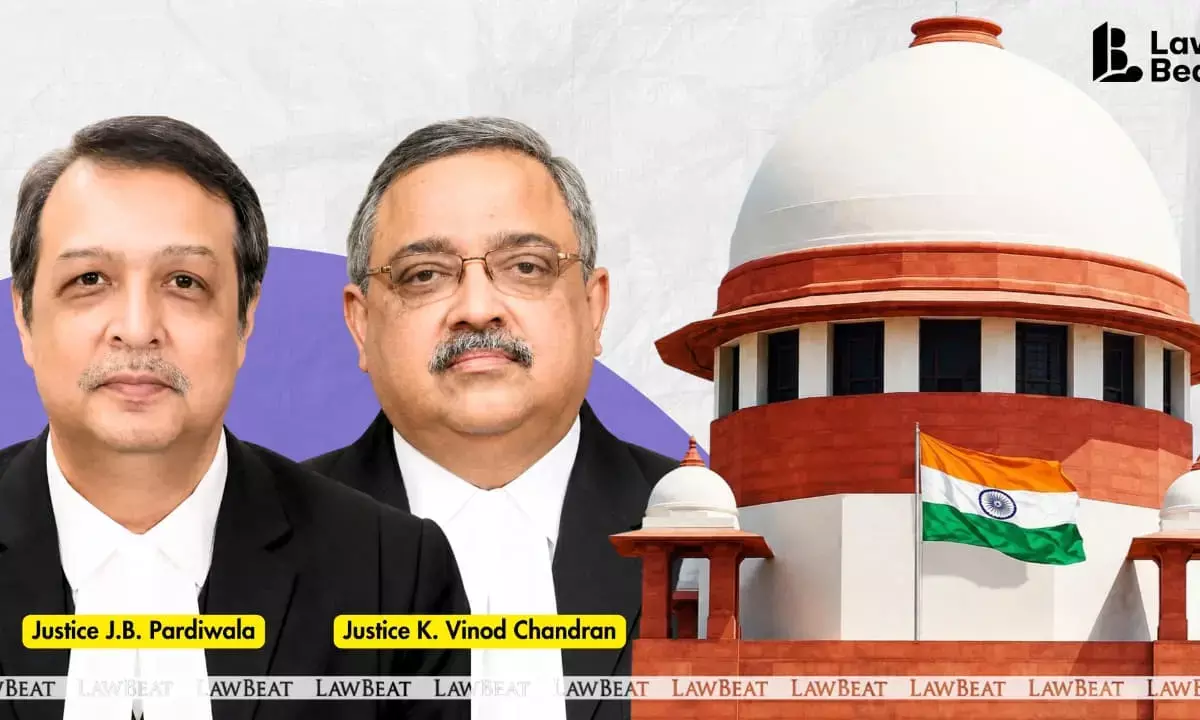
Supreme Court cautions against premature release of murder convicts.
The Supreme Court has cautioned courts against granting suspension of sentence to persons convicted of heinous offences merely because their appeals are likely to remain pending for a long time, stressing that the pendency of an appeal cannot by itself justify releasing a convict when the prosecution evidence is prima facie compelling.
A Bench of Justices J B Pardiwala and K Vinod Chandran said courts must exercise caution and circumspection while considering such applications and balance the liberty of the convict against the seriousness of the offence and the sentiments of the victim’s family. The Bench also noted that the presumption of innocence no longer applies after conviction by a court.
Why did Supreme Court cancel bail granted to the murder convict?
Court was dealing with an appeal filed by Hanuman Prasad alias Hanuta Ram, father of the deceased, against the Rajasthan High Court’s decision to suspend the sentence of the accused persons. It held that the high court had erred in suspending the sentence of A1, who was alleged to have masterminded the murder conspiracy, solely on the ground that the appeals were unlikely to be heard in the near future.
Court found prima facie evidence of a political motive, threats allegedly issued by A1 against the deceased and conduct indicating an attempt to create an alibi.
The case arose from political rivalry surrounding the election of a Sarpanch. The deceased was contesting a bye-election after A1’s son, who had earlier been elected Sarpanch, vacated the post upon securing government employment.
A1, a government teacher belonging to a rival faction, was allegedly angered by the deceased’s decision to contest the election. The prosecution case was that a conspiracy was hatched to eliminate the deceased, with A1 allegedly staying away from the scene while A6 arranged the assailants through A7, a gang leader with whom A6 had earlier been lodged in jail. The murder was allegedly carried out by A11 and A12.
A1 was convicted under Section 302 (Section 103 BNS) read with Section 120B (Section 61) of the Indian Penal Code and sentenced to life imprisonment. The other accused were convicted under Section 120B IPC and sentenced to 10 years’ imprisonment.
What evidence did Supreme Court find significant?
The Bench noted that several witnesses had been examined during the trial, including eyewitnesses and witnesses who spoke about the political rivalry between A1 and the deceased.
Court particularly noted evidence that A1 had openly threatened the deceased in the office of the Sub-Divisional Magistrate, who was the Returning Officer, saying that the deceased would not remain alive until the election.
The deceased’s father had also stated that his son had informed him about the threat. The high court had found that such a statement was not mentioned in the first information statement or in the statement recorded under Section 161 of the Code of Criminal Procedure [Section 180 of the Bharatiya Nagarik Suraksha Sanhita (BNSS)].
The Supreme Court, however, said that even if the father’s statement was not taken into account, there was credible testimony from other witnesses who were present when the threats were allegedly made.
Court also took note of the fact that A6, who allegedly arranged the assailants through A7, was still absconding, although A7 had been acquitted.
Another circumstance considered by the Bench was A1’s presence at a police station on the day of the murder. An Assistant Commissioner had stated that A1 was present at the police station with another person, without any notice or apparent provocation, even though neither had been summoned there that day.
The trial court had inferred that A1’s presence at the police station was a deliberate attempt to distance himself from the crime and create an alibi.
"On a prima facie consideration, especially considering the threats levelled and the motive alleged, as also the specific intention coming out from the threats to ensure that the deceased does not contest the election, we are of the opinion that the High Court erred in granting bail to A1," the Bench said.
Court, however, found no reason to interfere with the suspension of sentence granted to the other accused, observing that the evidence against them was weaker.
"Whatever be the reason for the pendency of cases, the courts cannot be complacent and release criminals convicted for heinous offences, especially when they have not undergone sentence for any considerable period," the Bench said.
Court observed that releasing such convicts merely because their appeals cannot be heard immediately raises concerns about the judicial process itself.
At the same time, the Bench clarified that courts must consider the actual period of incarceration along with the reality of long-pending appeals. The exercise, it said, cannot be a "knee jerk reaction" to the pendency of an appeal.
Court noted that there have been cases where the trial itself continued for a decade and the appeal remained pending for another decade while the accused remained in custody for long periods.
"What we indicate is the circumspection with which grant of bail has to be made with respect to persons convicted in heinous crimes," the Bench said.
In the present case, A1 had remained in prison for four months and 18 days and had otherwise been on bail. The FIR was registered in 2017 and the accused had remained on bail except for a brief period of incarceration during the trial.
The Bench further stressed that courts should remain sensitive to the sentiments of the victim’s family while considering the liberty of a person who has already been convicted.
"The courts should be sensitive to the sentiments of the victims’ family too while being concerned with the liberty of an individual, especially when the accused stands convicted by a court of law, no longer being enabled the presumption of innocence," it said.
Court consequently cancelled the suspension of sentence granted to A1 and directed him to surrender before the trial court within two weeks, failing which steps would be taken to apprehend him.
The Bench clarified that its observations regarding A1’s guilt were only prima facie and that its comments on the evidence against the other accused would not affect the consideration of their appeals.
Court accordingly partly allowed the appeal.
Case Title: Hanuman Prasad @ Hanuta Ram Vs State of Rajasthan & Ors
Bench: Justices J B Pardiwala and K Vinod Chandran
Date of Judgment: October 27, 2026