
Urgent Need For Digitisation Of Registered Documents, Land Records: Supreme Court
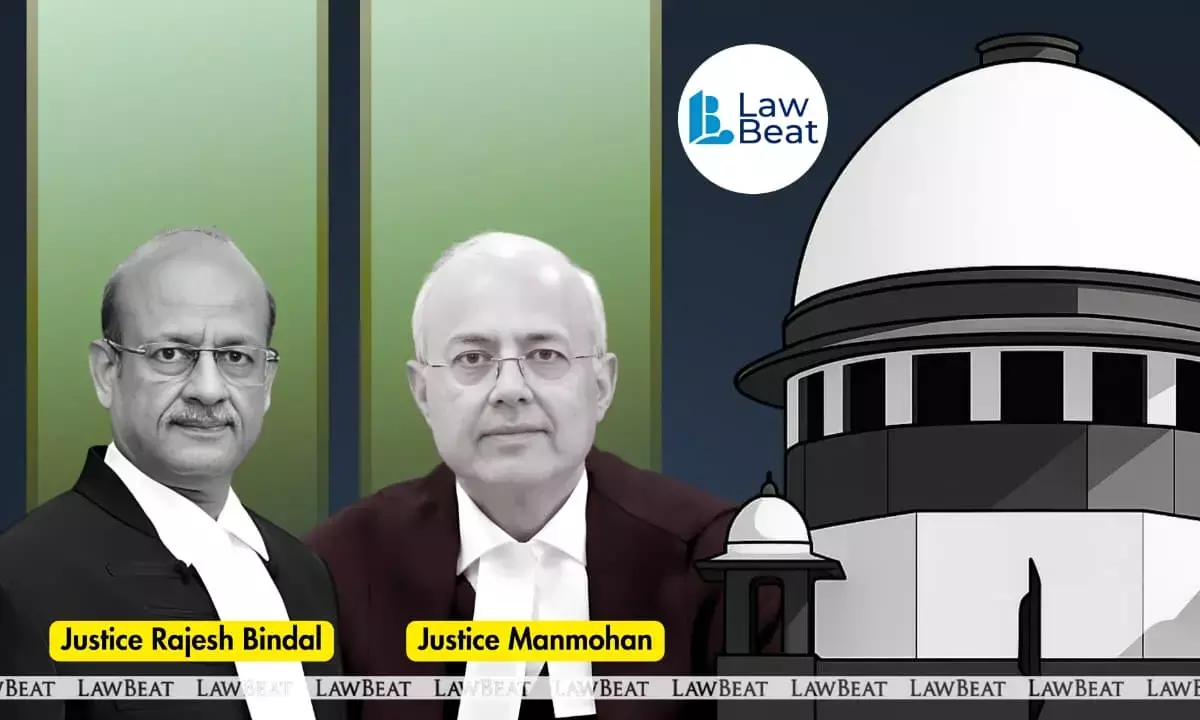
Supreme Court of India judges, Justice Rajesh Bindal and Justice Manmohan
Emphasising that registered documents must inspire absolute confidence to ensure the ease of doing business and to uphold the sanctity of property titles in a modern economy, the Supreme Court has said, there was an urgent need for the digitization of registered documents and land records using secure, tamper-proof technologies such as Blockchain.
A bench of Justices Rajesh Bindal and Manmohan said many experts believed that Blockchain, a shared, digital record book (ledger) system would ensure that once a transaction of a sale or mortgage or like nature is recorded, it becomes immutable and cryptographically secured.
Maintaining that such reforms are essential to minimize the scourge of forgery and "clever drafting" that clogs our judicial system, the court said, registered documents must inspire certainty; they cannot be rendered precarious by frivolous litigation, as it cautioned against the growing tendency to challenge registered instruments ‘at the drop of a hat'.
The court also said the person alleging that a registered deed is a sham must satisfy a rigorous standard of pleading by making clear, cogent, convincing averments and provide material particulars in his pleadings and evidence.
"This court is of the view that the test akin to a test under Order VI Rule 4 CPC is applicable to such a pleading and clever drafting and creating illusion of cause of action would not be permitted and a clear right to sue would have to be shown in the plaint,'' the bench said.
The court emphasised that there is a strong presumption about the validity and genuineness of a registered sale deed.
"A court must not lightly or casually declare a registered instrument as a “sham”,'' the bunch said.
The court pointed out, the burden of proof to displace this presumption rests heavily upon the challenger. Such a challenge can only be sustained if the party provides material particulars and cogent evidence to demonstrate that the Deed was never intended to operate as a bona fide transfer of title.
The grounds typically accepted to challenge a registered Deed at the instance of the vendee/executant are fraud or want of capacity in any party or mistake of fact or fundamental illegality like where the Deed was executed under deceit or sold by a fraudster who did not own the land or where the Deed was executed without consideration, namely, if no money or value was actually exchanged despite recitals in the Deeds or where there was coercion or intimidation like where the seller was forced to sign without free consent, the court said.
"Mere suspicion or nebulous averments without material particulars would not be sufficient to dislodge the presumption under Sections 91 and 92 of the Indian Evidence Act,'' the bench said.
Under Section 58 of the Transfer of Property Act, the bench said, the condition precedent for arriving at a finding that the transaction involves mortgage by way of conditional sale is that there must be an ostensible sale and the condition that on default of payment of mortgage money on a certain date, the sale shall become absolute or on condition that on such payment being made the sale shall become void, or on condition that on such payment being made the buyer shall transfer the property to the seller shall be embodied in the same document.
A deeming fiction was added in the negative that a transaction would not be deemed to be a mortgage unless the condition for reconveyance is contained in the document which purports to effect the sale, the court added.
The bench also said under Section 25 of the Indian Contract Act, the court underscored, mere allegation of inadequacy of consideration does not make the Deed void. It is only in the absence of sale consideration being tendered that the sale deed would be void.
"Revenue entries in the municipal records do not prove ownership,'' it said.
The court here allowed an appeal filed by Hemalatha (deceased) through legal representatives against the impugned judgment and order of February 4, 2010 passed by the High Court of Karnataka, Circuit Bench at Gulbarga.
The High Court allowed the appeal filed by respondent-plaintiff Tukaram (now deceased) and set aside the judgment of December 13, 1999 passed by Additional District Judge, Bidar.
By virtue of the impugned judgment and order passed by the High Court, the suit filed by respondent-plaintiff seeking relief of injunction and declaration to declare the sale deed and rental agreement of November 12, 1971 as sham and not to be acted upon, has been decreed.
In the case, the court examined the seminal question as to what is the threshold for declaring that a registered sale Deed is a sham.
In the matter, as both the sale deed and rental agreement in question were registered, there was a very strong presumption about the validity and genuineness of the documents in question, the bench said.
The pleadings in the present suit do not satisfy the test of Order VI Rule 4 CPC, the court noted.
The bench held that this court has no doubt that the intent of the parties while entering into the deed of November 12, 1971 was to conduct an outright sale of suit house in favour of appellant-defendant No.1 for a valuable consideration of Rs 10,000.
In the impugned sale Deed, there is no clause which effects or purports to effect the sale as mandated in proviso to Section 58(c) of the Transfer of Property Act, 1882, the court added.
The court noted, there is no finding recorded by the Trial Court or the High Court as to the legal compulsion for the respondent-plaintiff to execute a Sale Deed if it was the intention to execute a mortgage with conditional sale.
The claim made in the plaint clearly indicated that the intent of the parties at the time of execution of the Sale Deed of November 12, 1971 was to treat it as a real and genuine sale deed that was intended to be acted upon, it said.
The bench found the respondent-plaintiff’s contention that he had been paying municipal taxes for the suit house as an owner since 1971 is not correct as the respondent-plaintiff has failed to place on record any document to show that municipal taxes were paid by him between November 1971 (date of execution of Sale Deed) and April 1974 (date of issuance of legal notice by appellants-defendant Nos.1 and 2).
The court held the respondent-plaintiff had shown that the statutory taxes had been paid by him in a bid to defeat the rightful ownership of the appellants herein over the suit property.
The bench said the respondent-plaintiff’s contention that appellant-defendant No. 1’s name was not mutated in the revenue records was of no consequence, as it is settled law that revenue entries in the municipal records do not prove ownership.
Additionally, the court found, there was evidence to show that immediately after execution of the impugned sale deed, appellant-defendant No.2 (husband of Appellant Defendant No.1/buyer) was transferred from Bidar to Gulbarga and from there, he was transferred to Bellary.
When the appellants-defendant Nos.1 and 2 were staying away from Bidar, they could not have applied for change of mutation and in any event, such inaction in itself cannot defeat their right over the suit house, the bench added.
The court set aside impugned judgment and order of February 4, 2010 passed by the High Court and restored the judgment of December 13, 1999 passed by Additional District Judge, Bidar. Consequently, the court dismissed the suit with costs in favour of the appellants herein.
Case Title: Hemalatha (D) Thr LRs Vs Tukaram (D) by LRs & Ors decided by a bench of Justices Rajesh Bindal & Manmohan on January 22, 2026.