
‘Wrong Signal to Law-abiding Co-Accused’: Supreme Court on Grant of Anticipatory Bail to Absconders
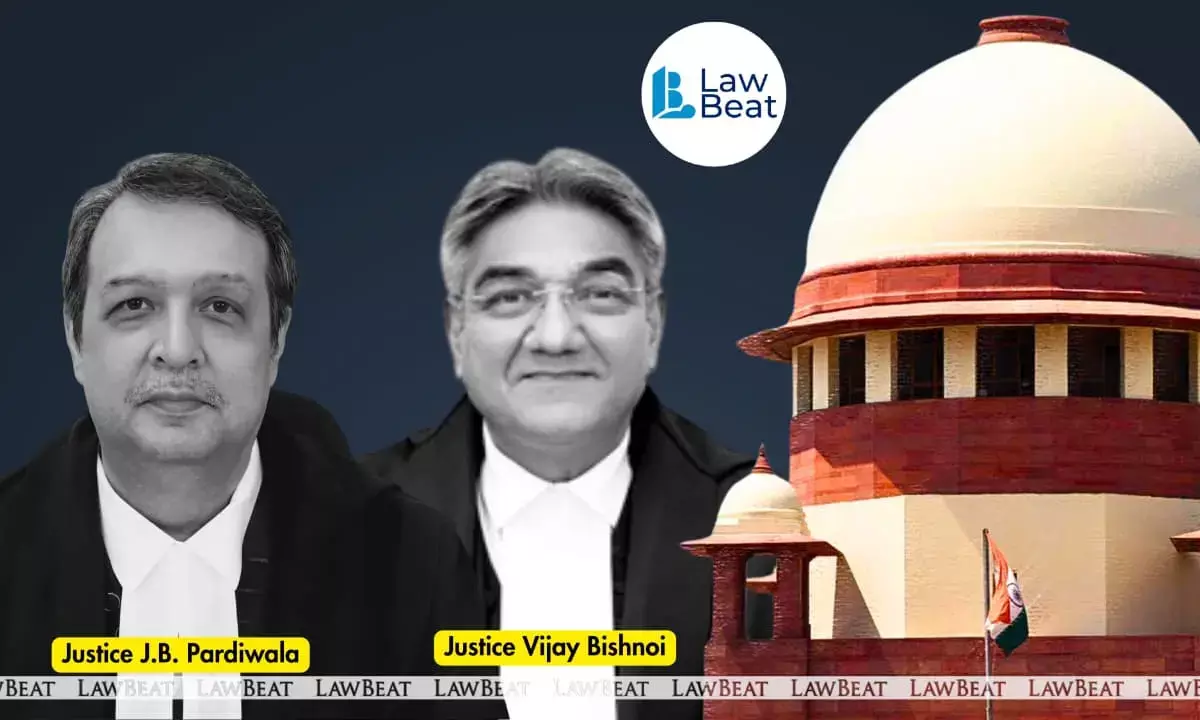
The Supreme Court says that absconding accused cannot ordinarily seek anticipatory bail, stressing that such relief must be granted only in rare cases.
The Supreme Court has held that granting anticipatory bail to an accused who has been absconding sends a wrong message and undermines the legal process, observing that it may even discourage those co-accused who cooperated with the trial.
A Bench of Justices J B Pardiwala and Vijay Bishnoi said that, as a general rule, an absconding accused should not be granted anticipatory bail. However, the Court clarified that in rare and exceptional situations, where a preliminary look at the FIR and case records shows no case is made out, the court may still exercise its discretion to grant such relief.
Court also made it clear that a person’s conduct after being granted bail cannot be considered while deciding whether bail was rightly granted. Such conduct is relevant only when a court is considering cancellation of bail.
The observations came while the court was hearing an appeal filed by former Congress MLA Balmukund Singh Gautam against a Madhya Pradesh High Court order dated January 19, 2024, which had granted anticipatory bail to an accused in a 2017 murder case linked to political rivalry.
In this case, a Special Judge (MP/MLA) in Indore had, in 2023, acquitted all named accused except the absconding accused. The court had also found that the complainant’s side were the aggressors in the incident that took place on June 2, 2017. In a cross FIR, however, the complainant and five others were convicted under Section 307 read with Section 149 of the IPC (two counts) [corresponding to Section 109 and 190 of the BNS, respectively] as well as under Section 148 of the IPC [corresponding to Section 191 (3) of the BNS]. Further, they were also convicted under Section 25(1-b)(a) and Section 27 of the Arms Act, 1959.
After the acquittal of the co-accused, the absconding accused filed a third anticipatory bail application, which was allowed by the high court.
Challenging this, the appellant argued that the accused had been absconding for a long time, had not cooperated with the investigation, and had even been proceeded against under Section 82 of the CrPC (corresponding to Section 84 of the BNSS). It was also argued that the high court wrongly granted bail on the basis of parity with co-accused and treated their acquittal as a change in circumstances, despite the accused having a separate and serious role.
The State supported these arguments and sought setting aside of the high court’s order. The Supreme Court, however, questioned why the State itself had not filed an appeal against the order.
On the other hand, counsel for the accused argued that mere non-appearance does not automatically mean absconding in law. It was also submitted that the earlier proceedings did not conclusively establish that the accused had been declared a proclaimed offender. The counsel further claimed that the appellant had suppressed material facts and that there had been no complaint of misuse of liberty after the accused was granted regular bail in 2024.
After examining the case, the Supreme Court noted that anticipatory bail under Section 438 of the CrPC (corresponding to Section 482 of the BNSS) is meant to protect individuals from arbitrary arrest in non-bailable offences and can only be granted by a sessions court or high court.
Referring to its earlier Constitution Bench judgment in Sushila Aggarwal and Others Vs State (NCT of Delhi) and Another, reported in (2020), Court emphasised that such relief must be granted cautiously.
The Bench observed that the accused had been absconding since the 2017 incident and had not cooperated with the investigation at any stage. Even though there was no clear material to show he had been formally declared a proclaimed offender, Court said this did not help his case, especially given his conduct.
Court found that no exceptional circumstances existed to justify grant of anticipatory bail. It also noted that the accused was part of the unlawful assembly, had allegedly threatened the injured victim, and had criminal antecedents.
Importantly, Court held that the acquittal or conviction of co-accused cannot influence the case of an absconding accused. It remarked that the accused had remained absconding for nearly six years, effectively making a mockery of the judicial process.
On the issue of post-bail conduct, Court reiterated that such considerations are irrelevant while deciding whether bail was rightly granted.
Setting aside the high court’s order, the Supreme Court directed the accused to surrender before the concerned court within four weeks. It clarified that after surrender, the accused is free to apply for regular bail, which will be decided on its own merits in accordance with law.
Case Title: Balmukund Singh Gautam Vs State of Madhya Pradesh And Anr
Bench: Justices J B Pardiwala and Vijay Bishnoi
Date of Judgment: February 13, 2026