
Aadhaar Cannot Prove Citizenship Or Address, PIL Tells Supreme Court; Seeks Limits On Its Use
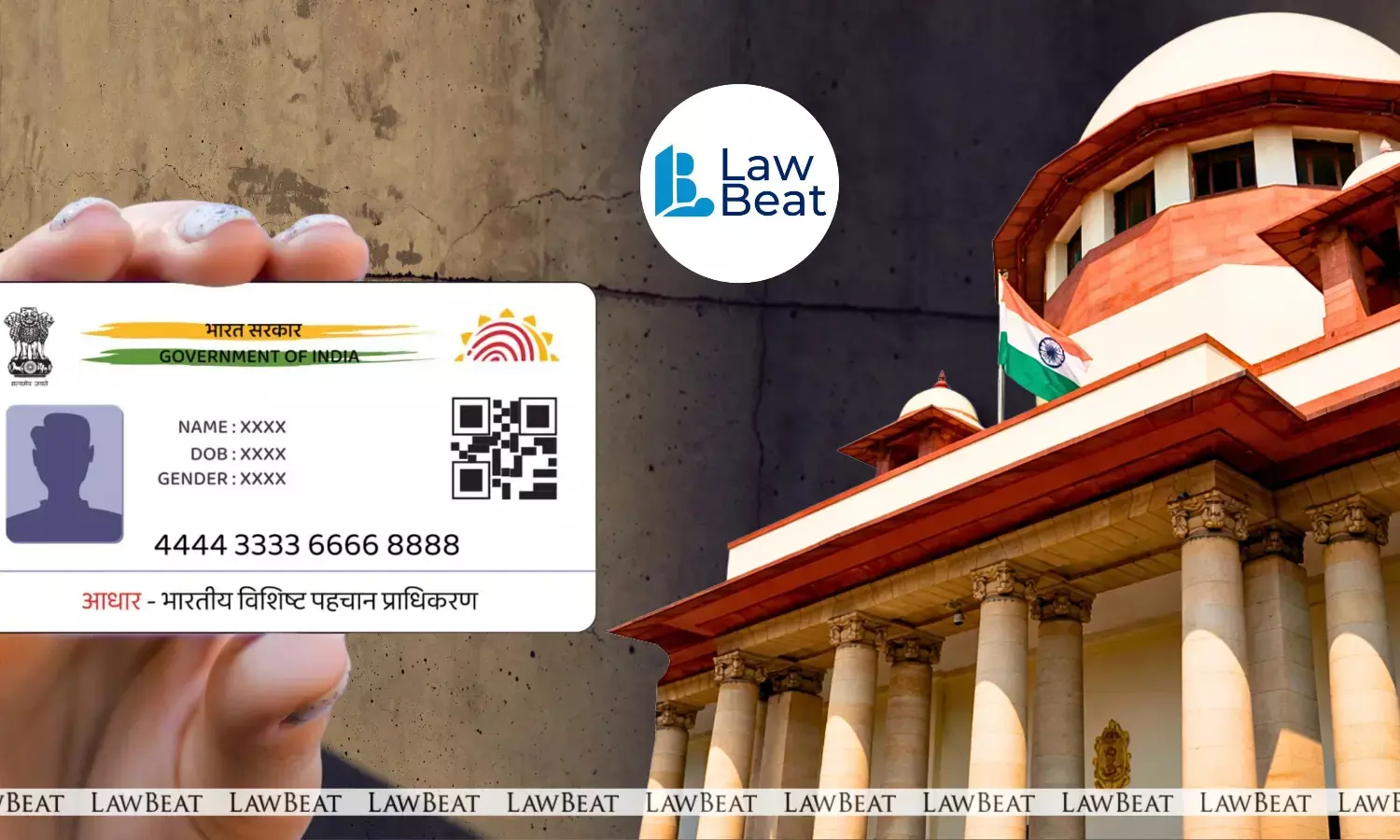
PIL in Supreme Court challenged the use of Aadhaar beyond identity verification and questioned its role in voter registration and electoral processes
A Public Interest Litigation (PIL) has been filed before the Supreme Court under Article 32 of the Constitution seeking directions to restrict the use of Aadhaar strictly as an identity proof, alleging that its current use across multiple administrative and electoral processes goes beyond the limits prescribed under law.
The petition filed by Advocate Ashwini Kumar Upadhyay contends that Aadhaar, as clarified under Section 9 of the Aadhaar Act, 2016 and reiterated in UIDAI notifications, is not a document of citizenship, domicile, address, or date of birth. It only establishes identity and, according to the plea, cannot be treated as conclusive proof for any other legal or administrative purpose.
Despite this statutory position, the petitioner argues that Aadhaar is being widely used in several official processes, including school admissions, property transactions, issuance of ration cards, driving licences, and birth certificates. The plea specifically raises concern over its inclusion as an acceptable document in Form-6 for new voter registration under the Registration of Electors Rules, 1960.
According to the petition, this practice creates a legal inconsistency, as Aadhaar is being relied upon for establishing eligibility criteria such as age and residence, even though UIDAI itself has clarified that it cannot be treated as proof of date of birth or address. The petitioner argues that this leads to a dilution of safeguards intended to ensure that only eligible citizens are enrolled in electoral rolls.
The plea further submits that the existing verification mechanism under Form-6 is inadequate and may allow individuals without proper supporting documents to be included in the electoral database. It argues that this undermines the statutory framework under the Representation of the People Act, 1950, particularly Section 23(4), which permits Aadhaar only for identity verification purposes.
The petition also raises broader constitutional concerns, citing Articles 14, 19, 21, 326, and 327 of the Constitution. It contends that the current system may result in unequal treatment of citizens and non-citizens in electoral participation and could compromise the integrity of the democratic process if identity documents are misapplied as proof of eligibility.
In its prayers, the petitioner has sought a declaration that the use of Aadhaar as proof of date of birth and residence in voter registration forms is unconstitutional, arbitrary, and void. It has also sought directions to the Union government, State authorities, and the Election Commission of India to ensure Aadhaar remains strictly confined to identity verification.
Additionally, the PIL urges the Court to direct a comprehensive overhaul of the verification framework used in electoral processes. It proposes the establishment of a high-powered monitoring committee comprising a retired Supreme Court judge along with cybersecurity and forensic experts to oversee reforms and ensure robust authentication mechanisms.
The petition also calls for stronger digital safeguards, including secure electronic verification systems, to prevent alleged misuse of identity documents and to enhance the reliability of public databases used for electoral and welfare purposes. The PIL states that the objective is to protect the integrity of electoral rolls and ensure that constitutional rights and welfare benefits are extended only to eligible persons under law. It has sought any other directions the Supreme Court may consider appropriate in the interest of justice and constitutional governance.
Case Title: Ashwini Kumar Upadhyay v. Union of India & Ors.
Bench: Supreme Court of India (hearing expected)