
Acknowledge Ustad Dagar's Contribution: SC tells AR Rahman in 'Veera Raja Veera' Copyright Case
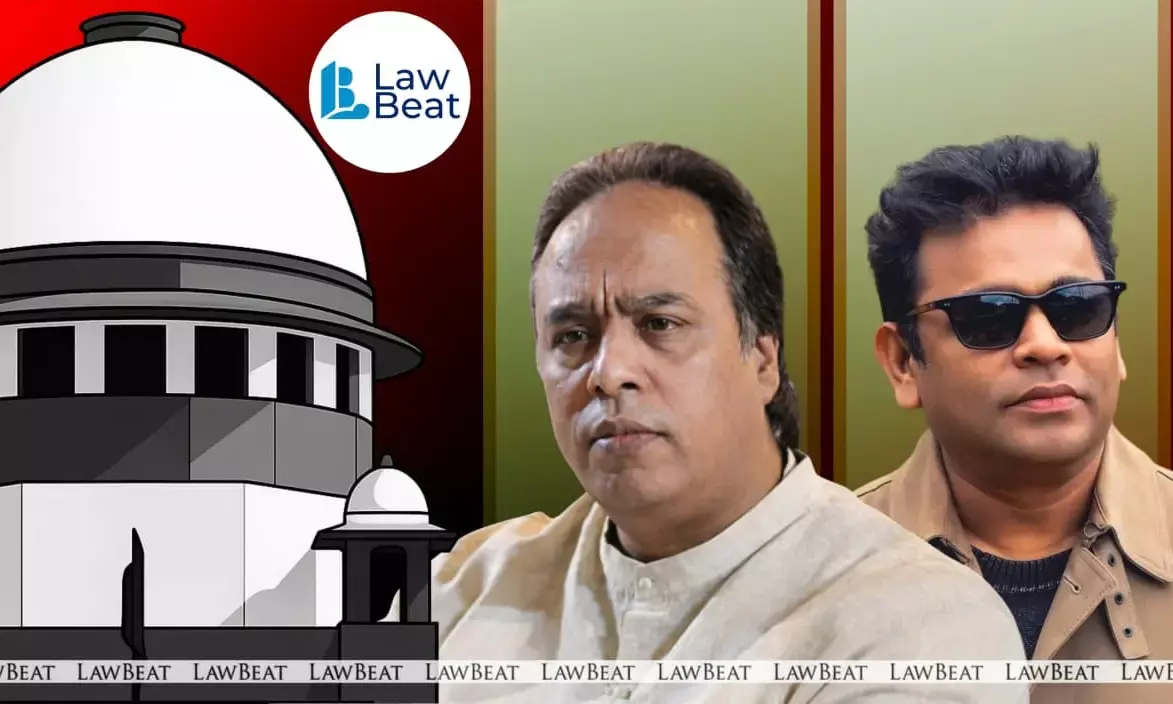
The copyright case pertains to use of Ustad Dagar composition “Shiva Stuti” in the song “Veera Raja Veera” in the Tamil film Ponniyin Selvan 2.
The Supreme Court today urged music composer AR Rahman to acknowledge the contribution of Dhrupad vocalist Ustad Faiyaz Wasifuddin Dagar in connection with the song Veera Raja Veera from the film Ponniyin Selvan II.
A bench of Chief Justice of India Surya Kant and Justice Joymalya Bagchi observed that while authorship would have to be examined, there was a deeper issue of recognition going beyond legal rights.
"See, there should be some acknowledgement. They are traditional worshippers of classical music,” Justice Bagchi told senior advocate Abhishek Manu Singhvi, appearing for Rahman.
Court further observed that the originality of the tune is undisputed, whereas the dispute pertained to authorship. It said that the parties, could have resolved the issue amicably through mediation, in recognition of the shared heritage of the Dhrupad tradition.
The issue before Supreme Court arises from the Delhi High Court's decision to overturn an interim injunction that had been granted in favour of veteran classical vocalist Dagar in his lawsuit alleging that music composer A.R. Rahman and other producers of the Tamil film Ponniyin Selvan 2 infringed the copyright of his composition “Shiva Stuti” through the song “Veera Raja Veera.”
A division bench comprising Justice C. Hari Shankar and Justice Om Prakash Shukla had set aside the earlier single-judge order, thereby allowing Rahman’s appeal. Court had earlier stayed the interim injunction originally granted to Ustad Dagar in his copyright infringement suit concerning “Shiva Stuti.” Dagar had alleged that Rahman and others used the composition in Ponniyin Selvan 2.
In April 2025, a single-judge bench presided over by Justice Prathiba M. Singh had granted the injunction in Dagar’s favour. Pursuant to that order, Rahman deposited Rs 2 crore. Justice Singh had observed,“The core of the impugned song Veera Raja Veera is not just inspired but is in fact identical in Swaras (notes), Bhava (emotion), and Aural impact (impact on the ear) of the suit composition Shiva Stuti, from the point of view of a lay listener. Hence, the Defendant’s composition infringes the Plaintiff’s rights in Shiva Stuti.”
Court had also held that Dagar was not given due acknowledgment as the original author of the composition, amounting to a serious violation of his moral rights. The order further noted, “These facts demonstrate the intricate link between Shiva Stuti and Veera Raja Veera. The balance of convenience is thus in favour of the Plaintiff, as once the movie and song lose their audience by the time trial is concluded, the Plaintiff would have lost any possibility of effective acknowledgment. Irreparable injury would thus be caused to the creative and moral rights of the original composers who are no longer alive.”
Accordingly, the single judge had directed Rahman and others to refrain from using the composition without proper attribution.
Ustad Faiyaz Wasifuddin Dagar, son of the late Ustad N. Faiyazuddin Dagar and nephew of the late Ustad N. Zahiruddin Dagar, belonged to the renowned Dagarvani Gharana of Hindustani classical music. His father and uncle, collectively known as the Junior Dagar Brothers, had composed "Shiva Stuti" in the 1970s.
In its analysis, the high court's single judge bench had recognized that Hindustani classical music, traditionally transmitted orally, could still qualify for copyright protection. Despite being based on traditional Raga Adana, compositions could be original if they incorporated unique elements, as was the case with the suit composition. Evidence presented by Dagar, including a 1978 recording and a family settlement document from 1994, confirmed that the Junior Dagar Brothers were the original authors of the composition.
The court further addressed the issue of infringement, finding that the impugned song ‘Veera Raja Veera’ mirrored substantial parts of Dagar’s work. Despite the Defendants’ claims that the song was an original creation blending various musical traditions, the court concluded that the musical structure of the song was closely similar to Dagar’s composition, especially in terms of its aural effect. This constituted copyright infringement.
“In Hindustani Classical music, when a musical composition is composed, the notes may or may not be written. It is the sound of the music or the aural effect of the music that would be the test insofar as Hindustani Classical Music is concerned. The musical composition may or may not have identical notes, but the aural effect of the notes could be the same for a lay listener”, the court remarked.
As a result, the high court had ordered Rahman and others to deposit Rs. 2 crores in a Fixed Deposit with the Registrar General, pending the outcome of the trial. Additionally, Dagar was awarded Rs. 2 lakhs in costs to be paid within four weeks. The court also granted the interim injunction, which required the Defendants to cease using the composition without proper attribution, though the injunction did not bind the final judgment.
Case Title: USTAD FAIYAZ WASIFUDDIN DAGAR Vs A.R. RAHMAN
Bench: CJI Kant and Justice Bagchi
Hearing Date: February 13, 2025