
Any Process Disenfranchising Millions Of Indians Is Intrinsically Arbitrary: Justice Ujjal Bhuyan
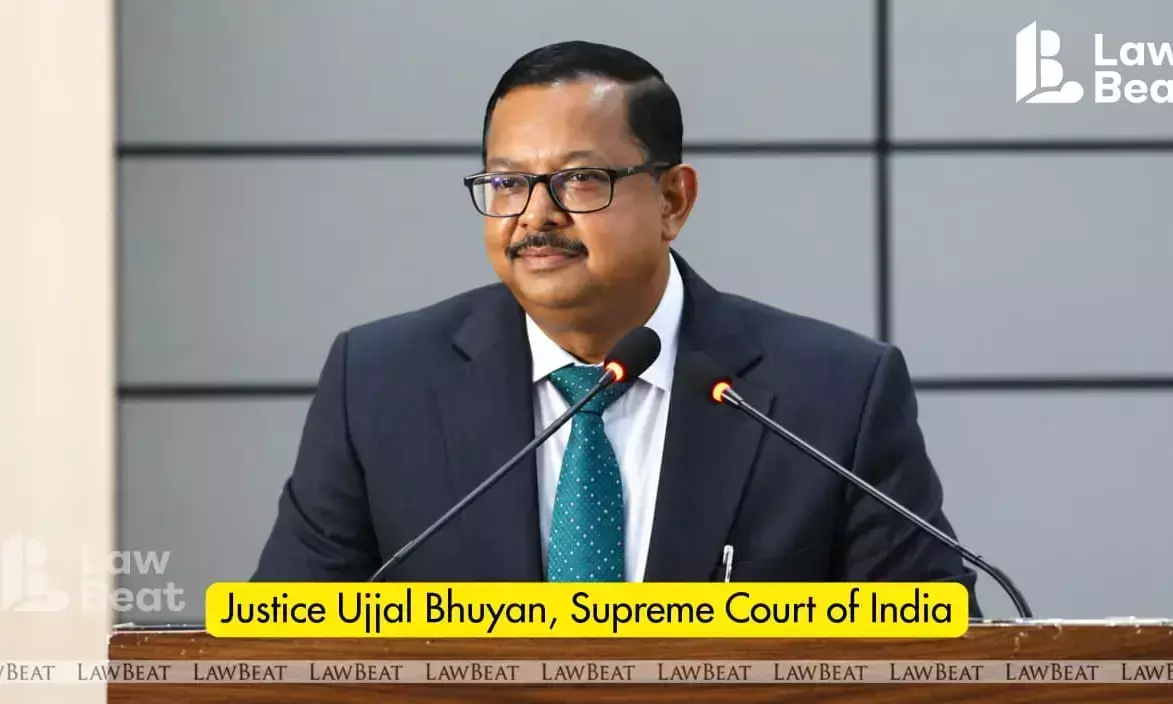
‘No Two Classes Of Citizens’: Justice Ujjal Bhuyan Warns Against Mass Disenfranchisement
Supreme Court Justice Ujjal Bhuyan has said that any process resulting in the disenfranchisement of millions of Indian citizens would be “intrinsically arbitrary”, warning that such a process would strike at the heart of the constitutional order.
Justice Bhuyan made the remarks while delivering the valedictory address at the 19th NALSAR-Justice B.R. Sawhney Memorial Moot Court Competition at NALSAR University of Law, Hyderabad, on Sunday.
Justice Bhuyan emphasised that the Constitution does not envisage two categories of Indian citizens—those with voting rights and those without them. “If any process results in disenfranchising millions and millions of Indian citizens making them second-class citizens in their own country in the sense of being citizens without voting rights, such a process is intrinsically arbitrary,” he said.
“No amount of whataboutery can justify it,” he added.
According to Justice Bhuyan, wholesale disenfranchisement would not merely raise an administrative or electoral issue but would directly implicate constitutional guarantees. “It strikes at the very heart of the Constitution,” he said, describing such a process as a “negation of the constitutional order” adopted under the Constitution of India.
Justice Bhuyan said the right to vote is not merely a statutory entitlement but a constitutional right flowing from Article 326, which provides for elections to the Lok Sabha and State Legislative Assemblies on the basis of adult suffrage. He observed that the right of an Indian citizen to cast a vote is central to the basic structure doctrine and described the franchise as the “very essence of citizenship”.
“From the persona of an Indian citizen, the right to vote or right to be included in the voters' list cannot be detached,” Justice Bhuyan said, adding that doing so would be “like taking out the soul from the body.”
He further linked the right to vote with India's historical struggle for freedom, observing that universal adult suffrage was a manifestation of the freedom secured after years of struggle and sacrifice. Justice Bhuyan said Article 326 “cannot be tinkered with at all” and stressed that constitutional authority cannot be exercised in a manner that effectively strips citizens of their voting rights.
“No authority can do it; no court can condone it. No one is above the Constitution,” he said.
Justice Bhuyan specifically connected mass disenfranchisement with Articles 14 and 326 of the Constitution.He said the Constitution does not provide for “two classes of citizens: citizens with voting rights and citizens without voting rights” and that any process resulting in wholesale disenfranchisement would violate the constitutional framework.
Justice Bhuyan said the right to vote gives ordinary citizens an equal opportunity to participate in the governance of the country. He also referred to the Supreme Court's earlier decisions recognising the right to vote as a constitutional right, even though it has not been treated as a fundamental right.
Referring to the legal framework and earlier Supreme Court rulings, he said an enrolled voter cannot ordinarily be removed from the electoral roll without being given notice and an opportunity of hearing. “Except in the case of a dead voter, the name of a voter once enlisted in the electoral roll cannot be deleted without notice and hearing,” he said.
He stressed that administrative exercises affecting voting rights must meet the same constitutional standards of reasonableness and fairness. Justice Bhuyan also invoked the democratic principle that the value of every citizen's vote remains equal irrespective of social or economic status, observing that a billionaire and a rickshaw puller possess votes of equal value.
The Supreme Court judge's observations assume significance amid the continuing debate over the Election Commission’s Special Intensive Revision (SIR) of electoral rolls, although Justice Bhuyan did not specifically name the exercise in his address.