
Bhojshala Temple Dispute: Supreme Court To Hear Plea Against High Court Judges' Site Visit
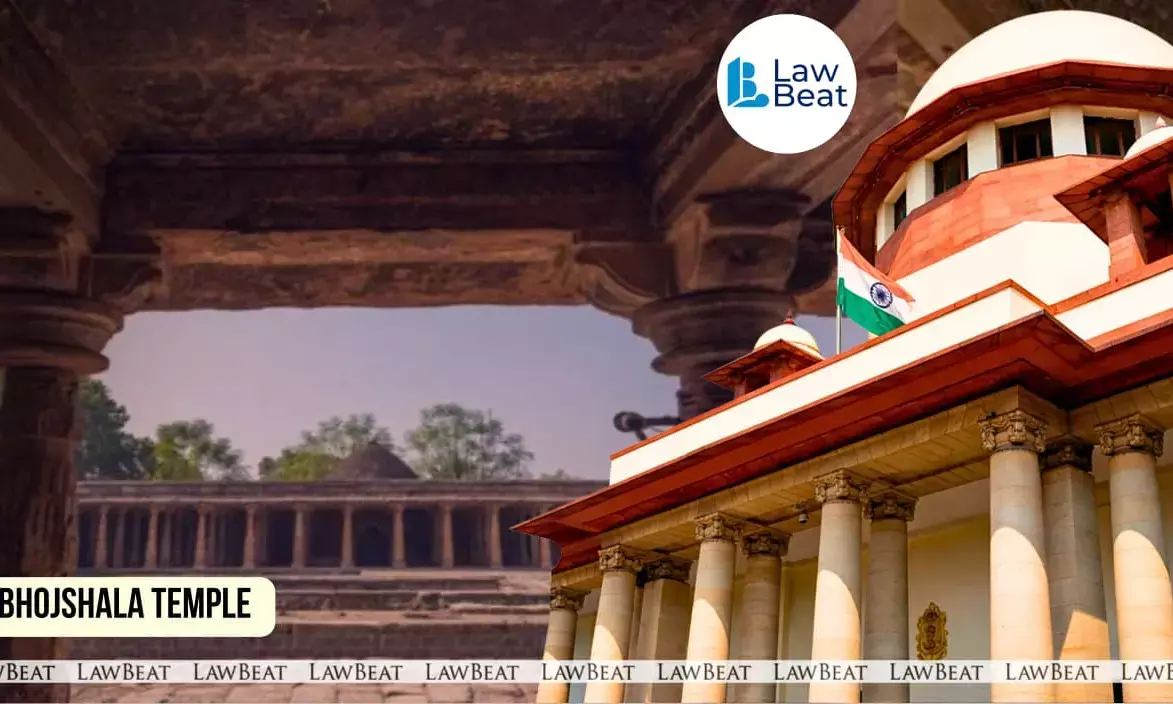
Supreme Court heard plea concerning Bhojshala Temple dispute.
The Supreme Court on April 1, 2026 will hear a petition filed against the Madhya Pradesh High Court's decision concerning the long-pending Bhojshala dispute in Dhar district to visit the disputed monument before the next hearing before it.
A bench of CJI Surya Kant, Justice Joymalya Baghci and Justice Vipul Pancholi will take up the SLP filed by Maulana Kamaluddin Welfare Society.
On March 16, the Indore Bench of the Madhya Pradesh High Court comprising Justice Vijay Kumar Shukla and Justice Alok Awasthi took up various applications connected with the ongoing litigation surrounding the Bhojshala complex, a protected monument maintained by the Archaeological Survey of India.
The Bhojshala site has for decades been at the centre of competing claims by Hindu and Muslim groups. Hindus regard the monument as the ancient temple of Maa Vagdevi Saraswati, while Muslims identify the structure as the Kamal Maula mosque.
The matter has progressed significantly after the High court earlier directed the Archaeological Survey of India to undertake a comprehensive scientific survey of the entire complex using modern and non-invasive techniques. The survey exercise continued for nearly ninety-eight days and aimed to examine the historical and structural aspects of the monument.
Following the completion of the survey, the ASI submitted its final report before the High court in a sealed cover. Subsequently, pursuant to directions issued by the Supreme Court of India, copies of the report were supplied to all parties involved in the litigation to enable them to examine the findings and place their responses before the court.
The Supreme Court had earlier clarified that the High court would consider the objections of the parties after providing them copies of the survey report and granting them time to submit their opinions, suggestions and recommendations. The Supreme Court also directed that until the writ petition is finally decided, the parties must maintain status quo with respect to any alteration in the character of the Bhojshala Saraswati Temple-cum-Kamal Maula Mosque.
On the March 16th hearing, the High Court took note of objections raised by various stakeholders regarding the contents of the ASI survey report and indicated that these issues would be examined in detail in the course of future hearings. The court also allowed all intervention applications filed in connection with the dispute. The intervenors were granted the right of audience before the court and were permitted to place documents on record. Allowing the intervention applications effectively expands the pool of stakeholders participating in the proceedings and enables additional parties to present their views on issues relating to the monument.
During the hearing, the bench further indicated that it may undertake a visit to the Bhojshala site before the next date of hearing in order to obtain a clearer understanding of the monument and its surroundings. The High court thereafter fixed April 2 as the next date of hearing in the matter. The bench directed all parties to remain present before the court on that date in view of the directions issued earlier by the Supreme Court concerning the proceedings.
Several petitions concerning the religious nature and management of the monument are currently pending before the High court. One of the principal petitions has been filed by the Hindu Front for Justice seeking a declaration regarding the religious character of the site, while another petition has been filed by the Kamal Maulana Welfare Society.
The plea also seeks directions to re-establish the idol of Goddess Saraswati (Vagdevi) which was established by King Bhoj in the year 1034 A.D but taken to London by the Britishers after it was desecrated. PIL challenges the ASI order dated April 7, 2003, which allowed Muslims to offer namaz within the Bhojshala complex, and restricted the right of Hindus to worship within the premises. Hindus consider the Bhojshala to be a temple dedicated to Vagdevi, while Muslims know it as the Kamal Maula Mosque.
At present, the Bhojshala complex functions under an arrangement originally issued by the Director General of the Archaeological Survey of India in 2003, under which Hindus are permitted to perform puja on Tuesdays and Muslims are allowed to offer namaz on Fridays.
Case Title: MAULANA KAMALUDDIN WELFARE SOCIETY vs. HINDU FRONT FOR JUSTICE
To Be Heard By Bench: CJI Surya Kant, Justice Joymalya Baghci and Justice Vipul Pancholi
To Be Heard On: April 1, 2026