
"Bring It To Parliament's Notice," Supreme Court on Plea Against TPA Exemption To Gifts Under Muslim Law
Supreme Court directs formation of SIT to probe Ghaziabad child rape and murder case
The Supreme Court today disposed of a petition filed before it questioning the validity of Section 129 of Transfer of Property Act, 1882 for excluding Muslims from executing a gift without the payment of any stamp duty post registration. The petition also challenged Section 2 of The Muslim Personal Law (Shariat) Application Act, 1937 which recognizes the transfer of property by making oral gift.
The petitioner argued that by virtue of provisions contained in Section 129 of Transfer of Property Act, the legislature has given special benefit to Muslims over and above Hindus. No other law governing transfer of property is in force in India and therefore, there are no restrictions governing transfer of property by Muslims giving them unreasonable and unconstrained powers of transfer of property, the petition states.
CJI Surya Kant asked the petitioner to approach then Law Commission of India with his plea. "It is an 1882 law, and suddenly in 2026, you challenge. Why have you not approached anyone? After 75 years of independence, you realised this law offends certain provisions. You can bring this to notice of Parliament that this law might have escaped you. The best forum is the Law Commission of India", the bench said.
At the outset, CJI Surya Kant qustioned the petitioner, "What is your problem? How are you affected?". To this, the petitioner replied that because of the said provision, Muslim gifts need not be registered, which will result in loss to the public exchequer.
"If there is any loss to the public exchequer, Parliament can amend the law," CJI Kant said. "By virtue of the section, Muslims are exempted from paying stamp duty, while non-Muslims are not exempted. Since registration is not compulsory for them, they are not liable to pay stamp duty," court was further told.
The petition filed by Advocate Parth Yadav stated that non-Muslims are required to follow Section 123 of Transfer of Property Act which requires the making of gift to be registered on which stamp duty is payable whereas Muslims have been excluded solely on the basis of religion and such discrimination is hit by Articles 14 and 15 of the Constitution of India.
Court was further told that in case immovable property is transferred by way of oral gift, a party to the litigation can take advantage of the uncertainty which will be prejudicial to non-Muslim litigant.
"The provision of oral gift of immovable property prevalent in Muhammadan Law is against the theme underlying Article 14 of the Constitution of India as such provision is unreasonable, irrational, illogical, discriminatory and against the interest of the State and the public," the plea added.
In India the transfer of immovable property can be made only through written instrument duly registered in accordance with the provisions contained in the Registration Act and the Indian Stamps Act but such provision has been made inapplicable to Muslims who can transfer the immovable property by way of oral gift without paying any stamp duty.
"The transfer of property by making oral declaration is unknown to Indian Legal System. The provision for making registration of instrument for transferring immovable property has been made in larger public interest to minimize the litigation and to give certainty to the Transfer of Property Act which may be subject to challenge in Civil Court applying the law of limitation. The provision for transferring the immovable property by way of oral gift in Muhammadan law was introduced more than 1400 years ago when there was no machinery for reducing the instrument in writing and registering it. The Muhammadan law of oral gift relating to immovable property cannot be enforced as being ultra vires to Articles 14 and 15 of the Constitution of India and such pre-existing law has become void and non existent under part III of the Constitution of India by virtue of provisions contained in Article 13(1) of the Constitution of India", the petition added.
Case Title: Hari Shankar Jain & Anr. vs. Union of India
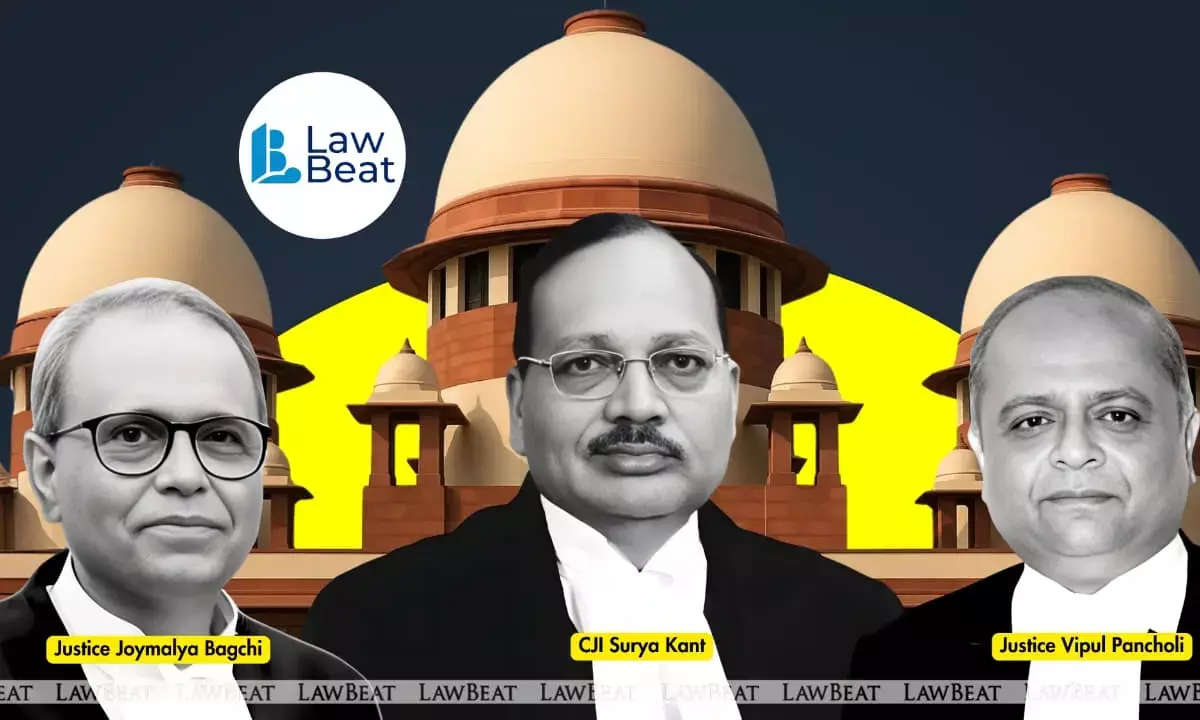
Bench: CJI Kant, Justice Bagchi and Justice Vipul Pancholi
Hearing Date: March 12, 2026