
"Cannot Second Guess Union's Decision," Supreme Court Expresses Concerns Over Plea Against Nuclear Energy Law
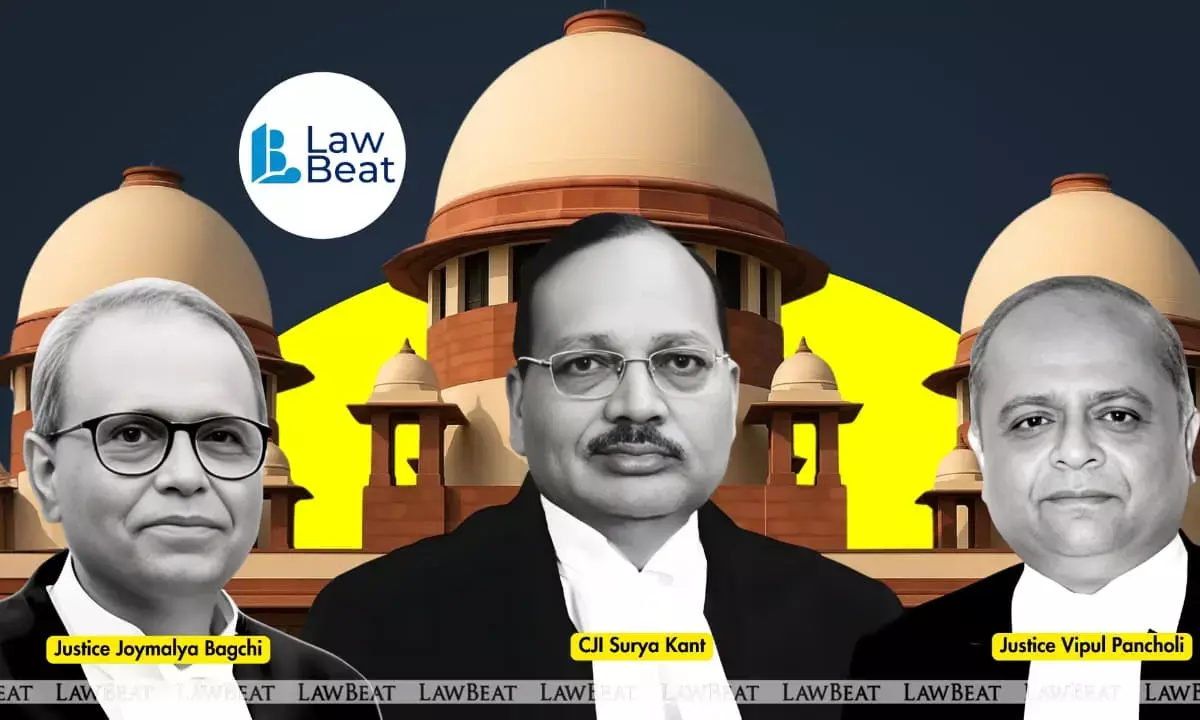
Supreme Court hears petition challenging provisions of SHANTI Act relating to supplier liability.
The Supreme Court today expressed its concerns over interfering with provisions of Sustainable Harnessing and Advancement of Nuclear Energy for Transforming India Act, 2025 (SHANTI Act) relating to supplier liability.
A CJI Surya Kant led bench heard Advocate Prashant Bhushan appearing for petitioner EAS Sarma who has challenged various provisions of the SHANTI Act.
Justice Bagchi, also on the bench told Bhushan today, "We cannot second guess the policy decision taken by the Union." CJI Surya Kant also told Bhushan that the issue belongs to the policy domain.
"I’m not even asking the Court to interfere with any policy of the government. But that policy cannot sacrifice safety. The US is a developed nation. Energy production through nuclear plants ..I tell you that Japan has stopped, Germany has stopped completely. They have dismantled all their plants. And not only that, my Lords, in Germany and Japan there is no cap on liability. Even in the US, the cap is more than a hundred times the cap imposed here. ₹1,54,000 crore is the cap in the US. In India, the cap is less than ₹4,000 crore," Bhushan told the bench today.
The bench refraining to issue notice in the plea has listed the same in July to resolve any apprehensions that the petitioner may have.
On the last hearing, the CJI had said, “Let us see the regulatory and precautionary measures. Let us not create a scene that anyone before coming to the country thinks whether or not to".
SHANTI Act, 2025 was brought into force recently, while allowing private sector and foreign companies to operate nuclear power plants in India has also capped the liability of these operators at an absurdly low level and exempted the supplier from any liability.
The plea seeks setting aside of Sections 11, 12, 13, 14, 16, 17, 19, 39, 44, 67, 81, and 87 of the Sustainable Harnessing and Advancement of Nuclear Energy for Transforming India Act, 2025, for being in violation of Articles 14, 19 and 21 of the Constitution of India as well as in violation of the Doctrine of Absolute Liability, Polluter Pays Principle, the Doctrine of Public Trust, Principles of Inter-Generational Equity, Sustainable Development, and the Precautionary Principle, which have been held by the Supreme Court to be an intrinsic part of Right to Life guaranteed under Article 21 of the Constitution of India.
"In contrast the repealed Civil Liability for Nuclear Damage Act, 2010 under Section 17 (b) expressly provided for operator’s right of recourse against the supplier. That Section 13 of the Act further caps the government’s residual liability at 300 million Special Drawing Rights - a figure that is abysmally low and effectively ensures that victims of death, injury, or property damage cannot recover even a small fraction of their actual losses," the PIL adds.
The plea cites the Chernobyl nuclear disaster and the Fukushima Daiichi Nuclear Power Plant Accident to argue that SHANTI Act, 2025 caps the liability of the largest plant operator in India at a mere Rs. 3000 crores (i.e., approximately 331 million USD amounting to less than 0.1% of the cost of damage caused by the accidents at Chernobyl or Fukushima). "That exemption of supplier from any liability in the SHANTI Act is bound to encourage manufacturers and suppliers to cut corners in safety so as to maximise their profits and hence risks jeopardizing the lives and livelihood of people," the plea argues.
Citing the judgment of M.C. Mehta v. Union of India (Shriram-Oleum Gas), wherein the Supreme court laid down the Doctrine of Absolute Liability holding that an enterprise engaged in hazardous or inherently dangerous activity (which a nuclear plant does) is absolutely liable to make good all damage arising therefrom, wholly independent of fault, negligence, or the exercise of due care, the petitioner argued that the impugned provisions of the SHANTI Act, 2025, are in violation of the settled principles of environmental jurisprudence.
Arguing that Act, 2025 envisages a rapid expansion of the nuclear energy sector and permits private participation, thereby reducing governmental control over nuclear facilities, the plea submits, "This dilution of state oversight raises grave concerns for national security and public safety, as nuclear materials and installations are inherently sensitive and pose exceptional risks. Unlike other industries, nuclear facilities constitute potential targets for terrorist attacks and hostile actions by both state and non-state actors, for being used as what is called a ‘dirty bomb’ to create a Chernobyl/ Fukushima type of radioactive contamination or fear of such contamination in major cities. Furthermore, numerous incidents involving the illicit and malicious use of radioactive material have been reported worldwide, as documented by the International Atomic Energy Agency’s Incident and Trafficking Database (ITDB), which, according to its 2025 Factsheet, has recorded a total of 4,390 confirmed incidents."
Case Title: EAS SARMA vs. Union of India
Bench: CJI Kant, Justice Bagchi and Justice Pancholi
Hearing Date: May 19, 2026