
CJI Surya Kant Says Mediation No Lesser Cousin Of Litigation, Warns Against Entirely AI-Based Online Mediation
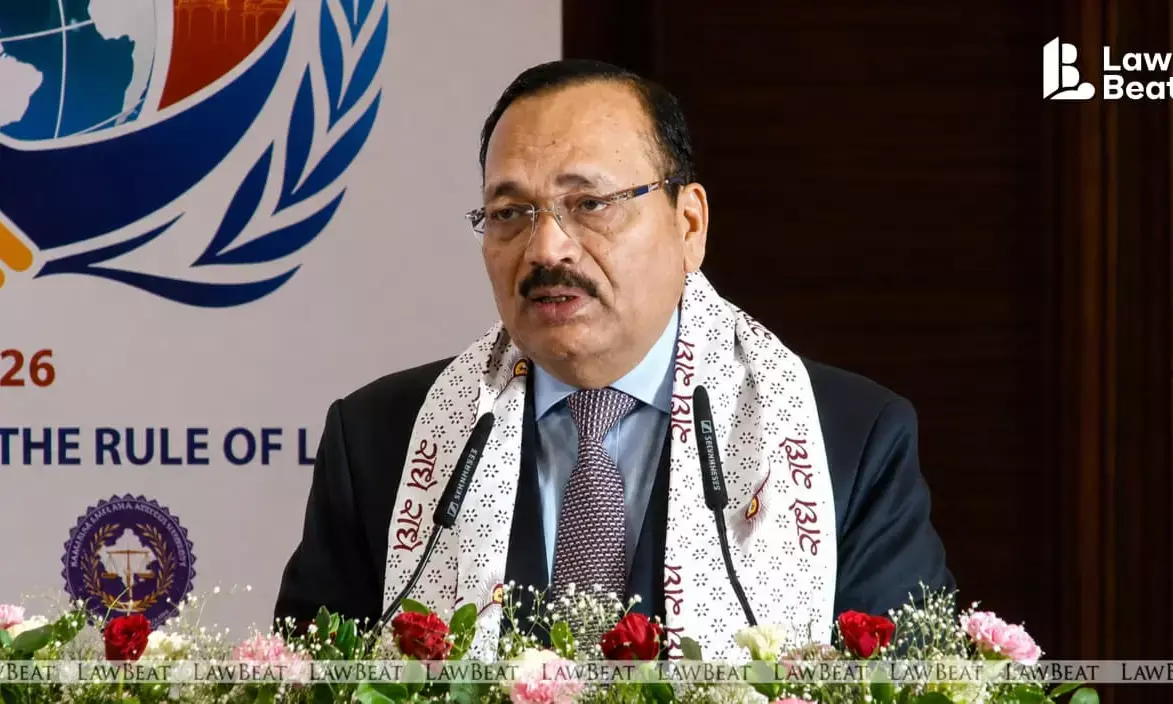
CJI Surya Kant delivers inaugural address at “Commonwealth Peace Mediation Conference 2026 — Peace Mediation And The Rule Of Law”.
The Chief Justice of India has backed the resolution of disputes through Mediation and said that Mediation must no longer be treated as a lesser cousin of litigation, waiting outside the courtroom for its turn.
"It has earned, through the persistence of practitioners like many of you in this hall and also now with the statutory backup of the Mediation Act, a seat at the same table as the court. The two are not competitors; they are complimentary to each other. The court gives us certainty, precedent, and the final word when all else fails. Mediation gives us the space to write our own ending, before the last word ever needs to be spoken. One does not diminish the other. They sustain each other, the way a river needs both its banks, " CJI Surya Kant said while speaking at the Commonwealth Peace Mediation Conference 2026 organised by the Rajasthan State Legal Services Authority.
While delivering his inaugural address, the CJI also cautioned against leaving Online Mediation entirely to AI-based software. "They may carry a human voice but won’t be able to display human empathy and apology. I recommend that online Mediation should be conducted predominantly by trained Mediators only," CJI said.
Justice Kant also reminisced a story from his own childhood. "In and around my village in Haryana, where I grew up, there was rarely a lawyer within miles. When two families quarrelled, whether over a boundary wall, a water channel, or access to a road, they did not rush to a Court thirty kilometres away. They sat under a tree, with the village elders, and talked until the matter was resolved. Nobody called it “Alternative Dispute Resolution” in those days. We called it Panchayat. It was Mediation before the word became fashionable, and it worked because everyone present had one thing in common: they had to live in that village long after the dispute was over. That, to my mind, is the truest test of any peace. Not whether the paperwork is signed, but whether the neighbours can still share a cup of tea the next morning," he shared before the gathering.
Addressing the eight distinct terrains where Mediation does its noiseless work, the CJI has highlighted how despite this enormous range, from a squabble over a shared wall to a ceasefire between nations, the underlying grammar of Mediation remains the same.
"Somebody has to listen more than they speak. Somebody has to translate anger into interest, and interest into an option that both sides can live with. That is not a soft skill. I firmly believe it is one of the hardest skills that the legal profession asks of anyone to learn through vigorous training and self-acquired experience," he explained.
On the adoption of Jaipur Declaration on Peace Mediation, the CJI said he hopes that the document travels further than most declarations do. Let it be less of a ceremonial parchment and more of a working promise, one that a young lawyer in Lagos, a Mediator in Colombo, or a Judge in Toronto can actually reach for, on such a difficult occasion, when two parties are seemingly exhausted and desperately looking for a graceful way home, the CJI urged.
In his closing remarks, the CJI said, "The true worth of this conference shall lie in the conversations it begins rather than concludes, in the friendships forged across jurisdictions that once seemed distant from one another, and in the Jaipur Declaration that we shall together adopt at the closing of these proceedings, and an earnest pledge to carry the spirit of mediation back to our respective courts, chambers, and communities. I am confident that the conversations over the next three days will not only enrich our understanding of mediation but will also strengthen our collective resolve to build justice systems that are more humane, more responsive and more conducive to lasting peace."