
CJI Surya Kant To Set Up Special Supreme Court Bench For Ladakh Cases
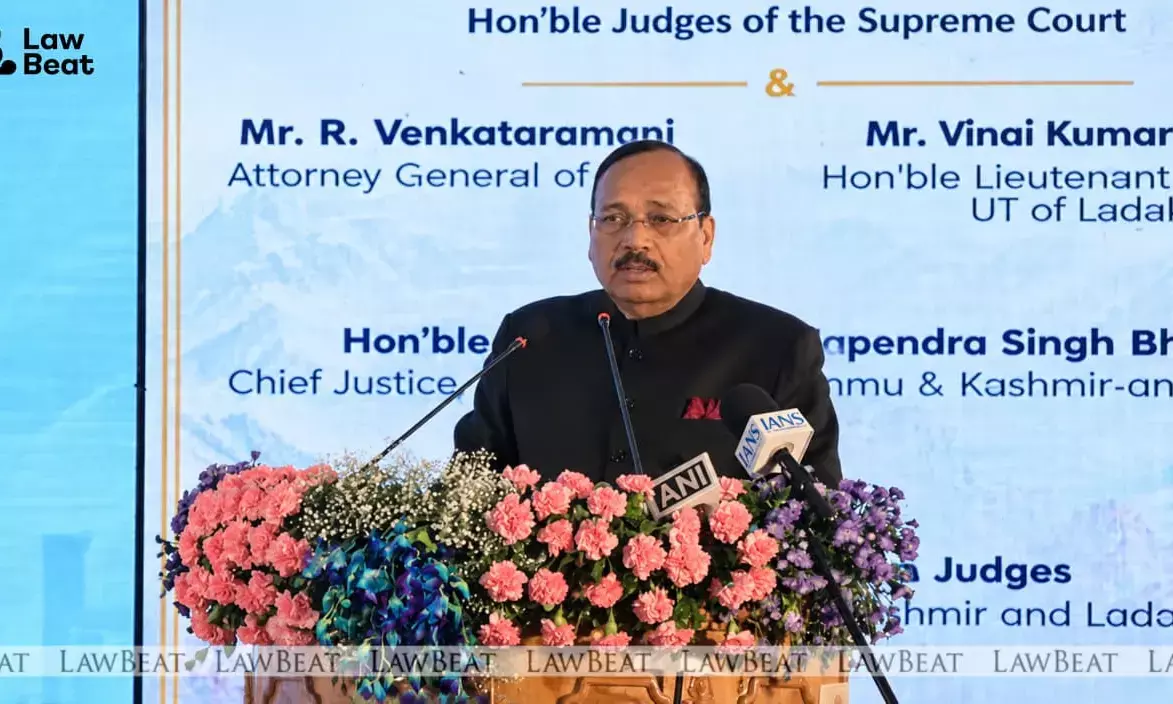
CJI Kant inaugurated the new bench of the J&K and Ladakh High Court, said it will significantly enhance access to justice for citizens living in remote areas of Ladakh.
Chief Justice of India (CJI) Justice Surya Kant on Sunday announced that the Supreme Court would set up a special Bench to hear cases originating from Ladakh and pending before the apex court, enabling lawyers from Leh and Kargil to appear virtually.
Making the announcement while inaugurating the Ladakh Bench of the High Court of Jammu and Kashmir and Ladakh in Leh, the CJI said the arrangement would help integrate the region's legal fraternity with the Supreme Court and reduce the difficulties associated with long-distance travel. “I will certainly make an arrangement to set up a special bench on one day to hear all cases from the Ladakh region that are pending before the Supreme Court,” Justice Kant said.
He added that lawyers from Leh and Kargil should argue these matters, with virtual appearances facilitated from the High Court Bench in Leh.
"One arrangement that I will surely be making is that all the cases pending from Ladakh before the Supreme Court, a special bench will be created for them, but there is one condition all those cases will be argued by the counsels from Leh and Kargil. You will be allowed to appear online. You can sit at the High Court bench over here in its conference room and argue, and we will sit in the Supreme Court and hear your cases. The reason is very obvious. I want that every member of the Kargil and Leh Bar must feel integrated with the Supreme Court and Supreme Court bar, and you must feel that you represent this area alone, and you are the representative of the bar Association of India," the CJI said.
The announcement came after Attorney General R Venkataramani suggested that a Constitution Bench of the Supreme Court could hold proceedings in Ladakh.
The CJI's announcement accompanied the inauguration of the Ladakh High Court Bench, which is scheduled to begin hearing cases on October 21.
The inauguration ceremony was attended by Supreme Court Judges Justices MM Sundresh, PS Narasimha and N Kotiswar Singh, Chief Justice of the High Court of Jammu and Kashmir and Ladakh Justice Pushpendra Singh Bhati, Attorney General for India R Venkataramani, Ladakh Lieutenant Governor Vinai Kumar Saxena and other judicial and administrative officials.
The establishment of the Bench fulfils a long-standing demand of the people of Ladakh, who have faced geographical challenges in accessing High Court services. The new facility is expected to reduce the need for litigants to travel outside the Union Territory for proceedings before the High Court. Congratulating the Centre on its decision to set up a bench at Ladakh, the CJI said, "I wholeheartedly congratulate the Government of India, Union Territory Ladakh Lieutenant Governor Vinai Kumar Saxena and all officials of Jammu & Kashmir and Ladakh High Court for this step."
Centre approved the establishment of the Ladakh Bench in August 2026. Subsequently, the President promulgated the Union Territory of Ladakh (Sitting of Bench of the High Court of Jammu and Kashmir and Ladakh in Ladakh) Regulation, 2026, which came into force on September 5. The High Court selected Leh as the location for the Bench's sittings on October 5.
The Ladakh Bench is scheduled to commence hearings on October 21. A Division Bench comprising Chief Justice Pushpendra Singh Bhati and Justice Sanjay Parihar is expected to hear five cases on the opening day. Justice Parihar is also scheduled to preside over a Single Judge Bench on October 22 and 23. The High Court has identified 75 cases for listing before the new Bench.
The establishment of the Bench is intended to make judicial services more accessible to residents of Leh, Kargil and other remote areas of Ladakh, where difficult terrain, long distances and weather conditions can pose challenges to travel.
Ladakh Lieutenant Governor Vinai Kumar Saxena described the inauguration as a landmark development, expressing gratitude to the CJI and acknowledging the Centre's role in advancing the region's institutional development.