
‘Considering Women For Judgeships Must Be The Norm’: CJI Surya Kant To HC Collegiums
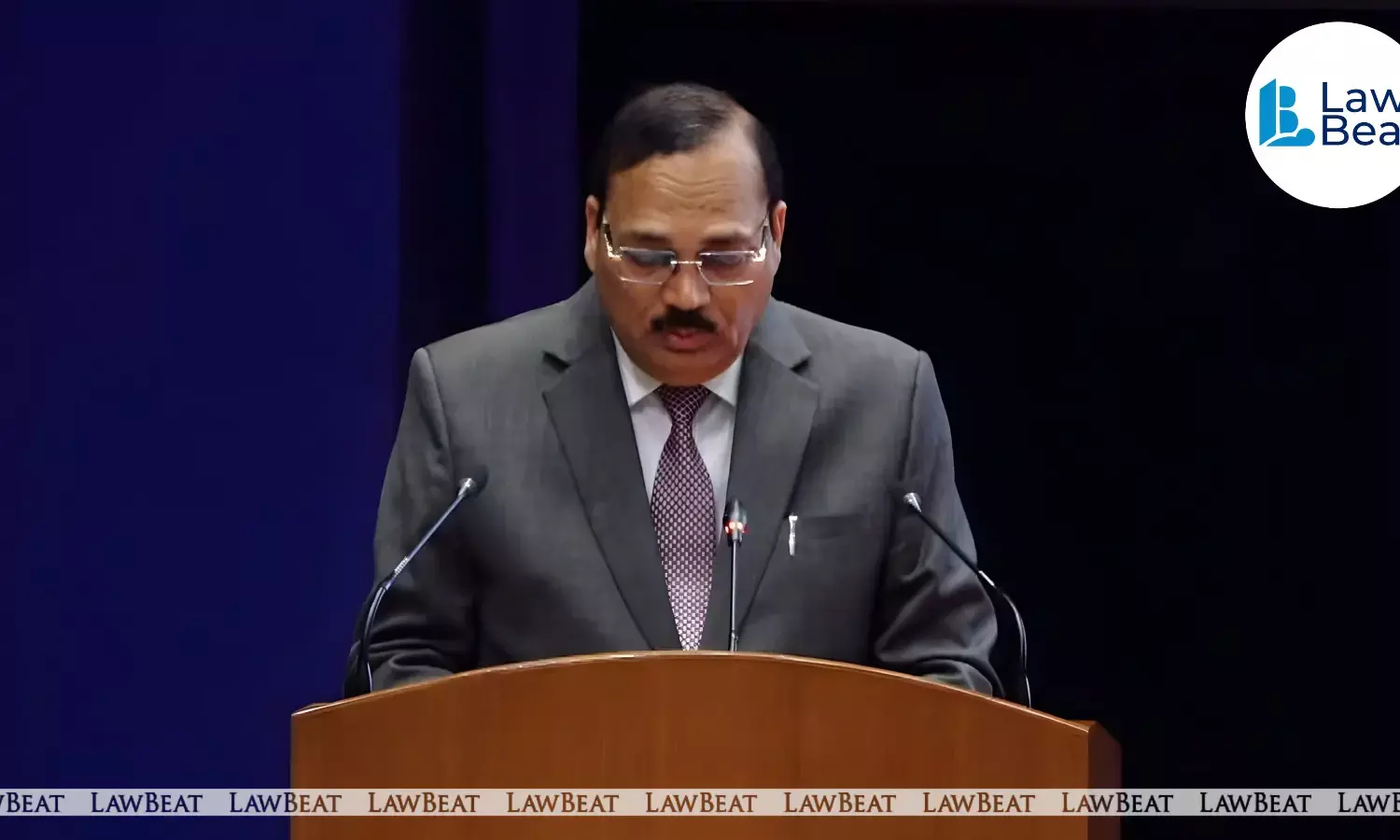
Chief Justice of India Surya Kant speaking at the International Women in Law Conference where he urged High Court collegiums to appoint more women judges
Chief Justice of India Surya Kant today called on High Court collegiums across the country to take proactive steps to increase women’s representation on the Bench, urging them to actively consider more women advocates for judicial appointments.
Speaking on the occasion of International Women's Day, the CJI also cautioned collegiums against mechanically rejecting potential candidates solely because they do not strictly meet the prescribed age criteria.
Delivering the keynote address at the International Women in Law (iWiL) Conference organised by Senior Advocates Pavani Mahalakshmi and Shobha Gupta on the theme “Half the Nation, Half the Bench,” the Chief Justice stressed that the judiciary must take concrete measures to improve women’s representation.
“High Court collegiums must recognize that the moment for measured action is not in the future, it is now,” he said. When suitable women members are available at the Bar, their consideration “should not be an exception but a norm,” he added.
The CJI further urged collegiums to widen the zone of consideration while recommending candidates for elevation. “Where in certain High Courts, if suitable women candidates within a particular age limit are not immediately available, that should not become a barrier. I earnestly request the High Court collegiums to widen their zone of consideration and include women advocates practising in the Supreme Court of India who belong to that State,” he said.
Reflecting on the historical barriers faced by women in the legal profession, the Chief Justice noted that barely a century ago women were not even allowed to practise law under the colonial legal system. He emphasised that the progress made by women lawyers has not been the result of concessions but of competence demonstrated consistently despite scepticism.
Invoking the words of Fathima Beevi, the first woman judge of the Supreme Court, the CJI said the symbolic breakthrough created by her appointment must continue to expand.
“Justice Fathima Beevi said in 1989, ‘I opened the door.’ It must remain open,” he said.
The CJI observed that when half of India’s population looks at the judiciary but finds limited reflection of itself on the Bench, it raises an important institutional concern. “The presence of women on the Bench should not be personal breakthroughs but must become an institutional norm,” he said.
Highlighting recent progress, the Chief Justice noted that there are currently two women Chief Justices in the High Courts and that the number will rise to three following the elevation of Justice Lisa Gill. He also praised the Punjab and Haryana High Court for having 18 sitting women judges, while the Madras High Court and the Bombay High Court were commended for having a significant number of women judges.
The Chief Justice pointed out that representation of women in the district judiciary has been particularly encouraging, with women accounting for roughly 37% of judges. “When the base of the system reflects greater inclusion, it is only a matter of time before it finds reflection in the higher judiciary as well,” he said, while cautioning against complacency.
The CJI emphasised that the inclusion of women judges does not change the substance of the law but enriches the judicial process by bringing diverse perspectives. “Women who ascend to the Bench do not bring a separate standard of justice. The Constitution remains the same, the oath remains the same, the office remains the same,” he said.
However, he added that women judges bring valuable lived experiences that shape judicial understanding.
At the same time, he acknowledged the challenges faced by women lawyers in the profession. “From late-night briefings to unreported workplace bias, the journey has not been easy,” he observed.
Despite these obstacles, he said many women have excelled in the legal profession because they believed in the ethos of the institution. “When a young woman sees a woman judge, aspirations become tangible,” the Chief Justice added.