
“Convicted Under TADA”: Supreme Court Refuses To Entertain Abu Salem’s Release Plea
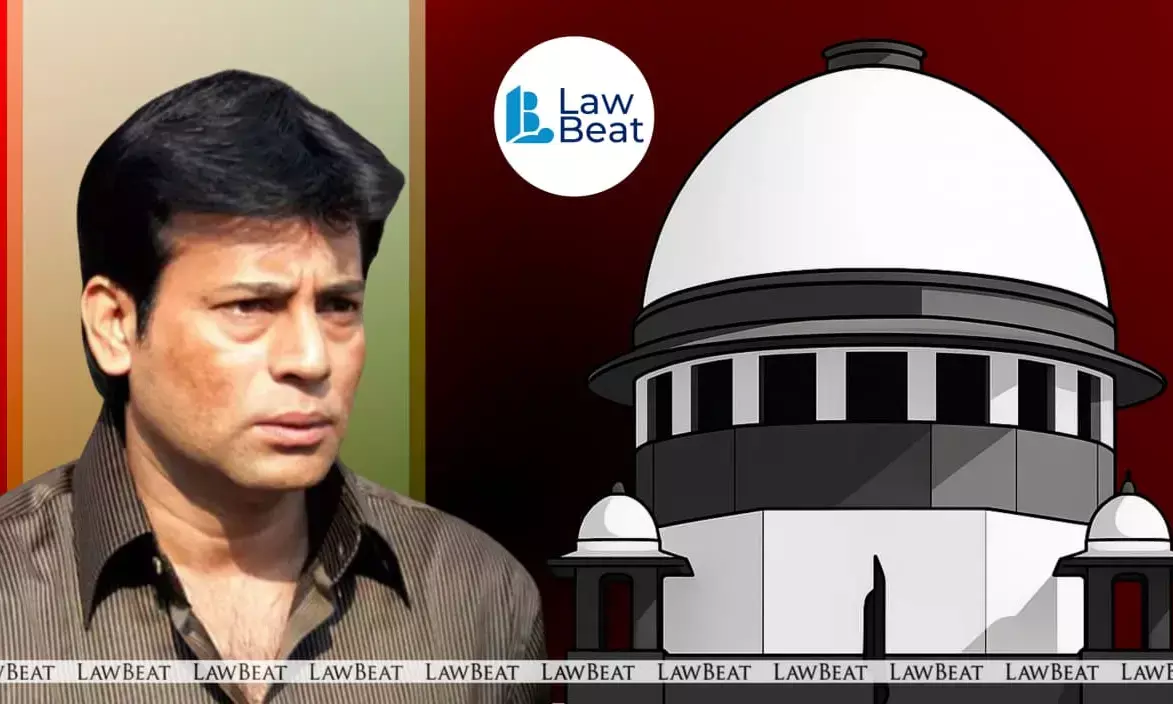
The Supreme Court reserved its order on 1993 Mumbai serial blasts convict Abu Salem's plea for premature release after hearing arguments on earned remission, undertrial set-off and India's extradition assurance to Portugal
The Supreme Court of India on Monday declined to entertain a plea filed by gangster Abu Salem, who sought release in the 1993 Bombay blasts case by claiming that he had completed 25 years of imprisonment in terms of the Court’s 2022 ruling.
Salem, a convict in the 1993 Mumbai serial blasts, was extradited from Portugal on November 11, 2005, after a prolonged legal battle.
The bench of Justices Vikram Nath and Sandeep Mehta refused to grant any interim relief and asked Salem to pursue his remedies before the Bombay High Court, which is already seized of the matter.
Appearing for Salem, Senior Advocate Rishi Malhotra submitted that he had placed on record the relevant Maharashtra prison rules on remission, as directed by the Court during the previous hearing. He argued that the High Court had erred in holding, prima facie, that Salem had not completed 25 years of incarceration, calling it “only an arithmetic error” supported by affidavits filed by prison authorities, including the Superintendent of Nashik Jail.
The Bench, however, was not persuaded. Observing that the High Court’s finding was only prima facie, the Court said it could not intervene at this stage and directed Salem to move an appropriate application before the High Court. When Malhotra argued that Salem had already undergone more than 10 months of “illegal custody” and complained of delays in hearing, the Bench remained firm.
“If all affidavits are filed, the High Court will consider and decide. We are not hearing you on this,” the Court said, dismissing the plea. When counsel urged the Court at least to request the High Court to urgently take up the matter, the Bench declined, remarking pointedly: “You are convicted under TADA. You were behind bars not for doing anything good to society.”
The Court had last month had asked Salem to place on record the applicable Maharashtra prison remission rules. With Friday’s order, the Supreme Court closed the door on immediate relief, leaving Salem to seek adjudication before the High Court.
Earlier, Salem had also moved the Bombay High Court seeking early release under the terms of his extradition from Portugal, but clarified that he has not yet completed the 25-year sentence mandated by the Supreme Court in line with international assurances.
Salem was extradited from Portugal in 2005 after India gave assurances to Portuguese authorities that he would not be awarded death penalty or imprisoned beyond 25 years, in accordance with Portugal’s domestic law and international obligations. In 2017, Salem was convicted and sentenced to life imprisonment in the 1993 Mumbai serial blasts case. However, in a landmark ruling in Abu Salem v. State of Maharashtra (2022), the Supreme Court directed that his incarceration shall not exceed 25 years, counting from the date of his extradition to India on November 11, 2005.
In 2022 a Supreme Court bench of Justices Sanjay Kishan Kaul and MM Sundaresh had held that Centre is bound to release terror convict Abu Saleem on completion of 25 years of sentence in order to honour its assurance to Portugal. The court, further held that the Central government should advise the President of India for exercise of power under Article 72 of the Constitution and the national commitment on completion of Salem's sentence.
Court had held so in a plea by Bombay blast convict Abu Salem challenging the life sentence awarded to him stating that his imprisonment cannot extend beyond 25 years as per the assurances given by the government of India to Portugal during his extradition. Advocate Rishi Malhotra appearing for Salem had contended that under Portuguese Law, it is unconstitutional to punish someone with life imprisonment or beyond a period of 25 years. He asserted that in view of this fact, there was an assurance given by the Central Government that Salem will not be punished beyond 25 years, however, now he has been punished with life imprisonment.
On September 18, 2002, Abu Salem Abdul Kayyum Ansari and Monika Bedi were arrested in Portugal. They were extradited and brought to India. The extradition was granted for Salem in respect of the Pradeep Jain murder case, Bombay Bomb blast case and Ajit Diwani murder case. On November 11, 2005, as soon as Salem was brought to India, he was arrested by the CBI in the Bombay bomb blast case and later on, was taken into custody by the Anti-Terrorist Squad, Mumbai in connection with the Pradeep Jain murder case. Salem was then granted life imprisonment by the TADA Court.
In June 2017, a Special TADA Court had found Abu Salem and five others guilty of conspiring and carrying out a string of bomb blasts across Mumbai in 1993, which ended up killing 257 people. Abu Salem was convicted for offences punishable under Sections 120B, 302, 307, 326, 427, 435, 436, 201 and 212 of the IPC, Sections 3, 3(3), 5, 6 of the TADA Rapid Protection Act, and provisions of the Arms Act, Explosive Substances Act and the Prevention of Damage to Public Property Act.
Case Title: Abu Salem vs. State of Maharashtra
Bench: Justices Vikram Natha and Sandeep Mehta
Hearing Date: February 16, 2026