
Delhi Air Pollution: Supreme Court Seeks Absolute No-Toll Regime, Long-Term Pollution Strategy for NCR
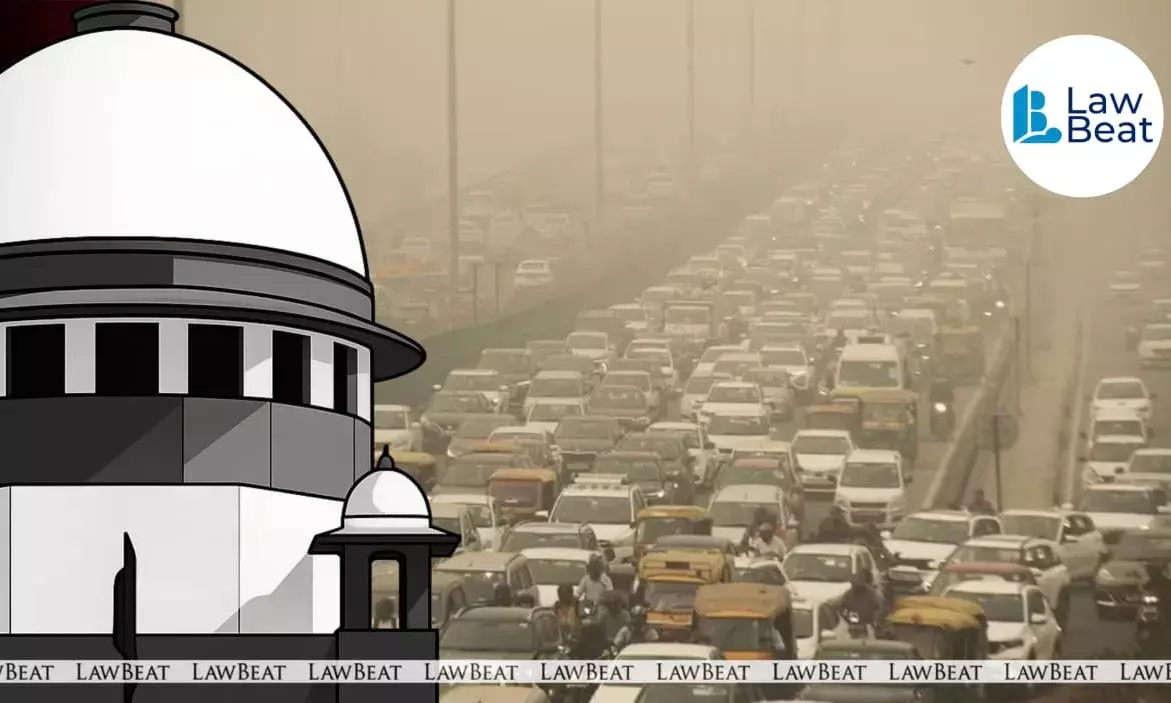
Supreme Court has directed registration of suo motu proceedings on the issues concerning Delhi-NCR air pollution.
The Supreme Court on Wednesday took up the worsening air pollution crisis in Delhi-NCR, signalling that ad-hoc, short-term measures such as blanket school closures and construction bans cannot substitute a coordinated long-term policy response.
The Bench of Chief Justice of India Surya Kant, Justices Joymalya Bagchi and Vipul M. Pancholi and heard multiple applications touching upon school closures, the impact on poor children, livelihood issues of construction workers, and the role of toll plazas in aggravating congestion and pollution.
Senior Advocate Menaka Guruswamy flagged that schools were shut up to Class 5, leading to two immediate consequences: loss of learning and disruption of the mid-day meal scheme. She argued that school closures disproportionately affect poor children, many of whom walk to school and do not contribute to pollution, while also worsening malnutrition.
Responding, the CJI observed that decisions on school closures are policy matters meant to be temporary. He noted that contradictory claims were being made before the Court and said such issues should ordinarily be left to policymakers. When Guruswamy questioned how keeping children at home without air purifiers protects them, the CJI remarked that the Court cannot be expected to opine on whether commuting to school or staying at home poses a greater health risk.
Additional Solicitor General Aishwarya Bhati suggested that the real prayer appeared to be for a hybrid option for Classes 1 to 5. The CJI pointed out that children of affluent parents would inevitably enjoy greater privileges, calling it a “Hobson’s choice”, while emphasising that such measures were not permanent and linked to advancing winter vacations.
Senior Advocate Siddharth Luthra, appearing for parents, argued that hybrid options should extend up to Class 12, noting that older children are not inherently more immune to pollution.
The Bench reiterated that the intent was only to prepone winter breaks if it helped reduce pollution exposure.
At one point, the CJI remarked that in such matters, courts often receive limited expert input, with lawyers ending up acting as experts instead.
Senior Advocate Shyel Trehan, appearing for construction workers’ associations, raised concerns over non-payment of minimum stipends during construction bans. The ASG informed the Court that out of 2.5 lakh registered workers, around 7,000 were found eligible after verification and would be paid.
The CJI stressed that payments must go directly into workers’ accounts and not be siphoned off, cautioning that Aadhaar verification alone was not enough. He suggested that authorities plan in advance by diverting workers to permissible activities during December shutdowns, rather than forcing them to migrate back to their villages.
Observing that construction workers are willing to do alternative work, the CJI noted that they could even assist pollution control boards, which currently lack manpower.
The Bench was also informed about severe congestion caused by toll plazas, particularly the MCD toll at Gurugram, leading to hours-long traffic queues and increased pollution.
Questioning the logic of such tolls, the CJI remarked that while tolls may generate revenue, they also generate massive litigation and daily suffering for commuters. The Court indicated its intent to work towards “absolute no toll plaza till January 31 next year” as a temporary measure.
Issuing notice on an application relating to toll plaza pollution, the Court asked NHAI to consider shifting nine MCD toll collection booths in Delhi to locations managed by NHAI, with a mechanism to compensate MCD for temporary revenue loss.
Calling air pollution an “annual feature”, the CJI said it was time to move beyond firefighting and evolve a phased, long-term plan. It requested the Commission for Air Quality Management (CAQM) to revisit long-term measures covering urban mobility, industry and energy, stubble burning and farmer incentives, regulation of construction with alternative employment, household pollution, green cover, public awareness, strengthening public transport, and any other relevant areas.
The Bench also underscored the need for coordinated action by Delhi, Uttar Pradesh, Haryana and Rajasthan through a unified NCR-wide body.
On December 15, the CJI had said that orders would be passed in the air pollution case that can be complied with by all the stakeholders. Recently, it had questioned whether stubble burning is the sole reason for the Delhi air pollution crisis. The bench noted that it is easy to blame farmers who engage in stubble burning when they are not represented before the Court.
Case Title: MC Mehta v. Union of India
Bench: CJI Kant, Justices Joymalya Bagchi and Vipul M. Pancholi
Mentioning Date: December 17, 2025