
‘Democracy In Peril’: Supreme Court Slams Mamata Banerjee Over Alleged ED Probe Interference
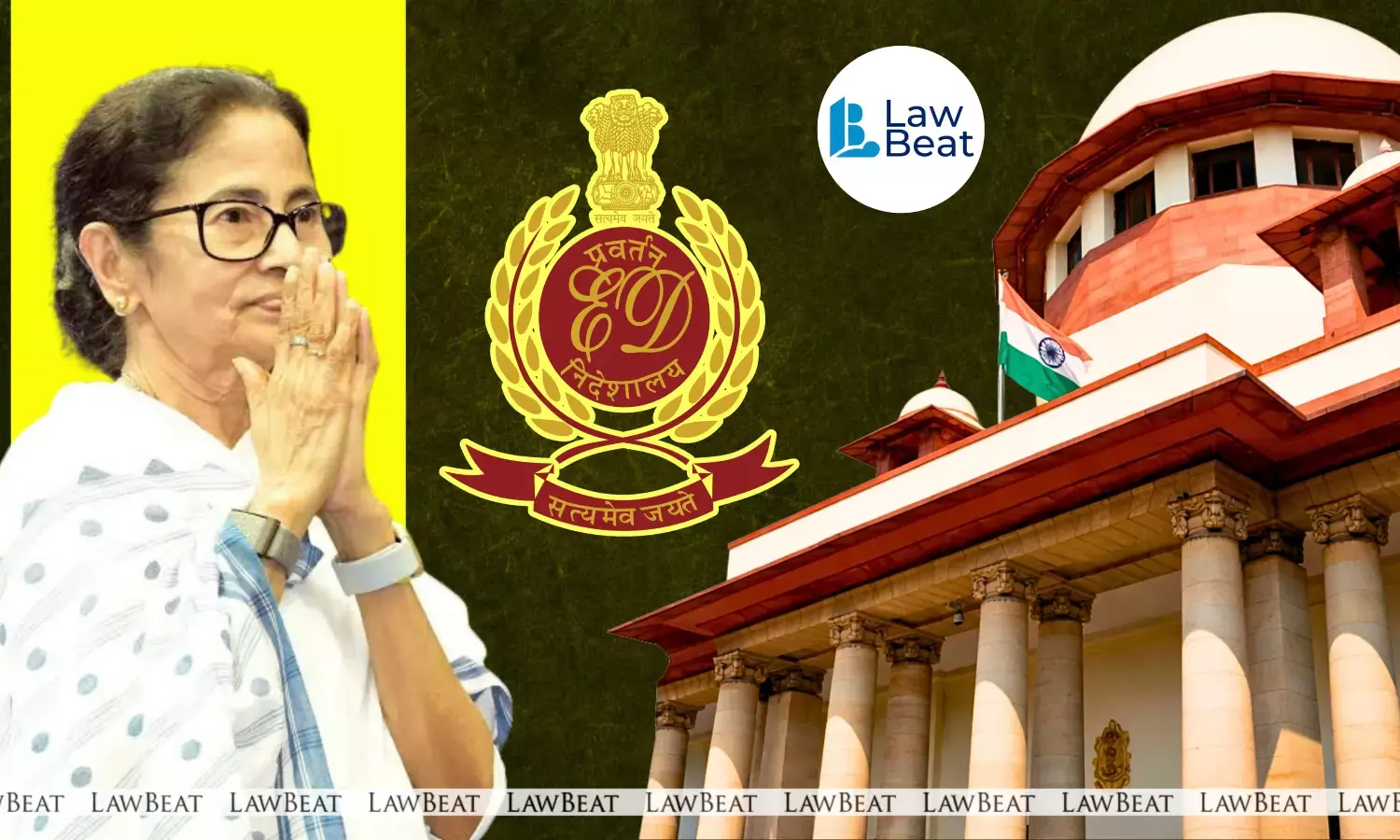
Supreme Court adjourned ED’s plea against Mamata Banerjee and West Bengal officials over alleged interference in the I-PAC probe and Kolkata searches
The Supreme Court on Wednesday came down sharply on Mamata Banerjee over allegations that she interfered with an ongoing investigation by the Enforcement Directorate (ED) at the Kolkata office of political consultancy firm I-PAC, observing that such conduct “puts democracy in peril.”
The bench of Justices Prashant Kumar Mishra and N. V. Anjaria made strong oral remarks while hearing writ petitions filed by the ED and its officers under Article 32 of the Constitution.The petitions seek, among other reliefs, a probe by the Central Bureau of Investigation (CBI) into the alleged obstruction of ED officials during search operations.
“This is not a dispute between the State and the Union,” the Bench observed. “A Chief Minister of any State cannot walk into the midst of an investigation, put the democracy in peril, and then say don’t convert this into a dispute between the State and the Union.”
The Court further remarked that such a situation was unprecedented and went beyond conventional federal disputes. “We never thought that in this country a day would come where a sitting Chief Minister would walk into the office where an investigating agency is probing a case,” the Bench said.
The controversy stems from an incident earlier this year when Banerjee allegedly entered premises linked to I-PAC during ED search operations and purportedly removed documents and electronic devices. The ED claims that the materials were crucial to its investigation in a money laundering case linked to alleged coal smuggling activities.
Appearing for the State, Senior Advocate Menaka Guruswamy challenged the maintainability of the petitions, arguing that the dispute essentially falls within the domain of Centre-State conflicts and ought to be addressed under Article 131 of the Constitution rather than Article 32.
However, the Bench was unconvinced. It questioned whether any fundamental right of the State was involved and rejected the characterization of the matter as an intergovernmental dispute. “What right of the State does this involve?” the Court asked, adding that the issue concerns actions of an individual holding constitutional office rather than a federal disagreement.
Senior Advocate Abhishek Manu Singhvi, appearing for a state police official, also argued that the ED, being a statutory authority, cannot invoke fundamental rights under Article 32. He contended that neither the agency nor its officers possess an independent fundamental right to investigate.
The Court, however, probed this argument, asking whether ED officers cease to be citizens entitled to fundamental rights merely because they act in official capacity. It also noted that accepting such arguments could unduly restrict access to constitutional remedies.
Rejecting the plea for referring the matter to a Constitution Bench, the Court observed that not every Article 32 petition involving legal questions warrants such reference. “In every petition there will be some question of law. That doesn’t mean each must go to a five-judge bench,” it remarked.
The Bench emphasized that judicial scrutiny in the present case is necessary to preserve institutional integrity and prevent any erosion of public confidence in investigative processes. It also reiterated that interference in ongoing investigations, especially by high constitutional functionaries, raises serious constitutional concerns.
During the hearing Solicitor General Tushar Mehta appeared for CBI.
On the last hearing, the bench had raised sharp questions to the West Bengal government over its objection to the maintainability of a plea filed by the ED, asking whether officers of the agency cease to enjoy fundamental rights merely because they are government officials.
Court was hearing the plea filed by ED against the West Bengal Chief Minister and certain state police officers over their obstruction of a search at the office of political consultancy firm I-PAC. Recently, Senior Advocate Siddharth Luthra had told court that ED must justify how it has been weaponized in the state. In a sharp response, Additional Solicitor General SV Raju had said, "It has not been weaponized, it has been terrorized..".
In a complete reversal of her stance, Mamata Banerjee had told the Court that ED allowed her to retrieve devices and physical files during its search at the office of political consultancy firm I-PAC, which works with the All India Trinamool Congress.
On January 15, the court had issued notice on petitions filed by the Enforcement Directorate (ED) and its officers alleging interference by West Bengal Chief Minister Mamata Banerjee and senior state police officials during a search conducted at the office of political consultancy firm I-PAC and the residence of its director Prateek Jain.
Case Title: Directorate of Enforcement v. The State of West Bengal
Bench: Justices PK Mishra and NV Anjaria
Hearing Date: April 22, 2026