
‘Digital Shift Not Optional’: Justice Vikram Nath On Reforming India’s Justice System
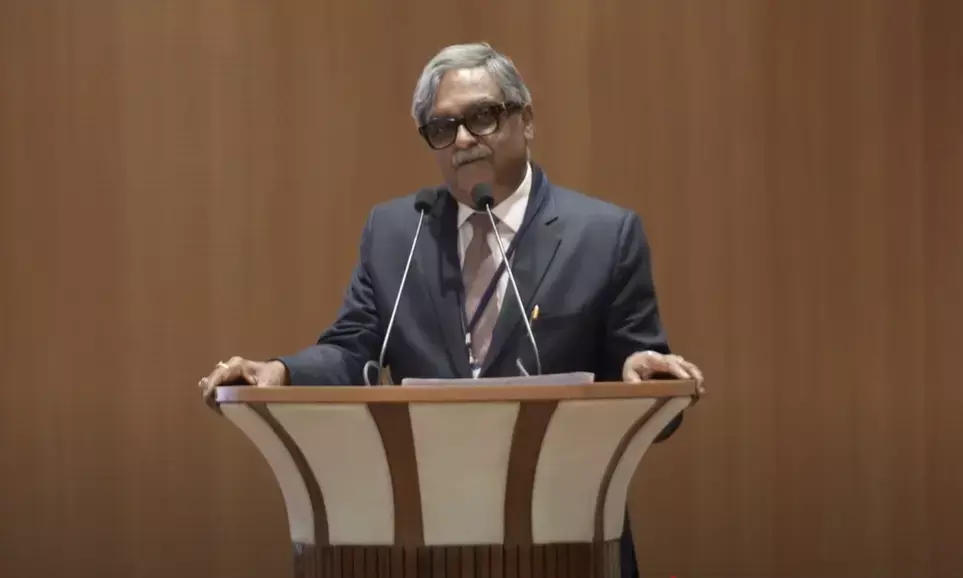
Justice Vikram Nath highlights need for technology-driven reforms in India’s justice delivery system
Supreme Court judge Vikram Nath on Saturday emphasised that India’s justice delivery system must continuously evolve to meet changing societal needs, highlighting the growing role of technology in improving access, efficiency, and responsiveness.
Speaking at the inaugural session of the two-day annual conference of Gujarat’s district judiciary, themed “Reshaping Dispensation of Justice-Transcending the Narratives,” Justice Nath underscored that in a constitutional democracy, the judiciary carries a “profound responsibility” that goes beyond mere adjudication.
“The justice delivery system must continuously evolve, responding to changing societal needs, technological advancements, and growing expectations of citizens,” he said, adding that the judiciary plays a critical role in safeguarding rights, upholding the rule of law, and reinforcing public confidence in governance.
He stressed that the legitimacy of the judiciary rests not only on the correctness of its decisions but also on its accessibility and efficiency. “To reshape the dispensation of justice is not to depart from our foundational principles, but to strengthen them by adapting to contemporary realities,” he observed.
Addressing challenges such as pendency and delays, Justice Nath described them as “human problems” that require balanced solutions. He called for greater integration of digital tools in judicial governance to tackle these issues and enhance access to justice, especially for economically weaker sections facing geographical barriers.
“It is in this context that digital transformation must be viewed not as an optional reform but as a structural necessity,” he said, noting that technology has the potential to reduce delays, improve efficiency, and bring courts closer to citizens.
Highlighting ongoing initiatives, Justice Nath pointed to the judiciary’s adoption of e-courts, e-filing systems, virtual hearings, and live streaming of proceedings. He also cited SUVAS (Supreme Court Vidhik Anuvaad Software), an AI-driven translation tool developed by the apex court to convert English judicial documents into various Indian languages, as an example of how technology can enhance accessibility.
“These initiatives demonstrate that digital tools can significantly improve both efficiency and accessibility without compromising the integrity of judicial processes,” he said.
At the same time, Justice Nath cautioned against over-reliance on artificial intelligence in adjudication. While AI represents the “next frontier” in judicial innovation and can assist in areas such as case management, legal research, and transcription, he emphasised that its role must remain limited.
“Adjudication is not purely a mechanical exercise. It involves interpretation, discussion, and a nuanced understanding of facts and human circumstances. It requires empathy and fairness that cannot be reduced to algorithmic outputs,” he said.
Reflecting on the role of judges, Justice Nath remarked that their responsibilities extend beyond courtroom proceedings. “A judge is not merely a student of law, but a student of life, constantly learning, unlearning, and evolving,” he said, adding that approaching each case without preconceived notions is essential for impartial adjudication.
He concluded by stressing that the true strength of the justice delivery system lies not in technological tools alone, but in the values and integrity of those who uphold it. “At the heart of the system will always remain a judge, guided by conscience, not by convenience, but by duty,” he said.
Justices N. V. Anjaria and Vipul Pancholi were also present at the event.