
Fake LLB Degree Racket: Supreme Court Cancels Bail, Lays Down Uniform Guidelines for Bail Orders Across Courts
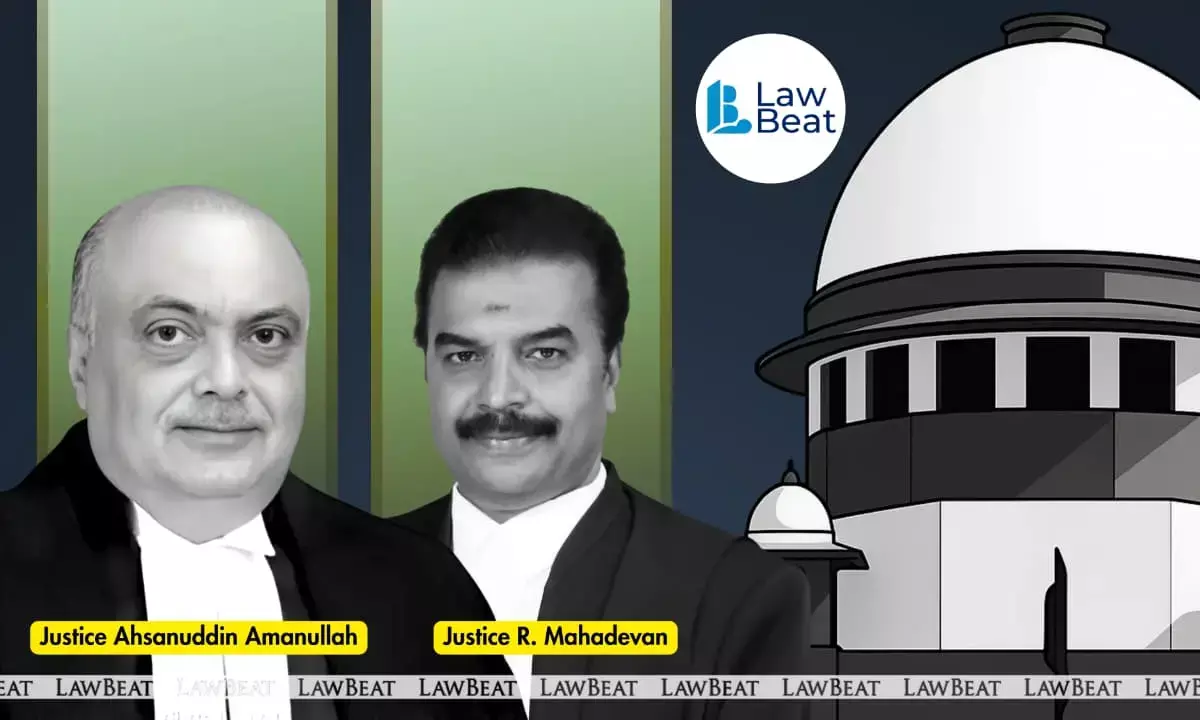
Supreme Court of India, Justices Ahsanuddin Amanullah, R. Mahadevan
The Supreme Court on Wednesday cancelled the bail granted to a man namely Zeba Khan accused of obtaining a fake LLB degree and running an organised racket for supplying forged law degrees, holding that the nature of allegations did not warrant continued liberty.
The bench of Justice Ahsan Uddin Amanullah and Justice R. Mahadevan found fault with the grant of bail and set it aside, while at the same time refusing to order a CBI investigation.
The Court observed that there was no reason to doubt the credibility or fairness of the investigation carried out by the police authorities.
The Court noted that the allegations disclosed a serious offence involving fabrication of academic credentials, which strikes at the integrity of the legal profession and the justice delivery system. In such circumstances, the Bench held that the accused was not entitled to the benefit of bail granted earlier.
At the same time, the Court declined the prayer for transfer of the probe to the CBI, holding that mere allegations of impropriety were insufficient and that the material on record did not cast any doubt on the conduct of the investigating agency.
In a significant development with systemic implications, the Supreme Court also issued detailed directions aimed at standardising bail orders passed by courts across the country. The Court directed that bail orders should clearly record essential particulars, including the FIR number and date, police station, sections invoked, maximum punishment prescribed, as well as procedural details such as the date of arrest, total period of custody undergone, current status of the trial, criminal antecedents of the accused, and details of previous bail applications and their outcomes.
The Bench directed the Registry of the Supreme Court to circulate a copy of the judgment to all High Courts, observing that High Courts may examine the feasibility of issuing appropriate administrative directions or incorporating suitable provisions in their respective Rules in exercise of their rule-making powers.
The Court further ordered that the judgment be circulated to the district judiciary as well, for guidance in bail matters, with the objective of ensuring greater consistency, transparency, and judicial discipline in the grant of bail.
Advocate Shreevardhan Dhoot, AoR Alabhya Dhamija and Advocates Arjun Aggarwal, Amrit Rathi appeared for the petitioner.
The case arose from a Special Leave Petition (SLP) filed against a July 30, 2025 order of the Allahabad High Court granting bail to the accused in FIR No. 314 of 2024, registered at Saray Khwaja police station in Jaunpur district under Sections 419, 420, 467, 468 and 417 IPC. The petitioner alleged that the bail was secured on the basis of false affidavits and fabricated documents, including a forged LLB degree and marksheet.
Before the Supreme Court, it was submitted that the accused is a habitual offender with at least nine criminal cases pending against him and has fraudulently enrolled himself as an advocate with the Bar Council of Maharashtra & Goa using fake educational credentials. Despite this, he allegedly appeared as an advocate before the Supreme Court, the Bombay High Court, and other courts and tribunals.
The petitioner contended that the accused gravely misled the High Court by relying on a screenshot of an online marksheet allegedly issued by the “Sarvodaya Group of Institutions”. It was pointed out that the institution is not recognised by the Bar Council of India to offer an LLB course. The online verification portal itself carried a disclaimer stating that the results published online could not be treated as original mark sheets.
Crucially, the petitioner placed reliance on letters issued by Veer Bahadur Singh Purvanchal University, which categorically stated that Sarvodaya Group of Institutions was not affiliated to the university and that the marksheet produced by the accused was not issued by it. The university had also requested registration of a complaint and investigation against the accused, indicating a wider conspiracy involving fake degrees.
The Court was also informed that the accused made contradictory submissions before different courts. While claiming in the bail application that he had never appeared as an advocate, he asserted in a separate petition seeking quashing of the FIR that he was a practising advocate before the Supreme Court and that the case had damaged his professional reputation. Photographs of the accused in advocate’s robes outside the Supreme Court were also placed on record.
The petition further highlighted serious irregularities in the online verification website relied upon by the accused. The website allegedly used a suspicious email ID, non-functional contact details, and dummy menus. An inspection of the source code revealed that the portal was mirrored from the University of Calicut’s official website, clearly indicating fabrication and forgery.
It was also alleged that the accused had fraudulently secured membership of the Supreme Court Bar Association and had appeared in SLP (C) No. 21615 of 2024 as an advocate, despite lacking a valid law degree. Multiple universities, including Rajiv Gandhi University of Health Sciences, Dr. Babasaheb Ambedkar Marathwada University, and Yashwantrao Chavan Maharashtra Open University, were stated to have lodged complaints against him.
Case Title: Zeba Khan v. State of Uttar Pradesh
Bench: Justices Ahsanuddin Amanullah and R. Mahadevan
Judgment Date: February 11, 2026