
“How Many Women In Karnataka Can Approach Supreme Court?”: Justice BV Nagarathna Questions Curtailing High Court’s Appellate Jurisdiction
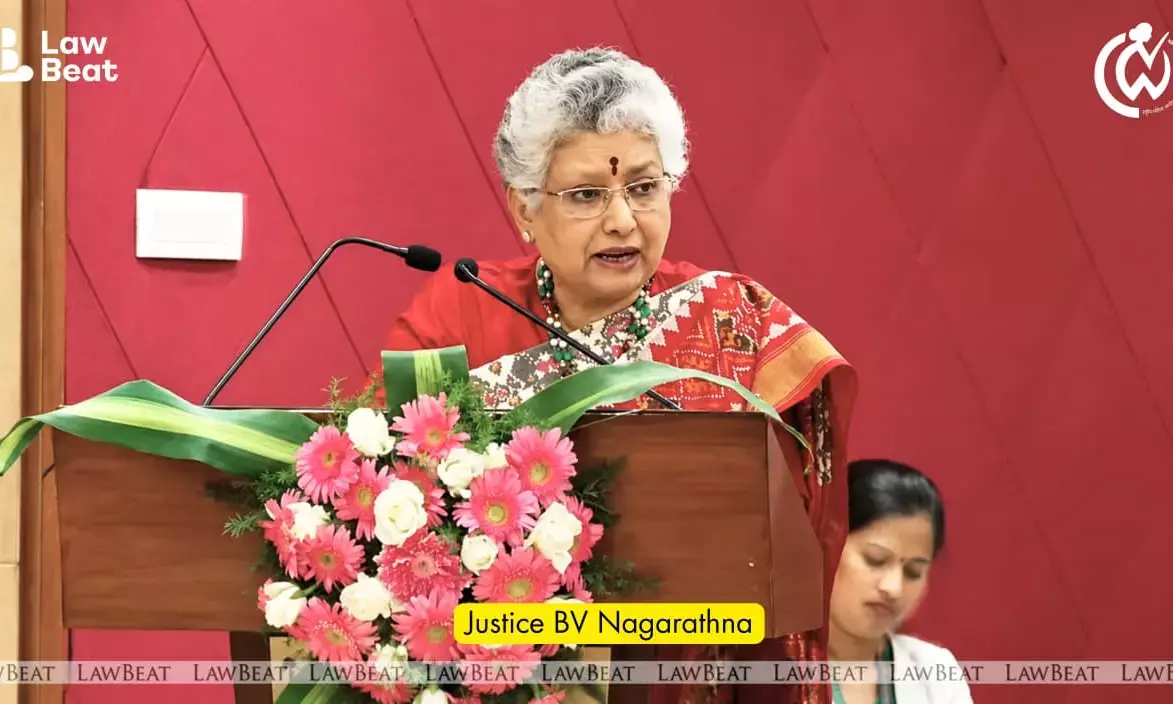
Justice Nagarathna spoke at the Inaugural Ceremony of the South Zone Regional Conference on "JUSTICE for WOMEN" organised by National Commission for Women in association with the High Court of Karnataka and Karnataka Judicial Academy.
Supreme Court judge Justice B.V. Nagarathna has questioned amendments that have taken certain first appeals away from the Karnataka High Court, asking how women litigants aggrieved by findings of fact can realistically be expected to approach the Supreme Court. She called upon the Karnataka Government to rectify the position and sought repeal of the provision.
Speaking at the South Zone Regional Conference on “Justice for Women”, organised by the National Commission for Women in association with the High Court of Karnataka and Karnataka Judicial Academy, Justice Nagarathna said the change could have serious access-to-justice consequences, particularly in property disputes involving women.
Referring to amendments to the Karnataka Civil Courts Act and the Karnataka High Court Act, Justice Nagarathna said the High Court had been “denuded” of its jurisdiction to hear regular first appeals in certain matters, with a judgment and decree of a Civil Judge, Senior Division, now being appealable before the District Court instead.
“What does this entail?” she asked.
Taking the example of disputes concerning women’s property rights, Justice Nagarathna questioned what remedy would realistically remain where a woman sought to challenge a finding of fact concerning whether property was joint family property or separate property.
“What do women do if they are aggrieved by a finding of fact?” she asked, pointing out that after the District Court, a litigant seeking to challenge such findings may have to approach the Supreme Court under Article 136 of the Constitution.
“How many women in Karnataka can approach the Supreme Court?” Justice Nagarathna asked.
She appealed to the State Government and the Advocate General to have the position rectified and the provision repealed, saying women in Karnataka should not be placed at a disadvantage. The issue, she added, ultimately disadvantaged male litigants as well.
The concern formed part of a wider address in which Justice Nagarathna questioned why, 76 years after the Constitution, India still needed conferences specifically devoted to “Justice for Women”.
“We do not conduct seminars on justice for men,” she remarked, asking whether the justice system was truly capable of serving women “from the womb to the tomb”.
Justice Nagarathna said the answer lay partly in the difference between formal and substantive equality. The Constitution itself recognised this distinction through Article 15(3), which permits the State to make special provisions for women and children.
The harms suffered by women, she said, are also often fundamentally different because perpetrators are frequently not strangers but men upon whom women may be financially or socially dependent. The home, which should ordinarily be a place of sanctuary, may itself become the site of violence.
She identified lack of awareness among women and inadequate sensitisation among authorities as further barriers to accessing justice.
On legal aid, Justice Nagarathna said the system needed to move beyond measuring success simply through the number of beneficiaries.
Citing NALSA figures, she noted that approximately 44.22 lakh individuals availed legal aid between 2022 and 2025. However, disparities between States remained significant.
She suggested that legal aid should become available to women immediately after an incident, including at police stations and hospitals, rather than only when they eventually reach court.
A structured framework connecting legal services authorities with police stations, primary health centres and government hospitals was required, she said, while also calling for studies into the actual outcomes achieved through legal aid.
Justice Nagarathna also advocated earlier payment of compensation to victims. Interim victim compensation, she suggested, should ordinarily be made available at the stage of filing of the chargesheet so that a survivor has resources for medical treatment and legal expenses.
Turning to the functioning of courts themselves, the judge warned that the pursuit of justice should not result in the “revictimization and stigmatization” of survivors.
She said judges did not willingly seek to perpetuate stereotypes, but bias could result from insufficient awareness and an inability to recognise one’s own prejudices. Judicial academies, she said, therefore had an important role in sensitising judges about stereotypes and even the language used while recording evidence and writing judgments.
She suggested a separate training module for judicial officers on the issue.
Justice Nagarathna also raised concerns about what happens to women’s property rights when disputes are settled through mediation.
While noting that mediation centres report settlement rates of around 60 to 65 per cent, she said courts often see women coparceners signing relinquishment deeds in mediated settlements in partition suits.
“The women coparceners readily agree to sign away their rights and properties as part of a mediated settlement. Why is this?” she asked, cautioning that relinquishment deeds should not become the central focus of settlement.
On workplace sexual harassment, Justice Nagarathna said more than a decade after the enactment of the POSH Act, it was necessary to examine not merely the existence of remedies but the actual cost borne by a woman in invoking them, including the professional and social consequences of making a complaint against colleagues.
She further urged the National Commission for Women to study the disbursal and utilisation of the Nirbhaya Fund across States and Union Territories.
Cybercrime, she said, posed another distinct challenge because material placed online could acquire permanence and be disseminated endlessly, making complete restitution potentially impossible. Existing cybercrime reporting mechanisms, women’s helplines and legal aid facilities therefore needed far greater publicity.
Concluding, Justice Nagarathna said the continuing need for a theme such as “Justice for Women” reflected the gap between what law promises and what women actually experience.
The harder task, she said, was changing “mindsets, societal attitudes and practices” through systemic reform of the justice delivery system.
She also stressed that women could not be treated as a homogeneous category. Women marginalised on account of caste, disability, neurodivergence or regional disparities may require different interventions to achieve the same substantive outcomes.
The objective, she indicated, must ultimately move beyond having laws on the statute book to ensuring that their promise translates into justice women can actually access.