
‘Jana Nayagan’ Makers Move Supreme Court Against Madras HC Stay on CBFC’s U/A Certificate
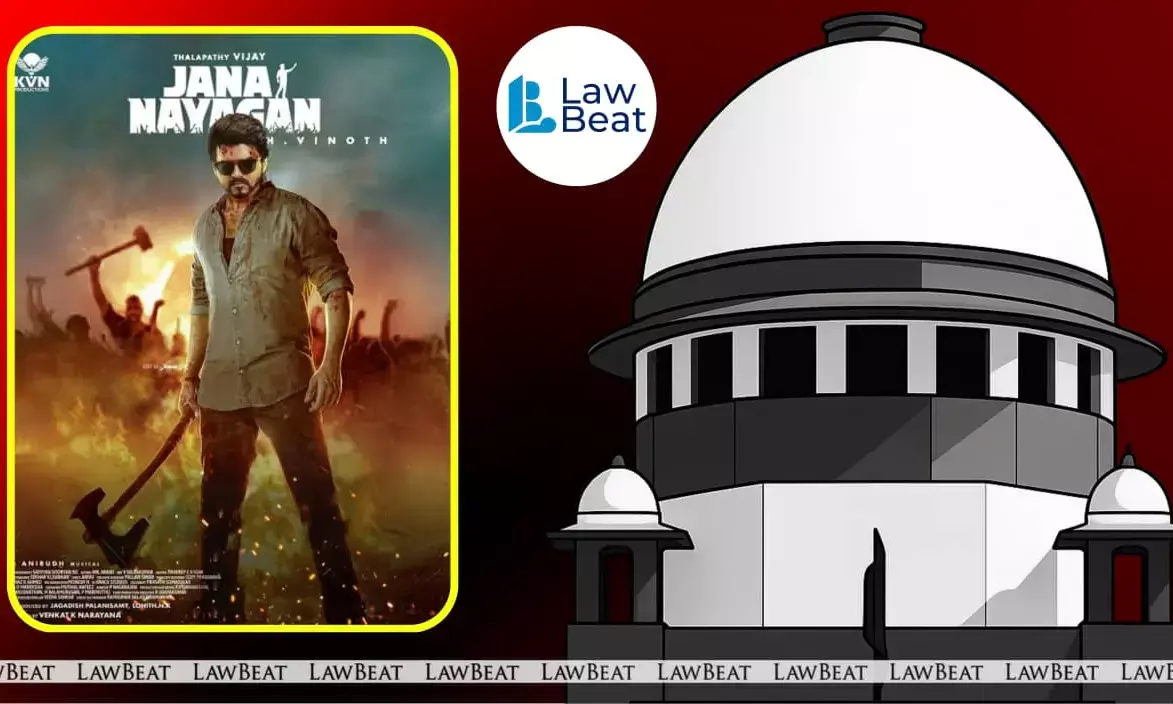
CBFC filed a caveat in the Supreme Court in the certification dispute over Vijay’s film Jana Nayagan, directed by H Vinoth
Thalapathy Vijay-starrer Jana Nayagan, one of the most anticipated Tamil releases and widely seen as the actor’s swansong, is now facing an indefinite delay after its makers moved the Supreme Court against an interim stay on the film’s certification.
The legal battle stems from a dispute over the Central Board of Film Certification’s refusal to issue a censor certificate on time, pushing the producers into Court just days ahead of the proposed release. The Madras High Court’s interim order has effectively put the film’s release on hold, with the final outcome now hinging on the Supreme Court’s decision.
In the latest development, the production house has approached the Supreme Court challenging the interim stay imposed by a division bench of the Madras High Court on the film’s certification. According to Nakkheeran, the makers have sought urgent listing of the matter and requested that it be taken up at the earliest, possibly on January 12.
The High Court stay had blocked the implementation of a single judge’s order directing the CBFC to issue a U/A 16+ certificate to the film, thereby halting its immediate release.
The controversy traces back to January 6, when the producers moved the Madras High Court citing delays in certification. During the hearing, the Censor Board informed the Court that a complaint had been received regarding a scene allegedly containing religiously offensive content, necessitating reconsideration of the certification.
Justice Asha questioned how a member of the certification committee could lodge a complaint in an individual capacity and why the film was subjected to further scrutiny after entering the certification process. The CBFC, in response, submitted that a symbol associated with the defence forces had been used without appropriate expertise, while maintaining that there was no hidden agenda behind the objection.
Notably, on January 9, Justice Asha directed the CBFC to issue a U/A 16+ certificate to Jana Nayagan. The order was promptly challenged by the Board before a division bench headed by the Chief Justice. The bench questioned the filmmakers for announcing a release date without securing certification and granted an interim stay on the single judge’s direction. The next hearing before the High Court is scheduled for January 21.
Allowing a writ petition filed by the film’s producer, M/s KVN Productions LLP, the High Court set aside the decision of the CBFC to refer the film to a Revising Committee after it had already accepted the Examining Committee’s unanimous recommendation to grant a UA 16+ certificate subject to excisions. Justice Asha had held that once the Board had accepted the Examining Committee’s recommendation and communicated the same to the applicant, the Chairperson of the CBFC ceased to have the authority to invoke revisional powers under the Cinematograph Certification Rules, 2024. Any subsequent attempt to reopen the process, the court said, was without jurisdiction.
Describing the complaint as an afterthought, the Court had warned that permitting such volte-face by members of the Examining Committee would give rise to a “dangerous trend” where committee members could renege on their own recommendations after a decision had been taken. Such a practice, court cautioned, would erode the sanctity and credibility of the CBFC’s certification process.
On the legal question, the Court had undertaken a detailed reading of the Cinematograph Act, 1952 and the Cinematograph Certification Rules, 2024, particularly Rules 24, 25, 26 and 27. It held that the Chairperson’s suo motu power to refer a film to a Revising Committee could be exercised only before the Board acted on the Examining Committee’s report. Once the Board decided to accept the recommendation and communicated it under Rule 26, the process moved into the stage contemplated by Rule 27, where certification follows upon compliance with excisions.
Case Title: KVN Productions LLP v. Central Board of Film Certification
Bench: Supreme Court of India (hearing expected)