
Judicial System Must Function Like Hospitals With Spirit Of Service: CJI Surya Kant
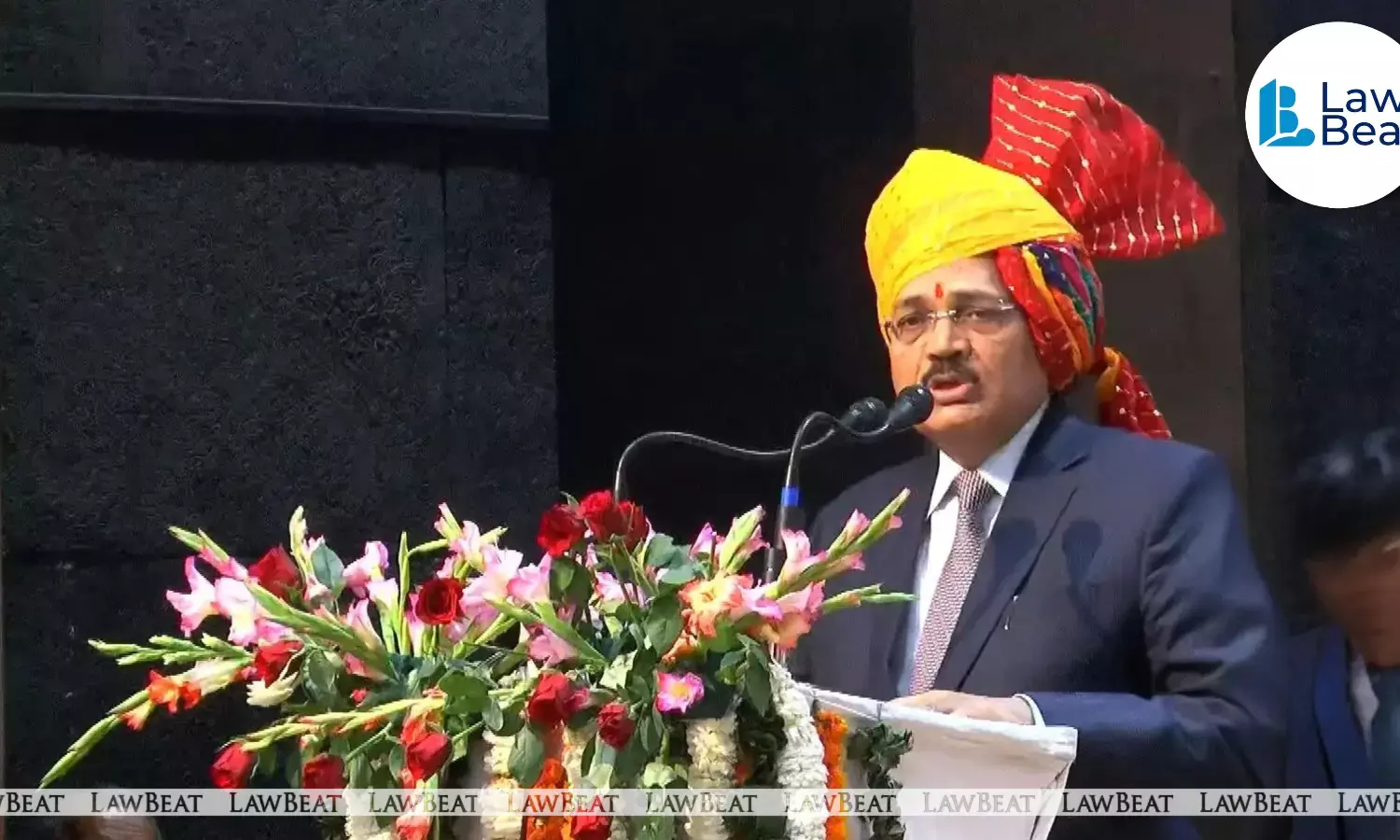
CJI Surya Kant addresses a legal literacy camp in Mandi after laying the foundation stone of the new judicial court complex
Chief Justice of India, Justice Surya Kant on Sunday said that judicial complexes should function with the same spirit of service as hospitals, emphasising that people approach courts with hope while seeking relief and justice.
The CJI made the remarks while addressing a legal literacy camp after laying the foundation stone for the Mandi Judicial Court Complex in Mandi, Himachal Pradesh.
Stressing the responsibility of the justice delivery system, the Chief Justice said that as infrastructure and facilities expand, the obligation of the judiciary to serve citizens with efficiency and sensitivity also increases.
He further highlighted that while public discourse often centres on fundamental rights, equal importance must be given to fundamental duties enshrined in the Constitution. He called for greater awareness at the grassroots level and urged authorities to organise more legal literacy and outreach programmes to educate citizens about their constitutional duties.
During the event, the foundation stone was laid for the Mandi Judicial Court Complex, a project estimated to cost ₹152 crore. The complex will be constructed on 9.6 hectares of land and will comprise four blocks designed to provide improved facilities for judges, lawyers, and litigants.
The Chief Minister further referred to several welfare initiatives of the state government, including adopting around 6,000 orphaned children as “Children of the State”, raising the legal marriage age for girls to 21 years, and granting daughters equal rights in ancestral property up to 150 bighas.
Also present at the event, Justice Gurmeet Singh Sandhawalia, Chief Justice of the Himachal Pradesh High Court, emphasised that justice is not confined to courtrooms alone. He said that ensuring justice also involves spreading awareness about legal rights, strengthening access to legal aid, and providing timely assistance to those in need.
In a related news, Justice Kant before being elevated as a the CJI, had called upon High Courts to envision their institutional growth much like a modern hospital which designs its emergency services, with structures that are equipped to respond swiftly, decisively, and with precision at the very moment a crisis arises.
"In the same way that an emergency ward cannot afford delay, our Courts too must aspire to that level of preparedness, efficiency, and coordinated response. This means strengthening technological capacity, streamlining procedures, building specialised expertise, and ensuring that judicial processes can adapt instantly to emerging situations. Only with such foresight can the Judiciary continue to deliver timely and effective remedies, rising to every challenge with the speed and clarity that a constitutional democracy demands. These are not mere administrative ideas; they are the next step in the evolution of access to justice", he had said while speaking at the Silver Jubilee Celebration of the High Court of Jharkhand.
Justice Kant had also spoke on the importance of High Courts and the constitutional commitment to rule of law, democracy, and fundamental rights. He has said the High Courts form the backbone of justice and shape the daily experience of constitutional ideals for millions. "The existence of High Courts, mandated by Article 214, is not merely an extra rung on the ladder to the Supreme Court. Their deeper significance lies in Article 226, which grants them the authority not only to enforce Fundamental Rights, as the Supreme Court does under Article 32, but also to protect legal rights of every kind. The presence of a High Court in every State, whether old or new, therefore, ensures that justice is truly local, immediate, and within reach", the judge had said.
He had highlighted how broad jurisdictional powers and proximity to the people, makes High Courts vital engines for legal development and social reform. "...since each High Court evolves in conversation with its region’s distinct culture and challenges, justice acquires a local heartbeat. When law intertwines with the lived realities of the people, it ceases to be abstract, it becomes human, inclusive, and transformative. Here lies the irreplaceable strength of the High Courts within our federal democracy.", he had said.