
Justice BV Nagarathna on CBSE's Three Language Policy: 'Don't start a new language in Class IX'
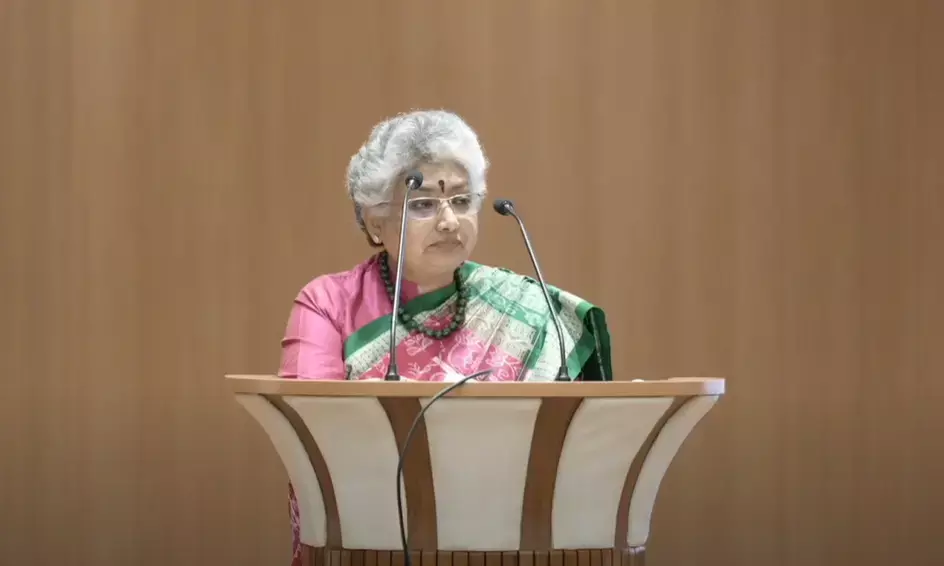
Justice Nagarathna has urged Centre not to introduce a new language for Class IX CBSE students.
The Supreme Court has urged Centre not to go ahead with the three-language framework for Class IX students saying it could be stressful for students if the Central Board of School Education (CBSE)'s three-language policy mandate is introduced starting from class 9.
"Don’t have a new language in 9th standard please. In 5th or 6th standard, you can start third language. And by 9th standard, it should stop, the third language. See the stress they (students) are having. Advise your government. The student in me is still alive!" Justice BV Nagarathna remarked today in court.
The bench comprising Justice Nagarathna and R Mahadevan was hearing the Tamil Nadu government’s plea challenging a Madras High Court judgment that had directed it to set up Navodaya Vidyalayas in every district.
Yesterday, while hearing a batch of petitions challenging the implementation of the Central Board of Secondary Education's three-language policy for Class 9 students, the CJI had remarked, "The learning of a language never goes waste..". Refusing to stay the policy in the interim, the court has posted the case for further consideration on July 22, 2026.
The Supreme Court is hearing petitions seeking to quash the Circular issued on May 15, 2026 by the Central Board of Secondary Education (CBSE), which stipulates the study of three languages, R1, R2, and R3, shall be compulsory for all students in Class IX. As per the Circular, at least two of the three must be native Indian languages, whilst foreign languages are relegated to the position of R3 only where both R1 and R2 are native Indian languages, or alternatively as an additional fourth language. This has been challenged on the ground that it unconstitutional, arbitrary, and ultra vires Articles 14, 19, 21, and 21A of the Constitution of India.
The Impugned Circular states that Class IX students shall use Class VI R3 textbooks as the primary pedagogical resource until dedicated secondary-stage textbooks are made available. It also provides that, in the absence of a qualified teaching staff proficient in the regional languages, the schools may, as an “interim arrangement,” engage teachers of other subjects possessing mere “functional proficiency” to teach R3 and that all R3 assessments shall be entirely school-based and internal, with no Board Examination required at this stage at the Class X level, though R3 performance shall be reflected in the CBSE certificate; and schools are directed to update R3 offerings on the OASIS portal by June 30, 2026.
Court had been told that the Impugned Circular further violates Article 21A of the Constitution, which guarantees the right to free and compulsory education as mandating a compulsory subject without textbooks, trained teachers, or an assessment framework does not amount to quality education. "Directing Class IX students to use Class VI textbooks, and permitting subject-matter teachers with mere “functional proficiency” to impart language instruction, are precisely the kinds of qualitative compromises that this Hon'ble Court held to be constitutionally impermissible in Devesh Sharma", the petition states.