
‘Justice Must Reach People, Not The Other Way Around’: CJI Surya Kant Envisions Borderless, Future-Ready Judiciary
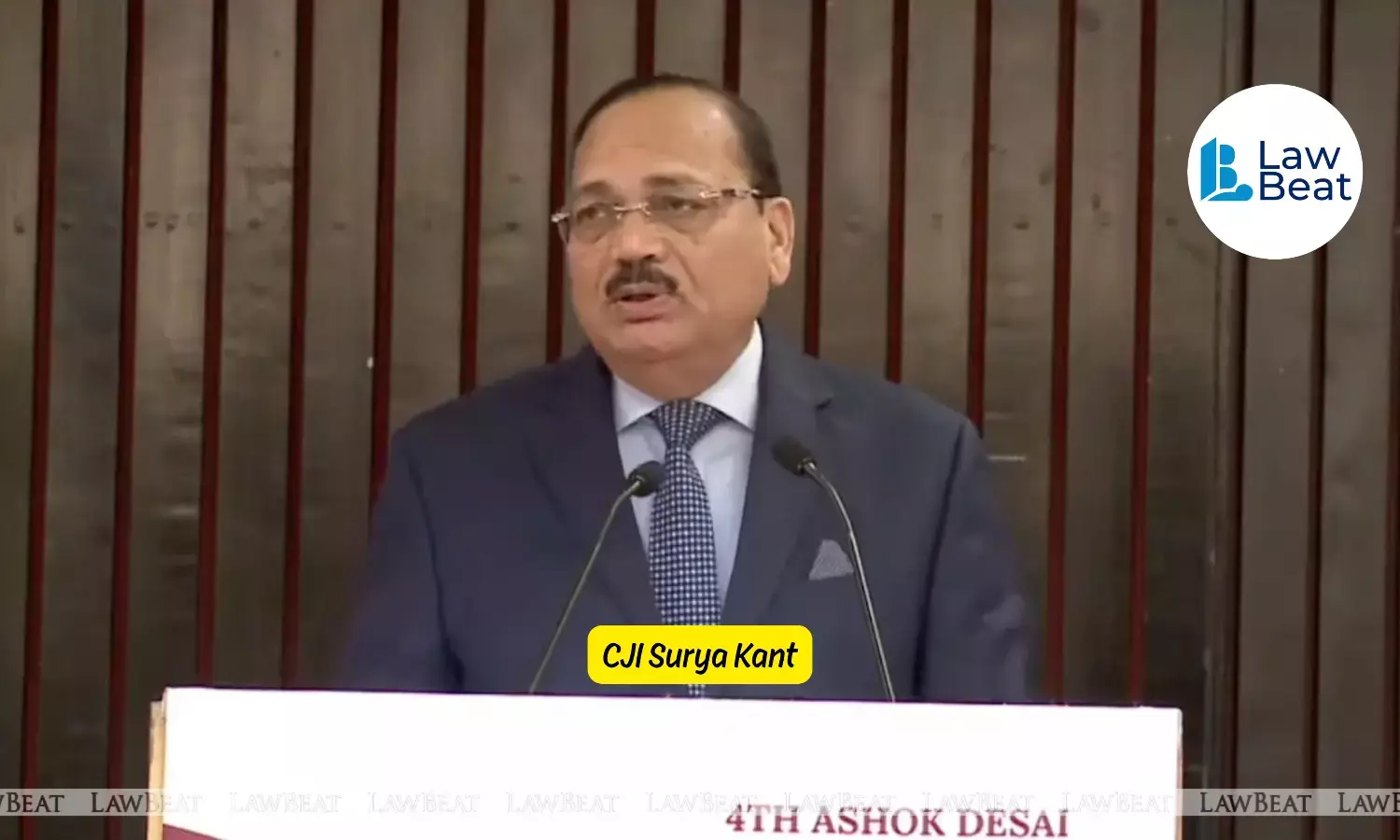
CJI Surya Kant speaking at the 8th Dinkar Memorial Lecture on social justice and AI bias
Chief Justice of India Surya Kant on Monday laid out an ambitious vision for the future of the Indian judiciary, asserting that courts can no longer remain confined within physical spaces or limited by geography.
Delivering the 4th Ashok Desai Memorial Lecture on the theme “Reimagining Justice: The Indian Judiciary 50 Years Hence”, the CJI emphasised the need for a justice delivery system that is accessible, responsive, and deeply integrated into the daily lives of citizens.
Underscoring the urgency of transformation, the CJI stated that the traditional model of justice; where citizens must approach courts physically, must give way to a system where justice reaches people efficiently and equitably. He highlighted that in a rapidly evolving society, the judiciary must adapt to ensure that access to justice is no longer dependent on location, resources, or procedural complexity.
“In such a vision, justice is no longer something one must travel to seek, but something that reaches individuals efficiently, equitably and with sensitivity to the realities of a changing society,” he observed. The remarks reflect a broader shift towards technology-driven and citizen-centric reforms within the judicial system.
The Chief Justice noted that the judiciary’s long-term goal should be to build a system that, over the next five decades, becomes more accessible, transparent, and closely aligned with the needs of society. According to him, the future of justice delivery lies in reimagining institutional frameworks to eliminate barriers that traditionally hinder access, particularly for marginalised and underserved communities.
Expanding on the role of judges in this evolving ecosystem, CJI Surya Kant pointed out that the nature of disputes before courts is set to become increasingly complex and interdisciplinary. He cautioned that judges of the future cannot remain confined to being mere interpreters of statutes and precedents, but must develop a broader understanding of emerging fields.
“The disputes that will come before courts will require an understanding that extends far beyond statutes and precedents,” he said, citing examples such as synthetic biology and deep-sea mining. These emerging domains, he noted, would raise novel legal questions involving liability, environmental responsibility, and jurisdictional challenges that transcend conventional legal boundaries.
The CJI’s remarks highlight the growing intersection between law, technology, and science, and the need for the judiciary to be equipped to handle such complexities. He suggested that future judges would need to engage with issues that are global in nature and may not fit neatly within existing legal frameworks.
At the heart of his address was the idea that justice delivery must evolve from a rigid, institution-centric model to a flexible, service-oriented system. This transformation, he indicated, would require not just technological adoption but also a shift in institutional mindset and approach.
The lecture forms part of an ongoing discourse on judicial reforms in India, particularly in the context of digitisation, accessibility, and efficiency. The CJI’s vision aligns with broader efforts to modernise the judiciary through initiatives such as virtual hearings, e-filing systems, and digital infrastructure aimed at reducing delays and improving transparency.
Concluding his address, the Chief Justice reiterated that the legitimacy of the judiciary in the coming decades will depend on its ability to remain relevant, inclusive, and responsive to societal changes. He emphasised that the success of any reform would ultimately be measured by how effectively it enhances the lived experience of justice for ordinary citizens.