
"Law Is Not Merely A Commercial Vocation": Justice BV Nagarathna's Message To NLU Delhi Graduates
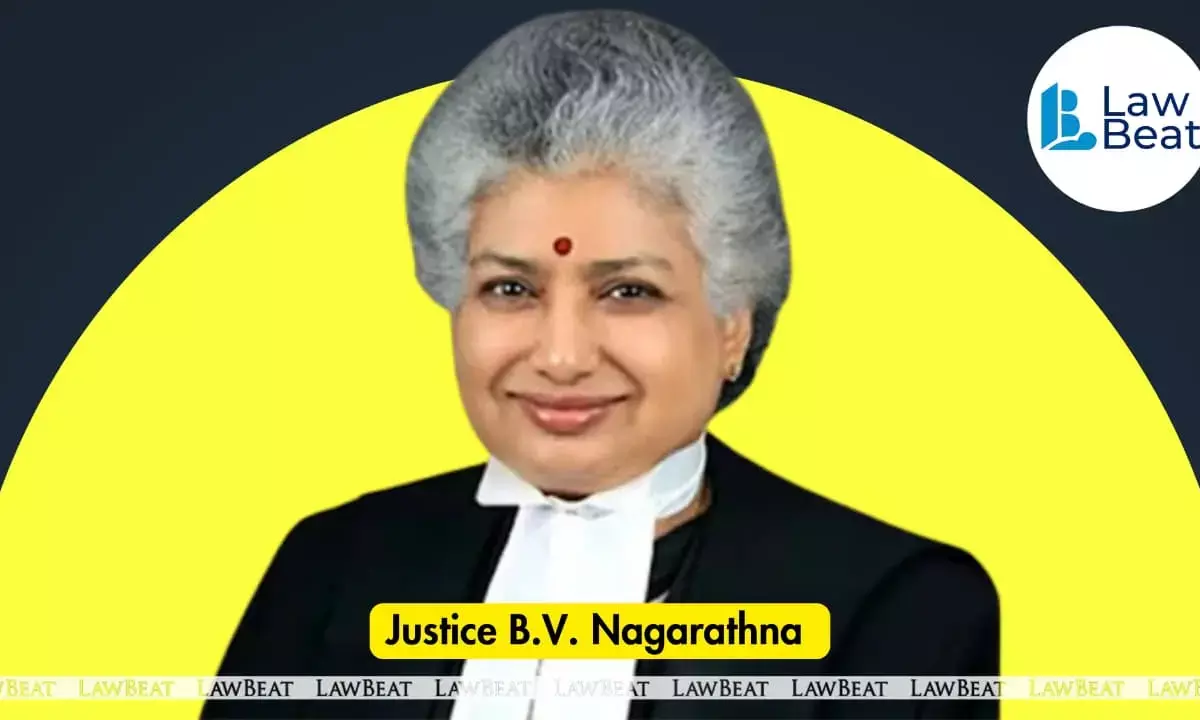
Supreme Court judge Justice BV Nagarathna, who addressed the 13th convocation of the National Law University, Delhi, on Bar Council accountability and the legal profession's response to pendency and rising costs
Supreme Court judge Justice B V Nagarathna on Saturday delivered a pointed message to the legal profession, stating that the legal system is bogged down by pendency, delays and rising costs, and calling on the Bar to change its mindset, rethink its role, and speak in a singular voice to sustain the justice dispensation system.
Speaking at the 13th convocation of the National Law University, Delhi, Justice Nagarathna stressed that when a bar council fails to earn the respect of its own members, "it is not a good sign for the legal profession."
"Not a good sign": Bar Councils must introspect
Justice Nagarathna said Bar Councils, at both the national and State levels, carry a significant institutional responsibility toward maintaining professional standards, ethical conduct and discipline within the legal profession; and that this authority must be accompanied by credibility and the trust of the Bar. She observed that it is time for members of the Bar to introspect on their duties in seeking justice for the distressed litigant and for sustaining democracy in the country.
"The lawyers of this country are the torchbearers of the values of our Constitution. Any lapse or errors of the bar will have a deep impact on our political and civic life. Hence, their importance in our society," she said.
She added: "I humbly remind every member of the Bar to change their mindset and endeavour to work for their clients as a public service, lest they lose their relevance in the future to come. That would be disastrous for our system of dispensation of justice and for preserving the rule of law in our country."
Her remarks come amid continuing discussions concerning the functioning and accountability of Bar Councils, and underscore that statutory authority alone cannot sustain the legitimacy of a professional regulatory institution, its credibility, she indicated, must equally flow from transparent functioning, ethical governance, fairness, and the confidence it inspires among its own members.
Bar must "speak in a singular voice"
Justice Nagarathna said the Bar must use its knowledge and judgment in service of the rule of law. "As the legal system in India is bogged down by pendency, delays, rising costs and uncertainty, the Bar in India must rise and speak in a singular voice as to how it could sustain the system of justice dispensation in India," she said.
Describing lawyers as the "safety valves" of democracies, she said the independence of the Bar is not an entitlement given to lawyers for their own benefit; it exists because a constitutional democracy requires a body of professionals who can advise, argue, challenge and represent without having to seek permission from the State, the market, or even their own clients before doing so.
She noted that this independence is not intended as a professional privilege but serves a larger constitutional purpose, enabling advocates to discharge their duties fearlessly and without undue influence. Law, she suggested, cannot be viewed merely as a commercial vocation in which legal expertise is exchanged for remuneration, it is a profession founded upon public trust, ethical obligations, and a commitment to justice.
The judge also reminded the gathering that the legal profession played an important role in the national movement and in the making of the Constitution, and that lawyers do not merely discharge obligations toward individual clients, as Officers of the Court, they bear a larger responsibility toward the administration of justice and the preservation of constitutional values.
On young lawyers entering a changing profession
Addressing the graduating law students directly, Justice Nagarathna spoke about the changing nature of the legal profession, noting that young lawyers of the 21st century are entering a field that must constantly adapt to a changing reality.
"The velocity of change around us is unprecedented, technological advancements, environmental crises, social upheavals, geopolitical shifts, and transformations in the way we live, work, and think. These are not theoretical conundrums. They go to the heart of what kind of society we want to live in and what role the law should play in shaping it. We need thinkers who can build bridges between the past and the future, between tradition and innovation, between legality and legitimacy," she said.
She reminded graduates that as future members of the Bar, their obligations would extend beyond individual litigation, and that they would become participants in an institution playing a central role in the functioning of constitutional democracy.
"Don't fall prey to hallucination": Warning against AI-generated fake judgments
On the use of technology, Justice Nagarathna said it is impossible to automate human judgment even with artificial intelligence, adding that some questions cannot be answered by a bare knowledge of law. She cautioned lawyers appearing before courts against relying on fake judgments generated through artificial intelligence, warning: "Don't fall prey to hallucination."
On the rise of Alternative Dispute Resolution
Justice Nagarathna also emphasised the growing importance of Alternative Dispute Resolution, noting a discernible shift from traditional litigation toward mechanisms such as arbitration, mediation and conciliation; though she maintained that litigation remained authoritative and courts remained the cornerstone of the justice system. She pointed out that litigation faces procedural complexity, delay, costs, and its inherently adversarial character, which has made ADR mechanisms an increasingly important component of the justice system.
"They require judgment, communication, strategy and an understanding of people. And these are precisely the skills that ADR develops," she said.