
Letter Petition Moved Before CJI Seeking Protection Of Sonam Wangchuk, Other Protesters' Fundamental Rights
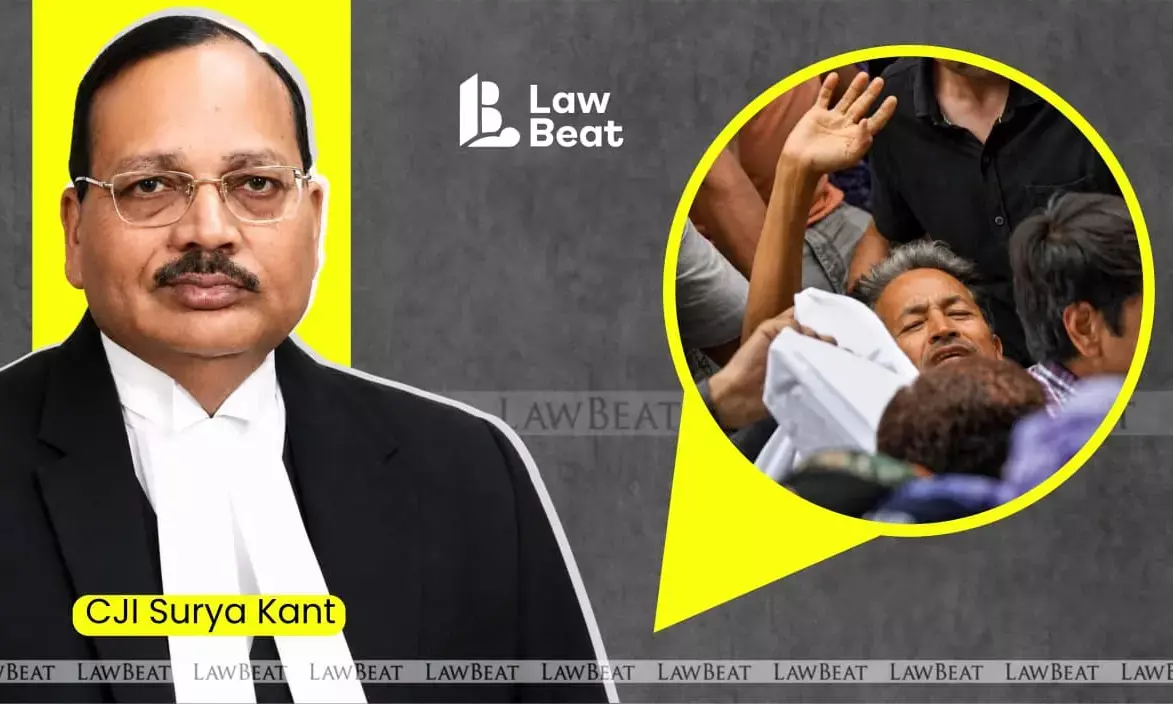
Letter Petition to CJI: Provide Medical Facilities at Protest Site, Not Just Hospital
A letter petition has now been filed before the Chief Justice of India seeking urgent, immediate directions to protect the fundamental rights of Sonam Wangchuk and other protesters at Jantar Mantar, hours after the activist was removed from the protest site and taken to Safdarjung Hospital.
Filed by advocate Narendra Mishra on July 18, the petition invokes Articles 14, 19, 21 and 32, and asks the Registry to place the matter before the Chief Justice for urgent consideration claiming that Wangchuk has been unlawfully detained and the "possible threat to the life, health and fundamental rights" of protesters still at the site.
The petition mentions the Jantar Mantar demonstration as a matter of larger public interest, noting that it has drawn a large number of students and young citizens protesting alleged irregularities in the NEET examination. It lists specific grievances raised by the protesters, including examination paper leaks, leakage of OMR answer sheets, instances of impersonation in exams, and the circulation of leaked papers disguised as "guess papers."
The petition states that following his removal, "the movement has been left without its principal leader" and that students participating in the protest "are apprehensive that their peaceful democratic expression may be curtailed." It argues that peaceful protest at a government-designated site such as Jantar Mantar is protected under Articles 19(1)(a) and 19(1)(b), and that any restriction on it by the State must be "fair, reasonable, proportionate and consistent with the rule of law."
On the medical concerns at the heart of the controversy, the petition submits that there is "a genuine apprehension" that protesters undertaking a hunger strike may not have access to adequate medical facilities at the site itself, thereby endangering their life and health under Article 21. It clarifies that the petitioner does not seek immunity from lawful regulation, but only that executive action against the protesters "remains fair, reasonable, proportionate and consistent with the Constitution."
The petition asks the Court to direct police to permit the peaceful protest and hunger strike to continue at Jantar Mantar, and to provide adequate medical facilities on site, including qualified doctors as mandated under the Delhi High Court's earlier order, emergency equipment, medicines, and periodic examination of Wangchuk and any other participant on a hunger strike. It further seeks a direction restraining police from interfering with the protest or using "unnecessary or excessive force, except in accordance with law."
Significantly, the petition also asks that, if Wangchuk is found to be unlawfully detained, the Court direct his release and facilitate his return "to the designated protest site, so that the peaceful protest may continue in accordance with law and under his leadership", effectively seeking to reverse his hospitalisation and restore him to Jantar Mantar rather than have the fast continue under medical supervision alone.
The petition places the standoff squarely within a constitutional framework, arguing that the State's power to maintain public order must be balanced against citizens' right to dissent peacefully, a balance the Supreme Court "has consistently recognised" in its jurisprudence.
The matter is now before the Registry for placement before the Chief Justice, and Wangchuk still under observation at Safdarjung Hospital for dehydration linked to his prolonged fast.