
"Marriage Cannot Result In Extinction Of Individual Autonomy," Supreme Court During Marital Rape Criminalization Hearing
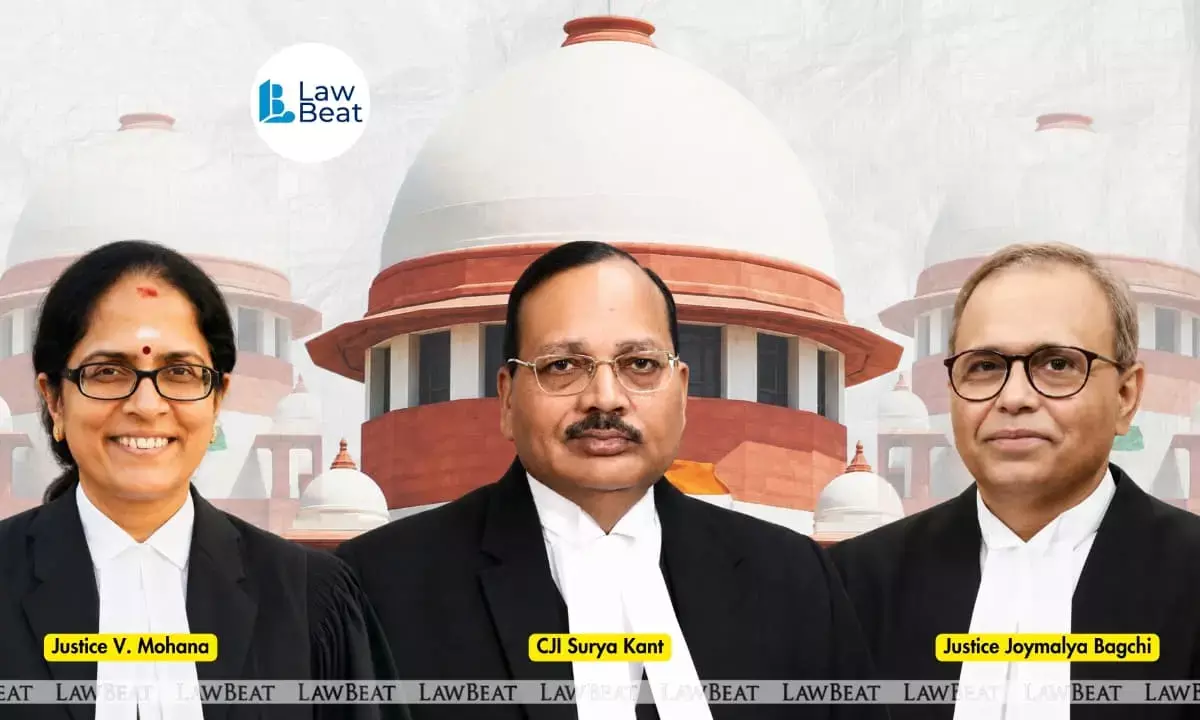
Supreme Court hears petitions pertaining to issue of criminalization of marital rape challenging the exception 2 of Section 375, Indian Penal Code.
The Supreme Court of India today took up the batch of petitions pertaining to the issue of criminalization of marital rape. A three-judge bench headed by Chief Justice of India Surya Kant has set aside Wednesdays and Thursdays for the final hearing in the matter.
"The Union Government has filed its reply in the connected matters also. A copy thereof shall be supplied to all learned counsel appearing in the connected cases within two days. We are informed that the other pleadings are complete. The nodal counsel, shall compile the pleadings and prepare a combined compilation. List these matters for final hearing," CJI Kant has ordered.
Notably, Justice Joymalya Bagchi today made some pertinent observations while hearing the counsels. "Where there is a clear definition and an exception under Section 375, the issue is about the remit of that exception...One is the safety and security of married women, and we fully appreciate the submission that there is no question of marriage resulting in an extinction of individual autonomy. It is a penal law... before a person can be prosecuted, rightly or wrongly, a constitutional court has to render a verdict that the exception is unreasonable or manifestly arbitrary."
Justice Bagchi further observed how there may be situations where courts may not, in the first instance, declare a provision ultra vires, particularly a provision which is penal in nature. The State may be allowed to take a look at it within a timeframe, failing which the Court may declare it ultra vires, he added.
"The Constitution is as liberal as its leaders make it and as illiberal as its leaders make it. A law can be unconstitutional on account of legislative incompetence or because it violates fundamental rights," he added.
The petitions before top court challenge the exception 2 of Section 375, Indian Penal Code as much as it excludes married women from filing rape charges against her husband. A challenge also centres on Exception 2 to Section 63 of the Bharatiya Nyaya Sanhita (BNS), which carries forward the marital rape exception from Section 375 of the old Indian Penal Code.
In 2024, former Chief Justice of India, DY Chandrachud had expressed his inability to conclude the hearing in the petitioner in a timely manner and had listed them before a fresh bench. "Will striking down the exception and criminalizing acts of non-consensual intercourse within marriage would have the possibility of destabilizing the institution of marriage?", the court had earlier asked as the hearing had commenced.
Central government has opposed before the Supreme Court a plea for criminal martial rape, saying a comprehensive, and holistic rather than a strictly legal approach was required in the matter. In an affidavit, the government highlighted that striking down exception to husband from the offence of rape on the ground of its constitutional validity will have a far-reaching effect on the institution of marriage and may severely impact conjugal relationship.
The relationship of marriage creates an intelligible differentia which has a rational nexus with the object sought to be achieved, it said. "The concept of marriage, across personal law and jurisdictions, once solemnised as per the prevailing societal rituals or legal requirements, creates reciprocal legal and social obligations on part of both individuals. It is submitted that at the same time, marriage creates social and legal rights on the part of both individuals and others in the family, in various domains of civil laws and even criminal law," Centre added.
Petitions before Supreme Court
Supreme Court had issued notice in September 2023 in an appeal filed against the split verdict pronounced by the Delhi High Court in the cases pertaining to the issue of criminalization of marital rape. Said appeal has been filed by one Khushboo Saifi who was a petitioner before the High Court in the matter. Supreme Court while issuing notice in the plea challenging the Delhi High Court's split verdict, had also issued notices in similarly placed appeals filed by Hridaya Nest of Family Harmony and All India Democratic Women’s Association.
Saifi had approached the top court after the high court bench consisting of Justice Rajiv Shakdher and Justice C Hari Shankar granted a certificate of leave to appeal before the Supreme Court as the matter involved a substantial question of law. While Justice Shakdher had held the provision unconstitutional and ordered the exception to be struck down, Justice Harishankar had held that the provision is constitutional and is based on “intelligible differentia”.
RIT Foundation, NGO is also before Supreme Court, that initiated the principal constitutional challenge before the Delhi High Court in 2015. All India Democratic Women's Association (AIDWA), a women's rights organisation, is supporting the challenge to the marital rape exception.
Hrishikesh Sahoo is another important individual petitioner whose case reached the Supreme Court. In 2017, Sahoo's wife had filed a complaint against her husband, accusing him of multiple offences under the Indian Penal Code, 1860 (IPC), including rape, cruelty and making threats of causing harm. He was also accused of abusing their daughter and was charged with sexual assault under the Protection of Children from Sexual Offences Act, 2012 (POSCO).
While the case was pending at the Sessions Court, Sahoo filed a writ petition at the Karnataka High Court. He invoked the ‘marital rape exception’ in the IPC and pled for the charges against him to be dropped. On 23 February 2022, Justice M. Nagaprasanna rejected Sahoo’s plea. The High Court relied on the the Justice J.S. Verma Committee report (2013) which recommended deleting the marital rape exception. It held that the exception was regressive and violated the right to equality by treating the wife as subordinate to her husband. The High Court held, “no exception under law can be so absolute that it becomes a license for the commission of a crime against society”. Sahoo then filed a Special Leave Petition at the Supreme Court of India on 10 May 2022, challenging the High Court’s decision.
Hearing Date: September 9, 2026
Bench: CJI Kant, Justice Bagchi and Justice Mohana