
Morality Means 'Sadachar' Under Articles 25 and 26: Supreme Court Told During Sabarimala Hearing
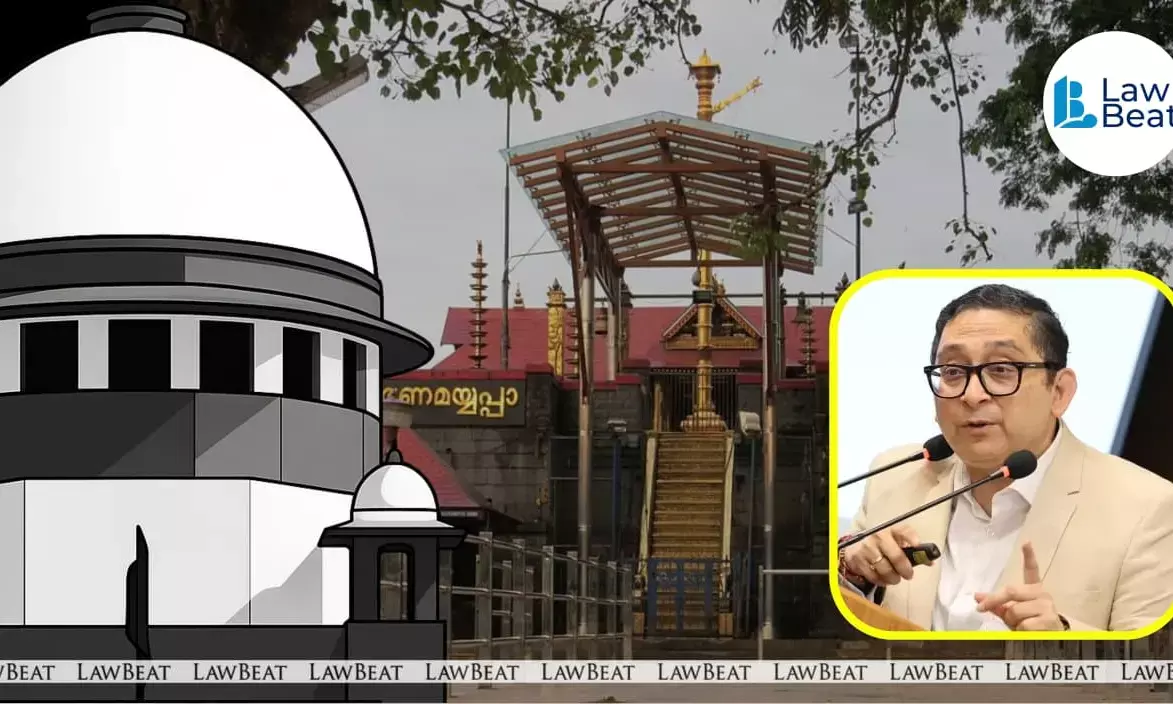
ASG Banerjee made submissions before Supreme Court's 9-judge bench hearing review petitions filed against its 2018 Sabarimala verdict.
The Supreme Court has been told that the word used for 'morals' as mentioned in Articles 25 and 26, in the Hindi Version of the Constitution of India is 'sadachar'.
"Sadachar means approved custom. There is no scope for something like constitutional morality to be read into morality when the word used is Sadachar. Your lordships have also spoken of a swadeshi interpretation of the Constitution if the Presidential Reference hearing," Additional Solicitor General Vikramjit Banerjee told the 9-judge bench hearing the Sabarimala review petitions.
CJi Surya Kant and Justice BV Nagarathna also discussed the meaning of 'sadachar' with ASG Banerjee who described it as 'accha acharan'. "Sadaachaari ko toh bahut sammanit kiya gaya hai, dharmatma tak bol diya gaya hai", CJI Kant remarked in court.
Justice Joymalya Bagchi asked ASG Banerjee if 'sadachar' can be equated to justice equity and good conscience. To this the ASg responded that there is an element of custom that will go along with 'sadachar'.
ASG Banerjee and ASG KM Nataraj supplemented the arguments made by Solicitor General Tushar Mehta. On denominational autonomy, ASG Nataraj submitted that a person cannot insist on non-vegetarian food in a temple that follows vegetarian traditions and “has no right to invade the rights of those believers.” He also referred to temples where liquor is offered as prasad, arguing that such practices cannot be overridden by individual choice.
Court also heard the concluding submissions made by Solicitor General Tushar Mehta who argued that there are temples where men are not allowed because it is a Devi Bhagwati temple. "There are temples, details of which I have mentioned, where male priests are under a religious mandate to wash the feet of female devotees. There are temples like the Pushkar temple, the only Brahma temple in the country, where married men are not allowed. There is also a temple in Kerala where men enter dressed as women. As I have read in detail, they go to beauty parlours, and their female family members help them dress in sarees and other attire. Only males go there. So it is not a question of male-centric or female-centric religious beliefs. In the present case, it happens to be woman-centric," the bench was told.
Supreme Court was also told that the right of entry into the Sabarimala temple must be tested against the rights of its devotees and the beliefs that they have. Solicitor General Tushar Mehta made this submission before a 9-judge bench hearing the long-pending Sabarimala temple review against its 2018 verdict which set aside the traditional ban on women aged between 10–50 years.
SG Mehta had also told a CJI Surya Kant led 9-judge bench that Sabarimala is a specific sui generis case wherein the attributes of the deity, i.e., Lord Ayyappa cannot be judicially examined. "Sabarimala is a specific sui generis case, this is the attribute of a deity, how can we judicially examine that..If a religious head states that something is a matter of faith and the followers abide by it, the question whether such a faith exists is something which the Court can examine using accepted judicial tools. However, the rationality or scientific basis of that faith cannot be gone into.", SG Mehta told the bench comprising Chief Justice of India Surya Kant and Justices B V Nagarathna, MM Sundresh, Ahsanuddin Amanullah, Aravind Kumar, AG Masih, R Mahadevan, Prasanna B Varale and Joymalya Bagchi.
In March, after five years of the review petitions being taken up last, the Supreme Court of India today took up the batch of petitions challenging its September 2018 decision wherein a 5-judge Constitution Bench of the Supreme Court by a 4:1 majority had ruled that the traditional ban on women aged 10–50 years entering the Sabarimala temple was unconstitutional. Notably, more than 50 review petitions have filed by devotees, religious groups, and organisations arguing that the Court interfered with essential religious practices as Lord Ayyappa devotees form a separate religious denomination.
The issue dates back to 2006, when Indian Young Lawyers Association had filed a Writ Petition challenging the validity of Rule 3(b) of the Kerala Hindu Places of Public Worship (Authorisation of Entry) Rules, 1965 (1965 Rules) and sought a direction to permit female devotees between the ages of 10 to 50 years to enter the Sabarimala temple without any restrictions.
By a majority of 4:1, the Supreme Court allowed the Writ Petition on 28 September 2018 holding that the devotees of Lord Ayyappa did not constitute a separate religious denomination and therefore cannot claim the benefit of Article 26 of the Constitution of India. Supreme Court also concluded that exclusion of women between the ages of 10 to 50 years from entry into the temple is violative of Article 25 of the Constitution of India. Further, Rule 3 (b) of the Kerala Hindu Places of Public Worship (Authorisation of Entry) Rules, 1965 was declared as violative of Article 25 (1) to the Constitution of India and ultra vires Section 3 of Kerala Hindu Places of Public Worship (Authorisation of Entry) Act, 1965.
On 14 November 2019, a five judge Constitution Bench delivered a crucial order by a 3:2 Majority wherein it kept the Review petitions pending without overturning the 2018 judgment and referred larger constitutional questions to a 9-judge bench. The 9-judge bench led by former CJI SA Bobde held that no matter is beyond the jurisdiction of a superior Court of record unless it is expressly shown to be so, under the provisions of the Constitution and held that the review petitions were maintainable.
The Sabarimala review petitions is now one of the most important constitutional debates, balancing gender equality with religious freedom. Instead of immediately revising the 2018 verdict, the Supreme Court has chosen to examine wider questions affecting multiple faiths, making the case a landmark in constitutional and religious jurisprudence. Court has now expanded the issue beyond Sabarimala to include Muslim women’s entry into mosques, Parsi women’s religious rights and Dawoodi Bohra excommunication practices along with other similar issues.
Case Title: KANTARU RAJEEVARU Vs INDIAN YOUNG LAWYERS ASSOCIATION THR.ITS GENERAL SECRETARY MS. BHAKTI PASRIJA AND ORS.
Bench: CJI Surya Kant, Justices B V Nagarathna, MM Sundresh, Ahsanuddin Amanullah, Aravind Kumar, AG Masih, R Mahadevan, Prasanna B Varale and Joymalya Bagchi
Hearing Date: April 9, 2026