
NALSA To Revisit Legal Aid Defense Counsel System Scheme
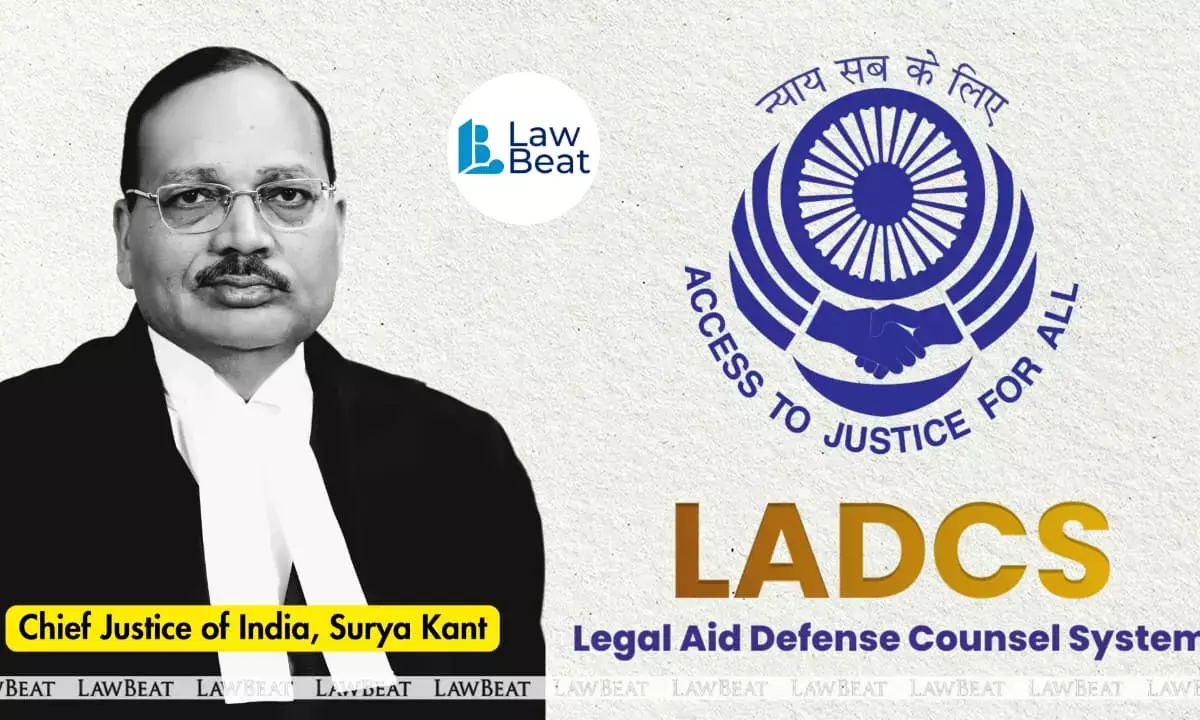
The CJI has decided to revisit the scheme on receiving a representation from Advocate from Punjab.
The Chief Justice of India & Patron-in-Chief, NALSA, has after consultation with the Executive Chairman, NALSA, constituted a committee to revisit the Legal Aid Defense Counsel System (LADCS) Scheme and Policy.
CJI Surya Kant has taken this decision after receiving representations from advocates from the State of Punjab regarding Legal Aid Defense Counsel System (LADCS) Scheme. A press release stating the same has been issued today.
Notably, the Committee shall consist of the following members:
1. Hon’ble Mr. Justice P. Sam Koshy, Judge, High Court of Telangana and Executive Chairman, Telangana State Legal Services Authority as the Chairman
2. Hon’ble Dr. Justice A. K. Jayasankaran Nambiar, Judge, High Court of Kerala and Executive Chairman, Kerala State Legal Services Authority as a Member
3. Mr. Sanjiv Pandey, Member Secretary, National Legal Services Authority as a Member/ Coordinator
4. Ms. Kumari Ranjana Asthana, Member Secretary, Jharkhand State Legal Services Authority as a Member
5. Dr. Manu Kalia, Member Secretary, Uttar Pradesh State Legal Services Authority as a Member
Government of India has been implementing a Central Sector Scheme namely the Legal Aid Defense Counsel System (LADCS) since F.Y. 2023-24, under the aegis of NALSA.
Under LADCS Scheme, legal aid is provided on criminal cases to the beneficiaries as per eligibility criteria mentioned under Section 12 of the Legal Services Authorities Act, 1987 (LSA Act).
The scheme involves full time engagement of Legal Aid Defense Counsels (LADCs) with support system. These counsels deal exclusively with legal aid work in criminal matters viz. pre-arrest through trial, appeal and regular jail visit.
Scheme was introduced noting that panel lawyers under the Assigned Counsel System of dispensation of Legal Aid often maintain private practice and were unable to devote full attention to legal aid cases and clients struggled to get timely updates of the case.
Last year in November, Justice Surya Kant, who was then next in line to be Chief Justice of India, had delivered a focused and deeply reflective address on the occasion of Legal Services Day, emphasising that the strength of a justice system is ultimately measured by its impact on ordinary lives. Speaking at the National Conference on Strengthening Legal Aid Delivery Mechanisms, he underscored that legal services are not a peripheral welfare measure but an essential constitutional mandate that transforms the idea of justice from a formal aspiration into a lived reality.
He had said that legal aid is the point at which constitutional promises meet social realities. Calling legal aid a bridge between the State and the “Invisible Victims of the System,” he noted that it allows the marginalised to “assert their rights, obtain remedies, and be heard.” In his view, the vitality of a legal system is not captured by the speed with which complex disputes are adjudicated, but by its ability to reach people who otherwise stand outside the formal justice framework.