
‘Naxalite’ Remark Triggers Supreme Court Showdown Between SG Tushar Mehta And S Muralidhar In Vande Mataram Row
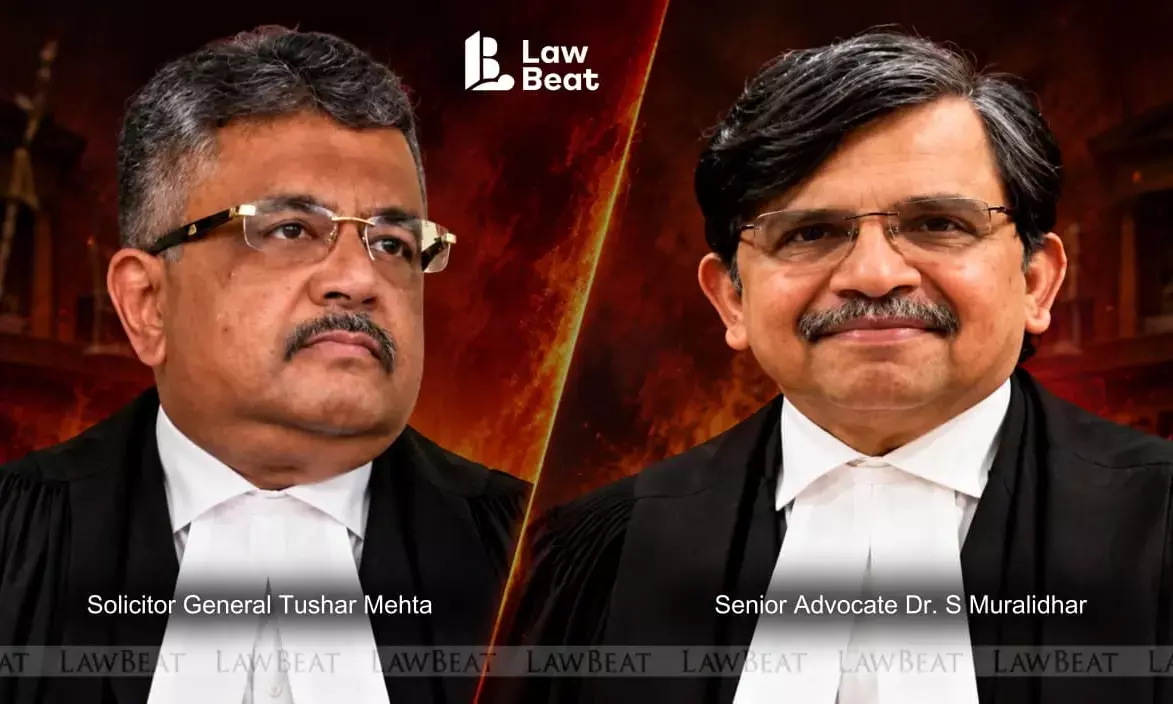
The Supreme Court today witnessed a heated exchange as it heard a plea challenging Centre's direction on singing the full six-stanza version of Vande Mataram.
A heated exchange took place in the Supreme Court on Tuesday between Solicitor General Tushar Mehta and Senior Advocate S Muralidhar during the hearing of Carnatic musician T M Krishna’s challenge to the Centre’s directions on singing the full six-stanza version of ‘Vande Mataram’.
Supreme Court's Bench comprising Chief Justice of India Surya Kant and Justices Joymalya Bagchi and V Mohana was hearing Krishna’s plea challenging the Centre’s directions mandating the use of the complete six-stanza version of the National Song at official and mass programmes, as well as the 2026 amendment to the Prevention of Insults to National Honour Act, 1971.
During arguments, Muralidhar, appearing for Krishna, questioned the legal framework extending statutory protection to Vande Mataram and the consequences that could follow from refusing to sing it.
While opposing the challenge, Solicitor General Mehta argued that the issue should not be viewed narrowly through the lens of secularism. He also referred to persons with a “Naxalite mindset” while arguing that those questioning the National Song should consider its historical significance and the role it played during the freedom struggle.
The exchange between the two was as follows:
SG Mehta: Law-making should not be according to Naxalites
Muralidhar: He should withdraw this. This is going live. This was unnecessary. Some decorum is to be observed. We don't expect this from law officers
SG Mehta: I can repeat what I said. One has to go by law. I said constitution cannot be intrepreted according to Naxalites.. I don't' know why he is taking it otherwise..
Muralidhar: He is again repeating. Now I have to register strong protest!
Muralidhar objected to the use of the term “Naxalite”, saying such an expression was inappropriate for a law officer. He urged the Solicitor General to withdraw the remark.
“This does not behove a law officer. I have never heard a law officer using this expression,” Muralidhar said.
SG Mehta maintained that his submission was directed at the argument being advanced and not at Muralidhar personally. The exchange prompted Justice Bagchi to intervene and describe the tension as unnecessary, urging the lawyers to focus on the legal issues before the Court.
What is the petition challenging?
Krishna has questioned the Centre’s directions requiring the official six-stanza version of Vande Mataram to be used when the National Song is sung at mass or official programmes. The Ministry of Home Affairs had earlier issued directions concerning the rendition of the official version at such occasions.
His plea contends that the last four stanzas contain references to Hindu deities, and that compelling their rendition raises issues concerning secularism, freedom of conscience and religious freedom. He has also challenged the statutory amendment extending the protection under the Prevention of Insults to National Honour Act, 1971 to Vande Mataram.
What has changed under the 2026 law?
Parliament amended Section 3 of the Prevention of Insults to National Honour Act, 1971 in 2026 to place the National Song within the same statutory protection previously applicable to the National Anthem.
Under the amended provision, a person who intentionally prevents the singing of the National Anthem or National Song, or causes disturbance to an assembly engaged in such singing, can face imprisonment of up to three years, a fine, or both. President Droupadi Murmu subsequently gave assent to the legislation.
The amendment places Vande Mataram on the same legal footing as the National Anthem, Jana Gana Mana, by extending to it the existing penal provisions of the 1971 Act.
The amendment inserts references to the national song in the relevant provisions of the 1971 Act. Consequently, actions that are presently offences only in relation to the National Anthem, such as intentionally obstructing its singing or disrupting an assembly engaged in singing it, would also become offences when committed in relation to Vande Mataram.
The legislation forms part of the government's broader effort to accord greater legal recognition to Vande Mataram, which has long held a special place in India's freedom movement and national heritage. Supporters of the measure argue that it fills a long-standing omission in the law by granting the national song explicit statutory protection.
Case Title: T M KRISHNA Vs UNION OF INDIA
Bench: CJI Surya Kant, Justice Bagchi and Justice Mohana
Hearing Date: September 22, 2026