
NEET Paper Leak Protest: Another PIL In Supreme Court Seeks Judicial Probe Into Alleged Police Excesses In Delhi, Bihar
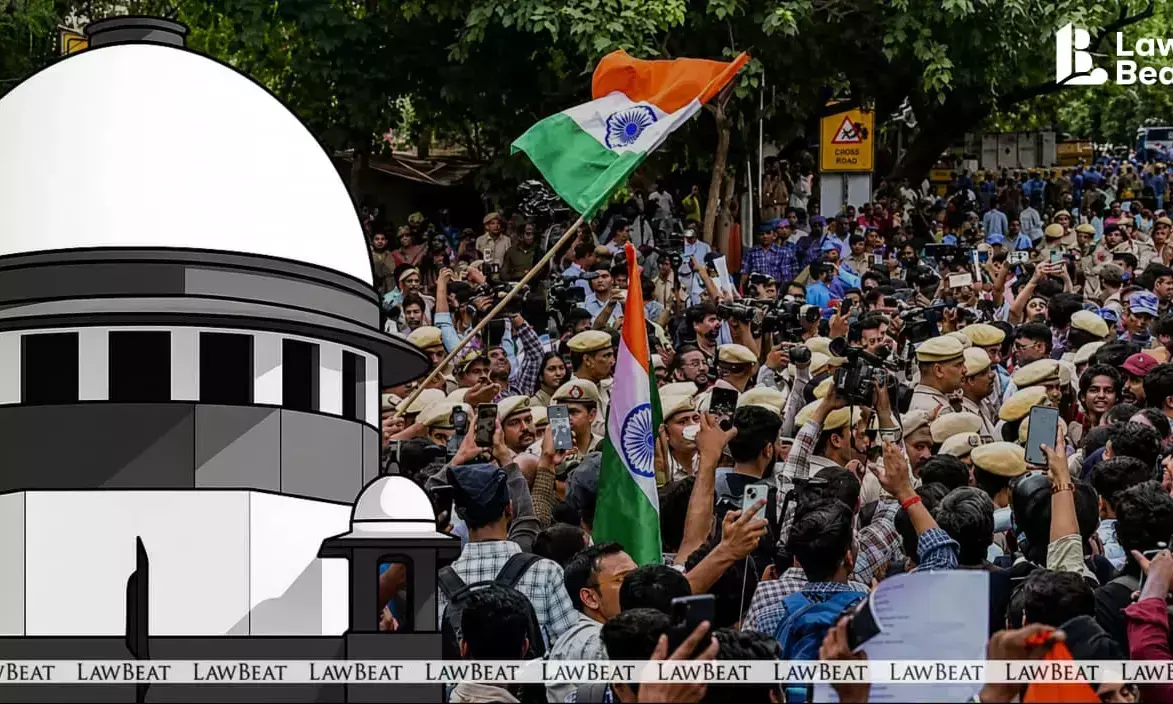
PILs before Supreme Court seek independent probe into the alleged excessive use of force against protesters during the NEET protest.
A Public Interest Litigation (PIL) has been filed before the Supreme Court seeking the constitution of an independent Judicial Commission headed by a retired Supreme Court judge to inquire into the alleged excessive and disproportionate use of force by law enforcement authorities against protesters during the NEET examination paper leak demonstrations in Delhi and connected incidents in Bihar.
Filed under Article 32 of the Constitution, the petition seeks enforcement of the fundamental rights guaranteed under Articles 14, 19 and 21, contending that while the State is empowered to maintain public order, its actions remain subject to constitutional limitations.
The petition filed through AoR Abhigya Kushwah and drawn by Advocate Vishal Tiwari states that it concerns "issues of substantial constitutional and public importance concerning the right of citizens to peacefully express dissent, assemble without arms and seek accountability from the Government."
It further submits: "The use of force against an assembly is required to satisfy the requirements of legality, necessity and proportionality, and the conduct of particular individuals cannot automatically justify indiscriminate action against peaceful participants."
Police Action during 'Sansad Chalo' March challenged
According to the plea, the protests began in June 2026 over alleged irregularities in public examinations, unemployment, corruption and governmental accountability, eventually gathering momentum at Jantar Mantar in New Delhi. The petition notes that social activist Sonam Wangchuk's hunger strike further intensified the movement before protesters proceeded with the "Sansad Chalo" march towards Parliament on July 20.
Referring to the confrontation between protesters and police during the march, the petitioner states that while instances of violence by certain protesters cannot be condoned, such conduct cannot justify indiscriminate police action against the entire gathering.
"The Petitioner therefore does not seek to portray every participant as peaceful or to justify any act of violence, assault, destruction of property or obstruction committed by any person," the plea states.
It adds: "The constitutional grievance raised herein is that misconduct by certain individuals cannot justify indiscriminate or disproportionate force against peaceful protesters, and that allegations of wrongdoing on both sides require an independent, impartial and evidence-based inquiry."
Reliance on Human Rights Watch findings
The petition places reliance on publicly available material, including findings of Human Rights Watch, to contend that questions remain regarding the legality and proportionality of the police response.
According to the plea, Human Rights Watch reported verifying videos allegedly showing security personnel using batons, tear gas and stones against protesters, while also recording incidents where protesters assaulted police personnel.
The petition states that the available material raises questions regarding: "...whether warnings and reasonable opportunities for dispersal were provided; whether the force used was necessary and proportionate; and whether force was directed against persons who were not participating in violence."
It also alleges that several police and Rapid Action Force personnel lacked visible identification tags, raising concerns over accountability.
Challenge to Interest Restrictions
Apart from the use of force, the petition questions the reported suspension of mobile internet services in parts of Central Delhi during the protests.
It contends that communication restrictions affected not only dissemination of information but also access to medical and legal assistance.
"The said allegations assume constitutional significance because restrictions upon communications during a public demonstration may affect not merely dissemination of information but also the ability of injured or detained persons to contact their families, obtain medical and legal assistance and document events," the plea states.
Accordingly, it seeks disclosure of all orders authorising internet suspension, including their statutory basis, territorial extent, duration and reasons.
Independent Judicial Inquiry sought
The petitioner argues that since allegations are directed against law enforcement personnel themselves, an independent mechanism is necessary.
"The Petitioner therefore seeks an independent Judicial Commission/Committee headed by a retired Judge of this Hon'ble Court... to ascertain the true facts, examine the legality and proportionality of the police action and identify individual and supervisory responsibility wherever established."
It further seeks immediate preservation of CCTV footage, police videography, body-camera recordings, drone footage, wireless communication logs, deployment records, detention registers, medical records and other electronic evidence, warning that such material may otherwise be overwritten or lost.
Reliefs Sought
Among other directions, the petition seeks:
1.Constitution of an independent Judicial Commission headed by a retired Supreme Court judge;
2. Registration of FIRs wherever cognizable offences by police or others are disclosed;
3. Investigation by an independent agency or Special Investigation Team;
4. Preservation and production of all electronic and documentary evidence;
5. Disclosure of orders relating to internet shutdowns, Delhi Metro restrictions and police deployment;
6. Medical assistance and compensation for victims of unlawful State action;
7. Uniform national Standard Operating Procedures governing policing of peaceful protests;
8. Mandatory visible identification for police personnel deployed during crowd-control operations; and
9. An independent mechanism to receive and examine complaints of alleged police excesses.
Relying on the Supreme Court's decision in In Re: Ramlila Maidan Incident v. Home Secretary, Union of India, the petitioner argues that constitutional democracy requires accountability on both sides.
"Peaceful dissent and public assembly constitute an essential part of constitutional democracy. At the same time, public protest cannot confer immunity for violence or destruction of property," the plea states.
It concludes by asserting: "The constitutional requirement is that both citizens and the State remain subject to law, and that coercive powers vested in the State are exercised fairly, transparently, necessarily and proportionately."
Case Title: Tripti Kashyap v. Union of India and Ors.
Bench: Supreme Court of India (hearing expected)