
No Alternate Investigation Into Air India Crash Required; Draft Report Will Be Ready By Oct 2026: AAIB Tells Supreme Court
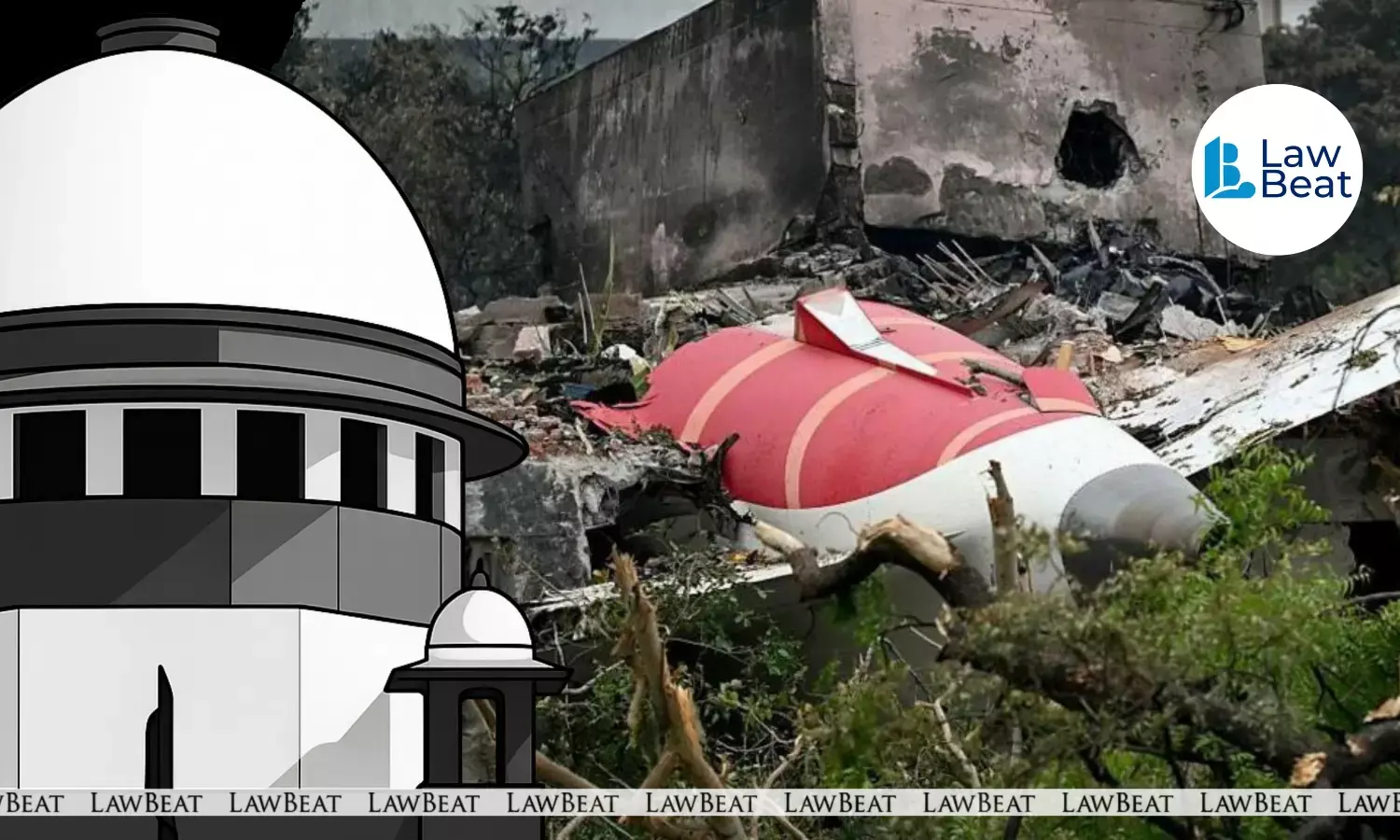
The ill-fated Dreamliner, operating as Air India Flight AI171 from Ahmedabad to London Gatwick, crashed shortly after takeoff on June 12, 2025, killing 229 passengers, 12 crew members, and 19 individuals on the ground
The Director General, Aircraft Accident Investigation Bureau ("AAIB") has filed a counter affidavit before the Supreme Court of India in the petitions seeking an independent, court-monitored investigation into the Air India plane crash at Ahmedabad on June 12, 2025 which claimed 260 lives.
Countering the prayers made for an independent inquiry into the incident, the AAIB has told court that it is merely the competent authority in law; but has demonstrated through its conduct since inception that it discharges its mandate with thoroughness, consistency, and in full conformity with international standards. AAIB is a specialised statutory body with demonstrated experience in the investigation of aircraft accidents and incidents of varying scale and complexity, the response states.
"Since its establishment in July 2012, AAIB has completed a total of 218 investigations, comprising 97 accident investigations, 120 serious incident investigations, and 1 incident investigation. This record establishes AAIB as a technically competent, functional, and fully operational investigation authority, entirely capable of conducting the investigation of the crash of Air India Flight AI-171 in accordance with the prescribed statutory and international framework. There is no warrant, whether on the facts or in law, for this Hon'ble Court to substitute or supplement this expert body with any judicial or alternative investigative mechanism," the top court has been told.
AAIB has told court that its investigation will be completed by 6 weeks, and its draft final report will be ready by October 2026. As per the affidavit, the Centre has taken up investigation into the unfortunate accident with the utmost seriousness and it is committed to examining, adjudicating, and determining the case arising from the accident.
"...considering the very seriousness of the accident, unfortunate lives having been lost, the legal regime existing in India and to meet with the accepted international protocols, the Central Government is proceeding in such a way that each and every procedural requirement is met with and the root cause emerges from such transparent process," the affidavit adds.
On the ongoing investigation, Court has been told that a serious accident involving an international flight is, by its very nature, not a matter purely of domestic inquiry, but one of international inquiry governed by the Chicago Convention and Annex 13 thereto, inasmuch as Article 26 obligates the State in which the accident occurs to institute an inquiry into the circumstances of the accident, while Annex 13 read with Aircraft (Investigation of Accidents and Incidents) Rules, 2025 expressly contemplates the participation of the State of Registry, State of Operator, State of Design, and State of Manufacture, each of whom possesses defined rights and responsibilities in the investigative process through accredited representatives and technical participation. Court has been told thus, the inquiry is not confined to an internal municipal exercise, but assumes the character of an internationally structured, treaty-governed investigation undertaken by the State of Occurrence in coordination with all concerned States having a legally recognised nexus to the aircraft, operator, design, or manufacture.
Earlier this year, Supreme Court had refused to order an independent inquiry into the crash while it was told by Solicitor General Tushar Mehta, "The investigation is at the fag end..It is an international investigation..let this be heard holistically".
Advocate Prashant Bhushan appearing for Safety Matters Foundation had told the bench recently under the government’s own rules, a “court of inquiry” is mandatory in such serious air accidents, not merely an investigation by the Aircraft Accident Investigation Bureau (AAIB). He contended that the AAIB’s preliminary report, reported as suggesting pilot error, was flawed and lacked transparency. Bhushan also flagged safety concerns regarding Boeing 787 aircraft, stating that “several system failures” had occurred after the crash and that the pilots’ association had called for their grounding. Justice Kant cautioned against “pre-judging” the issue, remarking, “It should not look like a fight between airlines.”
Solicitor General Tushar Mehta had opposed the plea, citing the international regime under the International Civil Aviation Organization (ICAO). He had said, “There’s an established process where even foreign nations whose citizens were victims send representatives for the investigation. The Ministry of Civil Aviation has already clarified that no blame has been attributed to anyone.”
Court had in November 2025 issued notice on a petition filed by 91-year-old retired Air Force officer and father of deceased Air India pilot Captain Sumeet Sabharwal, seeking an independent judicial probe into the Ahmedabad Plane Crash that claimed 260 lives in June 2025.
Supreme Court had also issued notice on a Public Interest Litigation (PIL) filed by the Safety Matters Foundation, seeking an independent and court-monitored investigation into the crash after the petitioner raised concerns over the impartiality and transparency of the probe conducted by the Aircraft Accident Investigation Bureau (AAIB).
The petition, filed by Safety Matters Foundation, a non-governmental organization dedicated to promoting aviation safety, raises grave concerns over the selective and incomplete disclosures made by the Aircraft Accident Investigation Bureau (AAIB) in its preliminary report. The ill-fated Dreamliner, operating as Air India Flight AI171 from Ahmedabad to London Gatwick, crashed shortly after takeoff on June 12, 2025, killing 229 passengers, 12 crew members, and 19 individuals on the ground. The aircraft, manufactured in 2013 and powered by GEnx-1B70 engines, had a valid Airworthiness Review Certificate at the time of the accident.
While the AAIB released its preliminary report on July 12, 2025, attributing the crash to the sudden transition of both fuel cutoff switches from RUN to CUTOFF, the petitioner claims the report is riddled with gaps. Sensitive technical information had already appeared in the Wall Street Journal before the report’s release, raising fears of selective leaks and compromised integrity.
The petitioner further alleges a conflict of interest in the investigating team, as three of the five members are serving officers of the Directorate General of Civil Aviation (DGCA). Since the DGCA is directly responsible for certifying the aircraft and monitoring Air India’s operations, its officials’ presence compromises the independence of the inquiry. The petition stresses that under Annex 13 of the Chicago Convention, to which India is a signatory, investigations must be independent, impartial, and aimed solely at preventing future accidents; not at apportioning blame. By failing to meet these standards, India risks undermining global trust in its aviation safety regime.
Case Title: Pushkaraj Sabharwal and Anr. vs. Union of India and Others