
No Right To An Illegal Sentence: Supreme Court Upholds 20-Year Term For Gang Rape Convicts
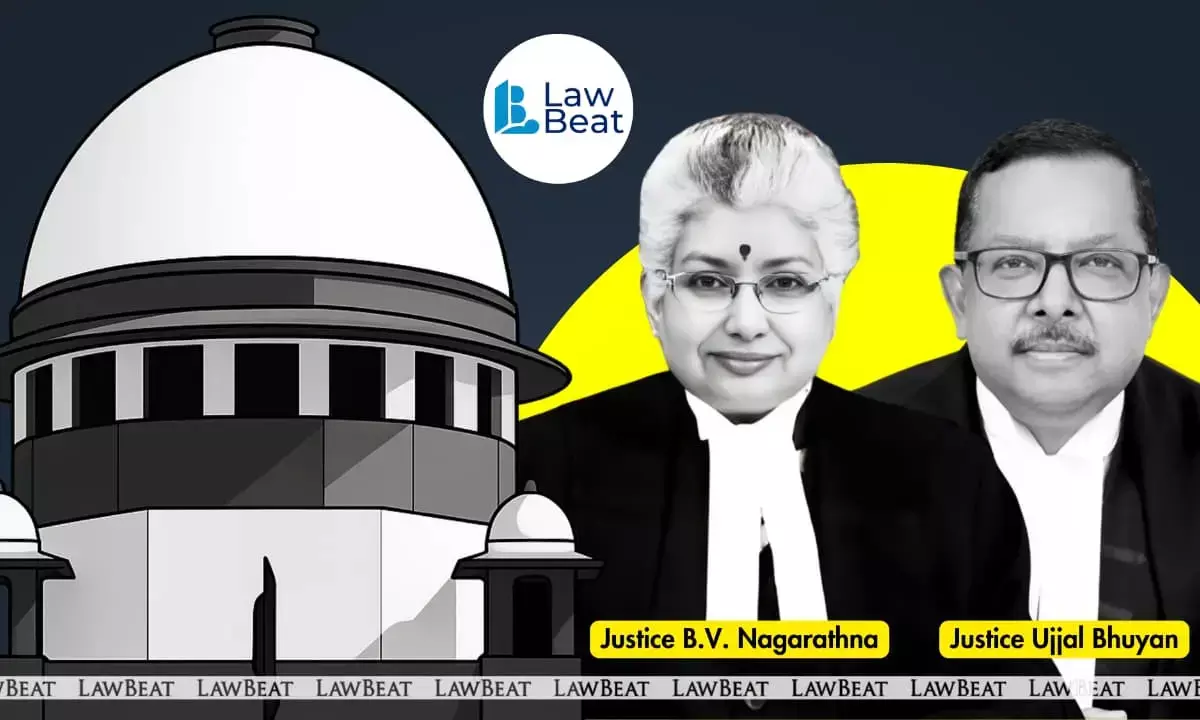
The Supreme Court upheld the Sikkim High Court's decision increasing a gang rape sentence from 12 years to the mandatory minimum of 20 years prescribed under law
The Supreme Court has held that a convict cannot seek to retain the benefit of a sentence that is contrary to law, even if neither the State nor the victim has challenged it.
Upholding a Sikkim High Court decision that increased the sentence of two gang rape convicts from 12 years to the statutory minimum of 20 years, the Court observed that correcting an illegal sentence is fundamentally different from enhancing a lawful one.
The Bench of Justices B. V. Nagarathna and Ujjal Bhuyan dismissed appeals filed by Karan Chettri and another convict, who had challenged the Sikkim High Court's decision affirming their conviction for gang rape while increasing their prison term to comply with Section 376D of the Indian Penal Code.
The case stemmed from an FIR registered in January 2021 at Yangang Police Station in Sikkim. According to the prosecution, the accused gang raped a 52-year-old woman at her residence. Following trial, the Sessions Court convicted them under Sections 376D, 376(2)(l) and 450 read with Section 34 IPC. While convicting them for gang rape, the trial court imposed a sentence of 12 years' rigorous imprisonment.
The convicts appealed before the Sikkim High Court. While partly allowing their appeals by setting aside the conviction under Section 376(2)(l), the High Court upheld the gang rape conviction and noticed that the sentence awarded by the Sessions Court was contrary to the statutory mandate under Section 376D, which prescribes a minimum punishment of 20 years. It consequently enhanced the sentence to 20 years.
Before the Supreme Court, the appellants argued that the High Court could not make them worse off in an appeal filed by them. Relying on Section 386(b)(iii) of the Code of Criminal Procedure and the Supreme Court's earlier judgment in Sachin v. State of Maharashtra, they contended that an appellate court hearing an accused's appeal cannot enhance the sentence.
The State, however, argued that this was not a case of enhancement of a lawful sentence. Rather, the Sessions Court had committed a patent error by imposing a punishment below the minimum prescribed by Parliament.
Agreeing with the State, the Supreme Court held that the trial court had no authority to award a sentence below the statutory minimum under Section 376D. Drawing a distinction between enhancement and correction of an illegality, the Bench observed: "Increasing the sentence from twelve years to twenty years, as in the instant case, where twenty years is the minimum punishment prescribed by the statute, was legally permissible... since the High Court was merely replacing an illegal sentence with a lawful one and not exercising appellate powers of enhancement."
The Court further clarified that when an appellate court brings a sentence in line with a mandatory statutory requirement, it is not imposing a harsher punishment by choice. "The appellate court, by raising the sentence to the statutory minimum, is not making the sentence harsher by choice but is merely giving effect to what the law compulsorily required from the outset," it said.
Addressing the broader principle involved, the Bench underscored that convicts cannot claim a legal entitlement to an unlawful sentence."The accused has a right to challenge his conviction, but he has no right to insist upon the continuance of an illegal sentence."
The judgment further noted that a punishment imposed below the statutory minimum suffers from a fundamental legal defect. "Such a sentence is not merely inadequate, but it is one rendered in derogation of the legal mandate and to that extent, suffers from a jurisdictional infirmity," the Court said.
Rejecting the appellants' contention that the High Court lacked power to interfere in the absence of an appeal by the State or victim, the Court warned against allowing unlawful sentences to survive merely because they were not separately challenged. "To hold otherwise would mean that a manifestly illegal sentence, merely because it was challenged by the convict and not by the State or the victim, must be perpetuated despite being contrary to the minimum punishment ordained by Parliament," it said.
In one of the judgment's most emphatic observations, the Court stated: "The prohibition under Section 386(b) cannot be understood as conferring upon an accused a right to insist upon the continuance of a sentence which the law forbids."
Distinguishing its earlier decision in Sachin, the Bench held that the previous case concerned enhancement of a lawful sentence, whereas the present case involved correction of a sentence that was illegal from the outset.
Finding no infirmity in the High Court's approach, the Supreme Court dismissed the appeals and affirmed the 20-year sentence.
Case Title: Karan Chettri and Another v. State of Sikkim
Bench: Justices BV Nagarathna and Ujjal Bhuyan
Judgment Date: May 20, 2026