
PIL In Supreme Court Seeks Ban On Dummy Schools, Regulation Of Coaching Centres Across India
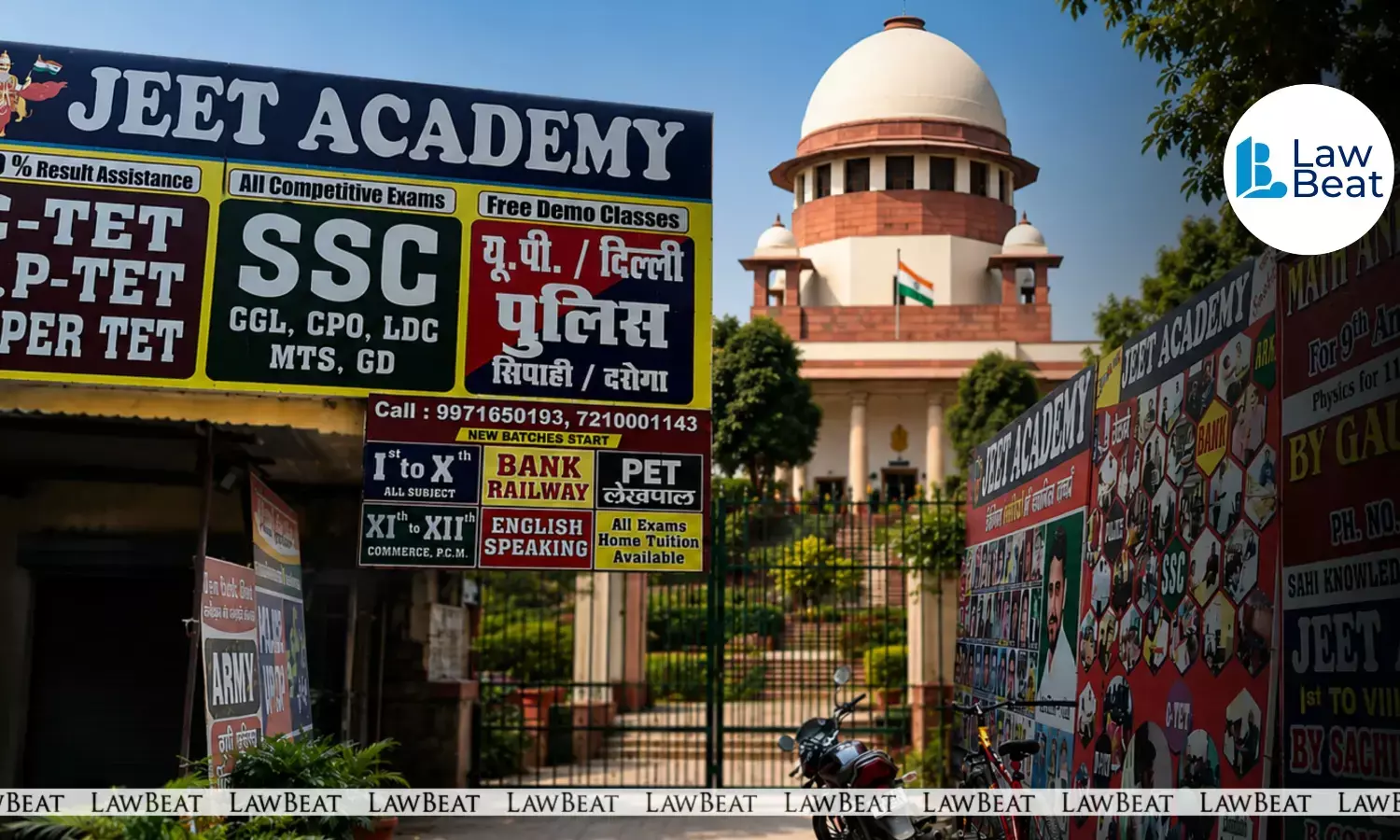
A PIL filed before the Supreme Court sought regulation of private coaching centres, abolition of dummy schools, and alignment of school education with national entrance examinations
A Public Interest Litigation (PIL) has been filed before the Supreme Court seeking sweeping reforms to India's private coaching ecosystem, alleging that the mushrooming of unregulated coaching centres and the "dummy school" model has created a parallel education system that undermines constitutional guarantees of equality and the right to education.
Filed under Article 32 of the Constitution by Advocate Narendra Kumar Goswami, appearing as petitioner-in-person, the plea contends that the existing system has reduced formal schooling to a mere certification process while making access to professional education increasingly dependent on expensive private coaching.
The petition invokes Articles 14, 21 and 21A of the Constitution, along with the Directive Principles contained in Articles 38, 39(f), 45 and 46, and provisions of the Right of Children to Free and Compulsory Education Act, 2009.
The respondents include the Union of India, Ministry of Education, National Testing Agency (NTA), CBSE, NCERT, National Medical Commission (NMC), IIT Council, Bar Council of India, Staff Selection Commission (SSC), Central Consumer Protection Authority (CCPA), National Commission for Protection of Child Rights (NCPCR), and all States and Union Territories.
"Parallel Education Republic"
The PIL argues that India today effectively operates two parallel education systems: one prescribed by law through schools, and another driven by private coaching institutions that determine success in competitive examinations such as NEET, JEE, CLAT, CUET and SSC.
According to the petitioner, students from financially stronger families gain access to specialised coaching, curated study material, mock tests and exam strategies, while those relying solely on formal schooling are placed at a structural disadvantage.
The petition describes this as a State-enabled inequality that defeats the constitutional promise of equal opportunity.
Dummy School system under challenge
A key challenge in the PIL concerns the alleged "dummy school" model, where students remain formally enrolled in schools but spend nearly all their time attending coaching institutes.
The petition alleges that such arrangements deprive children of meaningful classroom education, extracurricular activities, counselling and overall development, while converting schools into little more than examination registration centres.
It further contends that forcing students into prolonged coaching schedules adversely affects their physical and mental well-being and undermines the guarantee of free and compulsory education under Article 21A.
Coaching culture and Mental health
The PIL links India's coaching culture to the growing mental health crisis among students, arguing that extreme academic pressure has become institutionalised.
Referring to the Ministry of Education's January 16, 2024 Guidelines for Regulation of Coaching Centres and the CCPA's guidelines on misleading coaching advertisements, the petition submits that the government has already acknowledged the problem but has failed to create an enforceable legal framework.
According to the petitioner, advisory guidelines alone cannot address what has become a nationwide structural issue.
Reliefs Sought
The petition seeks wide-ranging directions, including:
-A binding statutory framework to regulate private coaching centres;
-Elimination of the dummy school system through strict enforcement of attendance norms;
-Alignment of school curricula with national entrance examinations such as NEET, JEE, CLAT, CUET and SSC;
-Creation of a free multilingual government digital platform for competitive examination preparation;
-Mandatory disclosure of actual coaching success rates and regulation of misleading advertisements;
-Institutional safeguards for student mental health; and
-Publication of annual data on successful candidates, including information relating to schooling background, coaching, socio-economic status and rural or urban origin.
The petitioner argues that if entrance examinations conducted or recognised by the State determine educational and professional opportunities, the school education system itself must adequately prepare students for those examinations.
Constitutional Question before the Supreme Court
The PIL raises a broader constitutional issue concerning whether the State can permit a system where formal schools exist in law while access to higher education is increasingly controlled by a private coaching market.
It argues that the right to education cannot be reduced to mere enrolment and that meaningful education requires regular schooling, trained teachers, social development, sports, counselling and equal access to learning opportunities.
The petitioner submits that the issue is not one of opposing merit, but of ensuring that merit is not determined by a family's ability to purchase expensive coaching.
The Supreme Court is yet to examine the merits of the petition. If listed, the matter is expected to require responses from the Union Government, education regulators and the States.
Case Title: Narendra Kumar Goswami v. Union of India & Ors.
Bench: Supreme Court of India (hearing expected)