
Polavaram Project Row in Supreme Court: Telangana Challenges Centre’s Aid to Andhra Pradesh
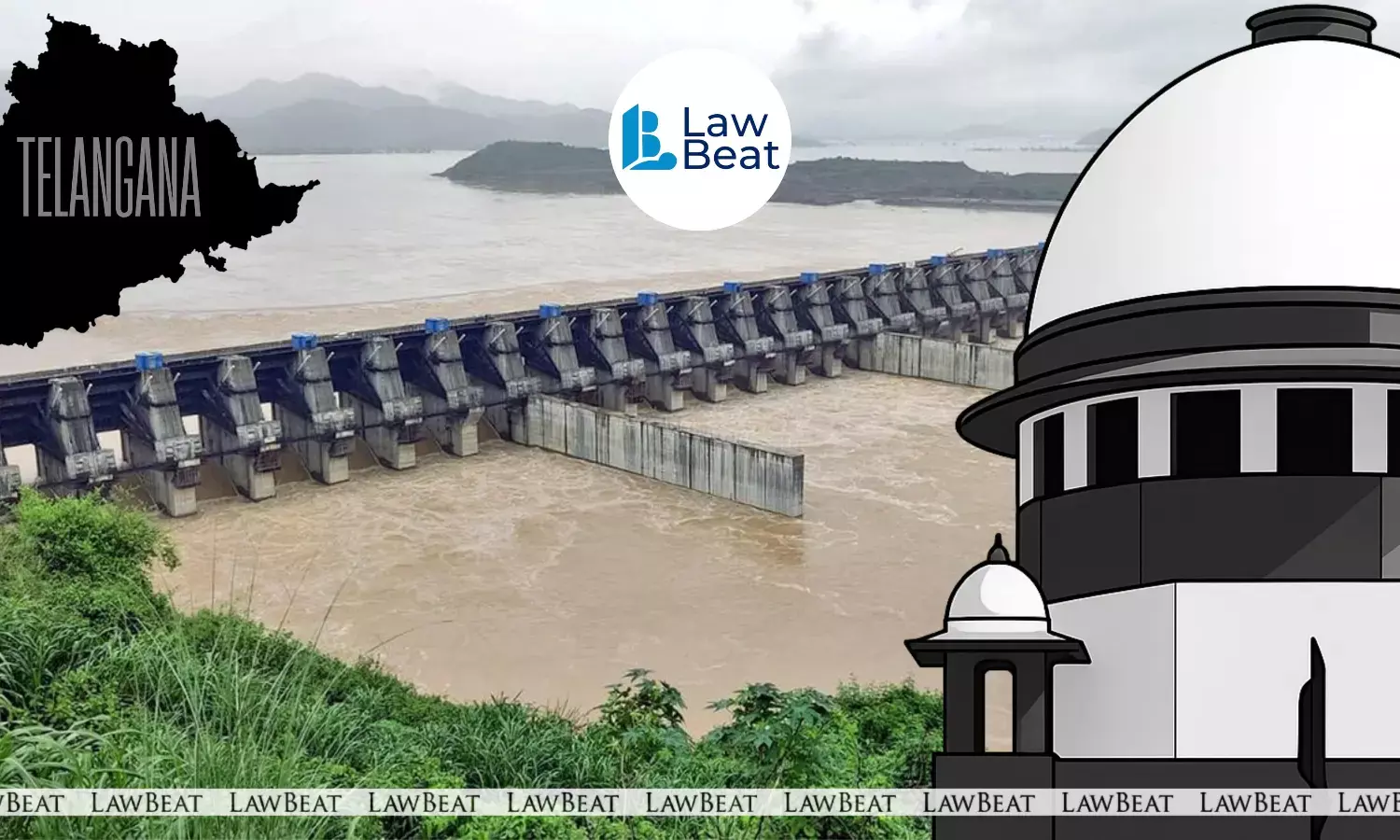
Supreme Court heard Telangana’s challenge to the Centre’s financial assistance for Andhra Pradesh’s Polavaram Project expansion
The Supreme Court on Monday heard a writ petition filed by the State of Telangana challenging the Union government’s extension of financial assistance to Andhra Pradesh for the expansion of the Polavaram irrigation project, with the Chief Justice of India Surya Kant indicating that the dispute appeared to fall squarely within the realm of an inter-state water dispute more suited to a civil suit.
Senior Advocate Abhishek Manu Singhvi, appearing for Telangana, contended that Andhra Pradesh had begun diverting excess flood waters beyond the agreed limits, causing serious and irreversible prejudice to Telangana, a relatively new state with several barrages still under construction. Singhvi argued that Andhra Pradesh was diverting flood waters in excess of 484 TMC, impacting Telangana’s legitimate share of 968 TMC, and that the diversion threatened to permanently reduce the water available to Telangana.
The CJI, however, repeatedly flagged the issue of maintainability, observing that “ultimately, at the end of the day, it is a water dispute.” Singhvi resisted this characterisation, submitting that Telangana had approached the Court under Article 32 in an emergency situation, particularly in light of directions and findings of central authorities.
Singhvi pointed out that the Central Water Commission and the Union Ministry of Jal Shakti had earlier opined that flood waters could not be reversed, and highlighted that on January 2, 2026, the Union government had constituted a High-Powered Committee (HPC) to examine the issue. According to him, despite the committee’s formation, Andhra Pradesh continued with construction activities, leaving Telangana with no effective remedy except approaching the Supreme Court.
The CJI noted that once the Centre had constituted a committee, Telangana ought to place its grievances before that forum. He observed that as Polavaram was a national project, no modification, diversion, or addition could be undertaken without prior central approval. “When the Central government has formed a committee, before the committee has reached a solution…,” the CJI remarked, expressing reluctance to intervene at this stage.
Singhvi countered that the committee lacked powers to grant interim relief or stay ongoing construction, and that only the Supreme Court could prevent irreversible consequences. He stressed that the CWC chairman, who headed the committee, had previously indicated that the diversion should be stopped, making the situation particularly sensitive and “emotive.”
The Bench suggested that Telangana’s proper remedy lay in filing a civil suit under Article 131 of the Constitution, impleading Andhra Pradesh and Karnataka as parties, noting that several such water disputes were already pending before the Court in the form of suits.
Singhvi acknowledged this position and sought time, submitting that he would consider either challenging the committee’s powers or instituting a civil suit.
Senior Advocate Balbir Singh, appearing for the Union, argued that Telangana was deemed to have given consent under the Andhra Pradesh Reorganisation Act. Senior Advocate Mukul Rohatgi, representing Andhra Pradesh, submitted that all reports were examined by concerned states and that the Detailed Project Report was sanctioned only after due process.
Senior Advocate Jaideep Gupta opposed the petition, alleging mala fides and warning that any stay would stall a national project. He argued that Polavaram pre-dated the formation of Telangana and that subsequent procedures had been duly followed.
After hearing the submissions, the CJI stated that the Court would hear both sides further and expressed hope that a “viable solution” would emerge. The matter has been listed for further hearing on January 12.
Case Title: State of Telangana v. Union of India
Bench: CJI Surya Kant and Justice Joymalya Bagchi
Hearing Date: January 5, 2026