
Prashant Kishor Challenges Bihar Government’s DBT Scheme in Supreme Court
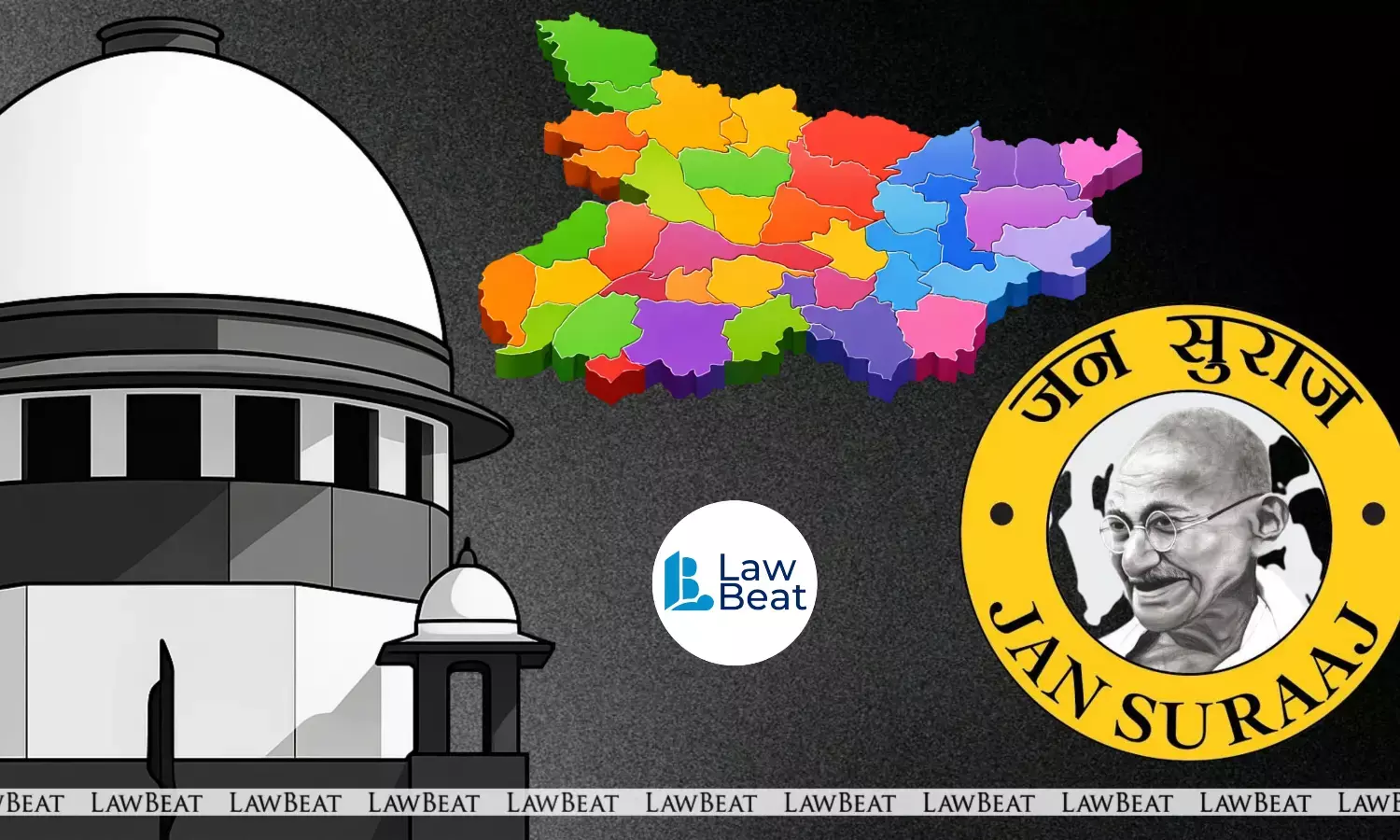
Prashant Kishore gets pulled up by Supreme Court of India for challenging the cash transfer scheme
A registered political party in Bihar, Jan Suraaj, has approached the Supreme Court under Article 32 of the Constitution, alleging that the 2025 Bihar Assembly elections were vitiated by corrupt practices adopted by the then State government through a last-minute welfare scheme implemented during the subsistence of the Model Code of Conduct (MCC).
The challenge arose from the Bihar government’s launch of the Mukhyamantri Mahila Rojgar Yojana just before the 2025 Assembly elections, under which cash assistance was transferred directly into beneficiaries’ bank accounts through DBT.
Relying on the Supreme Court’s landmark ruling in PUCL v. Union of India (2013), popularly known as the NOTA judgment, the petition underscores that free and fair elections form a core component of India’s constitutional democracy and that electoral processes must ensure a level playing field for all political contestants.
Filed through its authorised representative, the State President of the party, Prashant Kishor stated that it is a registered political party in Bihar and had contested 242 out of 243 seats in the 2025 Assembly elections. The party has sought issuance of an appropriate writ, including mandamus or certiorari, against the State of Bihar and the Election Commission of India (ECI), alleging violations of the MCC, the Representation of the People Act, 1951, and Articles 14, 21 and 324 of the Constitution.
At the heart of the challenge is the “Mukhyamantri Mahila Rojgar Yojana” (MMRY), a state-wide scheme launched by a Cabinet decision just before the elections. Under the scheme, the State government announced direct cash assistance of Rs.10,000 to one woman in every family to promote self-employment, with a further promise of Rs.2 lakh after assessment. Eligibility was restricted to women registered with the JEEVIKA self-help groups.
According to the petition, filed through AoR Aditya Singh, Bihar had approximately 11 lakh JEEVIKA self-help groups with around one crore women members immediately prior to the announcement of the MCC. However, newspaper reports dated November 28, 2025 indicated that as many as 1.56 crore beneficiaries had been paid under the scheme. Jan Suraaj alleged that this discrepancy showed that a large number of new beneficiaries were added after the election schedule was announced and that payments were made during the operation of the MCC, amounting to undue inducement of voters.
The party has contended that the scheme was introduced without legislative sanction and that funds were allegedly drawn from the Contingency Fund of the State, in violation of Article 267 of the Constitution. It argued that the scheme was not part of the regular budgetary allocation and was rushed through by executive action on the eve of elections.
In a further allegation, the petition claimed that members of JEEVIKA self-help groups, many of whom were beneficiaries of the scheme, were deputed at polling booths during the two phases of voting on November 6 and November 11, 2025, without any substantial basis. This, the petitioner argued, compromised electoral neutrality and fairness.
Jan Suraaj also relied on the Election Commission’s own instructions issued on January 7, 2007, which prohibit announcement or implementation of new welfare schemes, release of funds, or processing of beneficiary-oriented schemes once the MCC comes into force, unless prior approval is obtained. The petition asserted that the continuation and expansion of MMRY during the election period was in direct violation of these binding guidelines.
Alleging institutional failure, the party claimed that the Election Commission “failed miserably” to prevent the ruling government from adopting corrupt practices and did not adequately assess the impact of large-scale Direct Benefit Transfers on the electoral process. As a result, the petitioner argued, opposition parties were denied a level playing field, rendering the election process unfair and unconstitutional.
Due to the alleged non-availability of official government documents on public portals, the petitioner stated that it was constrained to rely on newspaper reports to substantiate its claims.
On these grounds, Jan Suraaj has urged the Supreme Court to intervene, contending that the integrity of the 2025 Bihar Assembly elections was compromised through inducement of voters and regulatory failure, striking at the root of free and fair elections guaranteed under the Constitution.
Case Title: Jan Suraaj Party v. Election Commission of India
Bench: CJI Surya Kant and Justice Joymalya Bagchi
Hearing Scheduled: February 6, 2026