
Public Figures Should Not Vilify Or Denigrate Any Community: Supreme Court
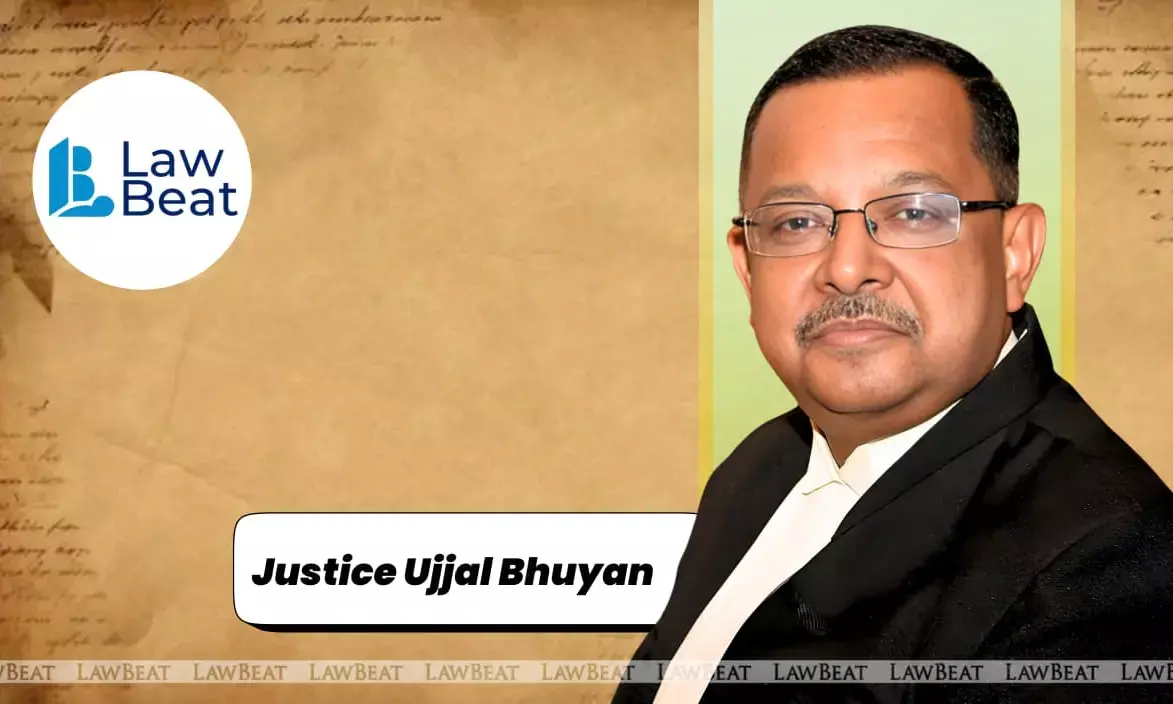
Justice Ujjal Bhuyan, Judge Supreme Court of India
Supreme Court of India has stressed that public figures occupying high constitutional office who have taken the solemn oath to uphold the Constitution should particularly refrain from any acts that may denigrate any community.
"It is therefore constitutionally impermissible for anybody, be it the State or non-state actors, through any medium, such as, speeches, memes, cartoons, visual arts etc. to vilify and denigrate any community. It will be violative of the Constitution to target any particular community on the basis of religion, language, caste or region by whosoever he or she may be. This is particularly true for public figures occupying high constitutional office who have taken the solemn oath to uphold the Constitution", Justice Ujjal Bhuyan has said in his separate opinion in a judgment delivered concerning the controversial title of an upcoming film, earlier titled Ghooskhor Pandat.
Justice Bhuyan, delved into the idea of fraternity to say that it was envisioned as a deep sense of well-being for others and understood as essential to counterbalance individualism, thereby preventing anarchy and sustaining moral order in society. "Dr. Ambedkar’s introduction of the term ‘fraternity’ into the constitutional Preamble reflects his persistent efforts towards eradicating caste discrimination, his advocacy for unity and brotherhood which mirrors his commitment to inclusivity. Unlike the West, in India, fraternity is distinctly perceived as a vital instrument for realising equality and harmonizing the diverse segments of society. It serves as a conduit for transcending societal disparities and working towards collective well-being. Therefore, in the Indian constitutional context, fraternity assumes a dynamic and inclusive role, aligning with the broader goals of social justice, equality and upliftment", Justice Bhuyan has observed.
The Supreme Court judge also dealt with the freedom of a movie maker to make a movie expressing his thought process either to send a message across the society at large or for pure entertainment.
Recently, Filmmaker Neeraj Pandey filed an affidavit before the Supreme Court stating that the controversial title of his upcoming film, earlier titled Ghooskhor Pandat, has been “unequivocally withdrawn” and will not be used in any form. Denying allegations of hurting religious sentiments, Pandey asserted that neither he nor his production house had any “deliberate or malicious intention” to outrage the religious feelings of any community. He maintained that the film does not insult or attempt to insult any religion, caste, or community through its title, visuals, promotional material, or narrative.
Pandey further informed the Court that the earlier title stands completely abandoned and that any new title, yet to be finalised, would not be similar to or evocative of the withdrawn one. The new title, he said, would accurately reflect the film’s storyline without inviting unintended interpretations.
The affidavit was filed pursuant to the Supreme Court’s February 12 hearing, when a Bench comprising B. V. Nagarathna and Ujjal Bhuyan came down heavily on the filmmakers, observing that freedom of speech and expression cannot be used to denigrate a section of society. The Court had issued notice to the Centre, the Central Board of Film Certification, and the filmmaker, while indicating that the film would not be permitted to release unless the title was changed.
Notably, on February 12, the court had directed the makers of the Netflix film “Ghooskhor Pandat” to change its title, holding that it was denigrative of a particular community and could not be permitted under the constitutional framework governing free speech. The bench had underscored that freedom of speech under Article 19(1)(a) is subject to reasonable restrictions, particularly when it threatens public order, morality, and fraternity.
Observing that filmmakers, journalists, and creators are expected to act responsibly, the court had reminded the respondents that the framers of the Constitution were acutely aware of India’s social diversity. “As early as the late 1940s, the framers recognised the multitude of castes, races, and communities, and therefore introduced the concept of fraternity. If you use your freedom to denigrate any section of society, we can’t permit it,” Justice Nagarathna had said.
The petition, filed through AoR Vinod Kumar Tewari under Article 32 of the Constitution, has been moved by Atul Mishra, National Organisation Secretary of the Brahman Samaj of India (BSI), in a representative capacity on behalf of the organisation. The plea seeks the issuance of a writ of mandamus or any other appropriate directions against the Union of India, the Central Board of Film Certification (CBFC), and the producer and director of the film. According to the petitioner, the film’s title and storyline are prima facie offensive and derogatory, portraying the Brahmin community in a defamatory manner. The petition specifically takes objection to the use of the word “Pandat” a caste and religion identifying title alongside “Ghooskhor”, which denotes bribery and moral corruption. This, the plea argues, creates a direct and offensive stereotype against an identifiable religious community.
Serious allegations have also been levelled against the CBFC, with the petitioner claiming that the statutory body either failed to properly scrutinize the film’s content or acted arbitrarily in granting certification. The petition asserts that the CBFC is constitutionally and statutorily obligated under the Cinematograph Act, 1952 to ensure that certified content does not promote contempt or ridicule of any community, unnecessarily hurt religious sentiments, or reinforce caste-based prejudice under the guise of satire.
Case Title: Atul Mishra v. Union of India & Ors.
Bench: Justices BV Nagarathna and Ujjal Bhuyan
Judgment Date: February 19, 2026