
Rahul Gandhi, INDIA Bloc Seek ECI's Internal SIR Files, Retired-Judge Audit Of Voter Deletions In SC: What The Petition Says
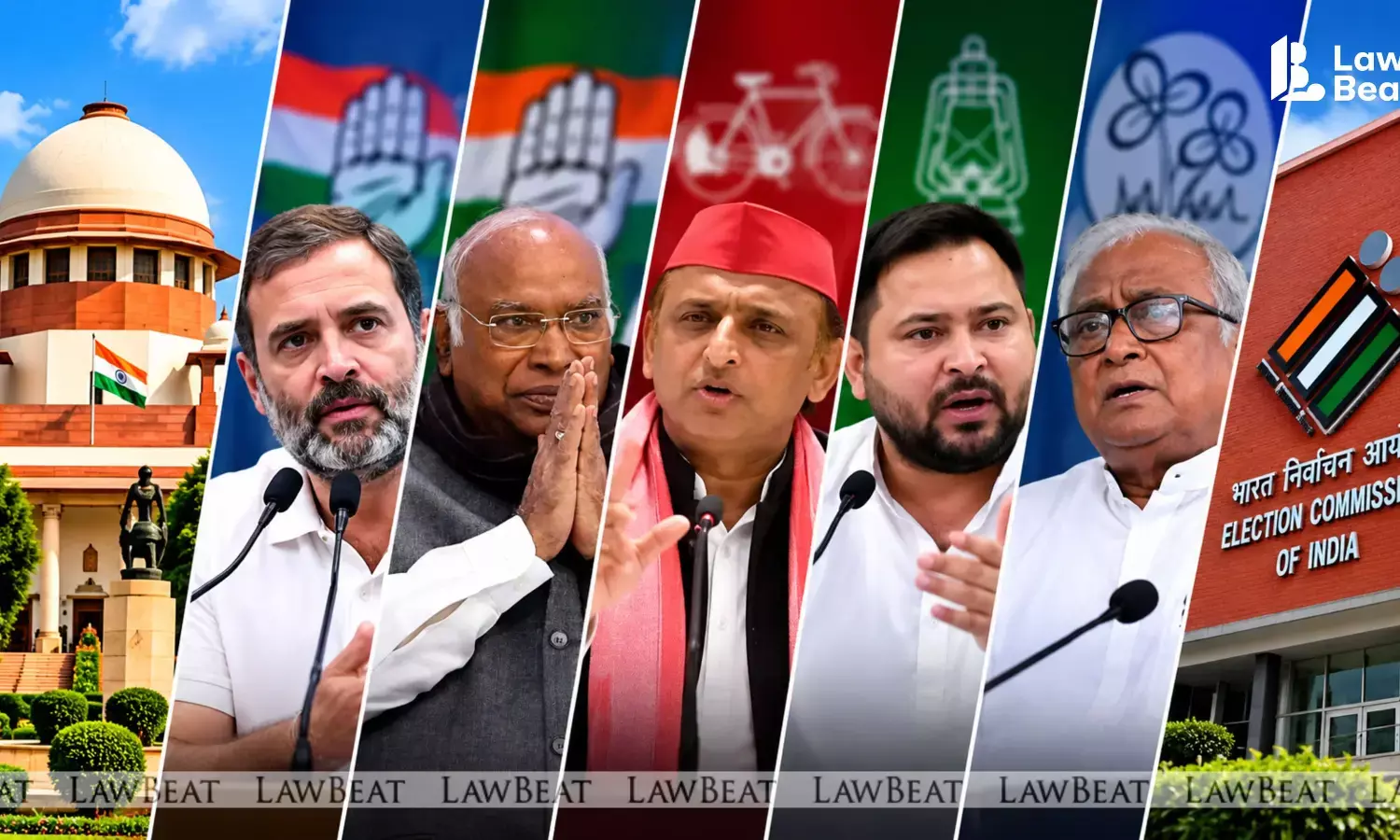
Leaders of Opposition Rahul Gandhi and Mallikarjun Kharge have asked the Supreme Court to direct the Election Commission of India to produce its internal records on the Special Intensive Revision of electoral rolls
Opposition leaders led by Rahul Gandhi through a petition have told the Supreme Court that the Chief Election Commissioner allegedly exercised the "collective powers" of the Election Commission of India on his own during the Special Intensive Revision (SIR) of electoral rolls, and have asked the Court to call for the Commission's files, minutes and notings to test whether its decisions were lawfully taken.
The writ petition, filed under Article 32 of the Constitution by Gandhi, Leader of the Opposition in the Lok Sabha, and Mallikarjun Kharge, Leader of the Opposition in the Rajya Sabha, along with other party leaders and Members of Parliament, also questions the modification of the statutory Form 6, the design and operation of the ECINET and ERONET electoral-roll databases, and the "large-scale exclusion of electors without adequate notice, hearing or an effective mechanism for restoration."
The petition was filed through Advocate-on-Record (AoR) Prasanna S.
The petition was filed pursuant to a written communication of the Chief Justice of India dated October 11, 2026, in reply to a representation by Gandhi and Kharge dated October 10. The Chief Justice is quoted in the petition as having replied: "Incidentally, some matters highlighting similar issues are scheduled for hearing on Tuesday, 13.10.2026. If so advised, you may submit your petition on Monday … You have my assurance that any such petition shall be heard at the earliest possible opportunity, in accordance with law."
The petitioners state that they have approached the Court "in discharge of their public duties", adding that "the right to vote belongs to every eligible citizen irrespective of political affiliation, and its protection is a constitutional imperative that transcends party politics."
The petitioners acknowledge the Supreme Court's judgment of May 27, 2026 in Association for Democratic Reforms v. Election Commission of India, which upheld the validity of the SIR.
They state expressly that they are not seeking to revisit that ruling, "The present Petition does not seek to reopen the question of the validity of the SIR as such. Its concern is narrower and distinct: whether the safeguards recognised by this Hon'ble Court, and the requirement that the Election Commission act as a collective constitutional institution, have actually been complied with in the implementation of the exercise."
As per the petition, "The validity of the SIR does not dispense with the requirement that each decision taken in its implementation must conform to the Constitution, the governing statutes and the applicable Rules."
The petition relies on a report published by The Indian Express on September 23, 2026, which stated that the two Election Commissioners had recorded objections "on at least fourteen occasions over a period of ten months" on decisions concerning voter registration, deletion and restoration of names, and access to electoral-roll data. The objections reportedly indicated that decisions and communications were being issued in the Commission's name without their knowledge or approval.
The petitioners note the Commission's response that the reports present only one part of the picture, that differences of opinion are normal in deliberative processes, and that its decisions were unanimous. They state that they do "not seek to prejudge these competing positions", and frame the question as "whether the decisions in question were taken in accordance with the Constitution, the governings statute and the law declared by this Hon'ble Court."
Relying on the Constitution Bench ruling in T.N. Seshan v. Union of India, the petition states that the Chief Election Commissioner "does not enjoy a superior status over the other Election Commissioners, who are not mere advisers but members of the Commission with a say in its decisions." It adds that Section 18 of the Chief Election Commissioner and Other Election Commissioners (Appointment, Conditions of Service and Term of Office) Act, 2023 gives statutory expression to this principle by requiring the Commission's business to be transacted unanimously as far as possible, and otherwise by majority.
The petitioners also submit that the issue "is not merely one of internal administrative procedure. It concerns the lawful exercise of constitutional authority by the institution entrusted with safeguarding the integrity of elections." They add that free and fair elections "form part of the basic structure of the Constitution."
The petition cites the Commission's own replies under the Right to Information Act, 2005. An RTI application dated July 28, 2025 sought the files and notings by which the Commission decided to undertake the SIR across the country. On August 27, 2025, the Central Public Information Officer supplied only the published order dated June 24, 2025 and stated that no other information was available.
In the first appeal, according to the petition, the First Appellate Authority "recorded that the Commission had, until then, not taken any decision to initiate a nationwide SIR in 2025."
The petitioners say this "appears irreconcilable" with paragraph 10 of the June 24, 2025 order, which declares that the Commission had decided to begin the SIR throughout the country, and with the Commission's press note of September 26, 2026, which states that the order had the unanimous approval of the Commission. They seek production of the complete file recording the June 24, 2025 decision, "if such a file exists".
The petition challenges the modification of the online Form 6 on ECINET in July 2026, which added a declaration concerning whether the applicant or their relatives appeared in an earlier SIR electoral roll. Form 6 is the form prescribed under the Registration of Electors Rules, 1960, framed under Section 28 of the Representation of the People Act, 1950, for inclusion in the electoral roll.
The petitioners allege that the form was changed without amending the Rules, "notwithstanding reported objections raised by the Election Commissioners themselves." They point out that on October 5, 2026, the Supreme Court clarified orally in the pending SIR proceedings that it had not approved the modified Form 6.
According to the plea, "The addition of an unauthorised condition to a statutory form may impose an unlawful burden upon eligible citizens seeking registration, particularly first-time voters, and may result in the exclusion of persons otherwise entitled to be enrolled."
On the ECINET and ERONET databases, the petition refers to reported internal concerns about the absence of an audit of persons who could access and modify the voter database. It states that the review committee set up by the Commission is headed by its own Senior Deputy Election Commissioner and includes an outside technical expert, and submits that "an internal review cannot substitute an independent audit". The petition also refers to reports of eligible electors who could not be restored to the roll because the software allegedly lacked a rollback facility.
It argues that Section 13B of the Representation of the People Act, 1950 vests the preparation and revision of electoral rolls in the Electoral Registration Officer (ERO), whose discretion "cannot be curtailed by technical fiat or a manner of implementation of software."
The petition reads, "The centralised and opaque design, implementation and configuration of ECINet, restriction of ERO access, and denial of rollback facilities by the DG(IT) lack statutory sanction. Article 324, read with Section 18 of the 2023 Act, vests superintendence in the Commission acting collectively, not its IT division. Such centralisation is ultra vires and subverts the decentralised architecture safeguarding free and fair elections."
The petition refers to Shailendra Mani Tripathi v. Union of India, which alleges that approximately thirteen crore names were deleted from electoral rolls across all States and Union Territories during the SIR. It records the Commission's stand that the figure represents electors marked as absent, shifted, dead or duplicate at the draft stage and does not represent final deletions.
The petitioners say that, nevertheless, "the scale of electors marked for removal, and the possibility of eligible voters being wrongly excluded, warrant an effective and transparent verification mechanism." They also raise concerns about bulk filing of Form 7 objections, "the alleged use of forged names and targeting of specific communities and women", the denial of effective notice and hearing, and inadequate enforcement against false declarations.
Invoking Articles 14, 21 and 326 of the Constitution and Sections 21 to 23 of the 1950 Act, the petition submits that "the deletion of an elector already on the electoral roll must be accompanied by the safeguards of notice and a reasonable opportunity of hearing recognised by this Hon'ble Court in Lal Babu Hussein v. Electoral Registration Officer."
To show urgency, the petition points to Punjab, where the draft electoral roll published on August 13, 2026 reportedly reflected a reduction of approximately 20.66 lakh names from an electorate of about 2.14 crore recorded in June 2026. A further 12.80 lakh electors reportedly could not be mapped to the rolls prepared after the 2003 revision and were required to produce documents within a month to remain on the roll. The final roll was scheduled for publication on October 12, 2026.
The petition warns that "in the absence of effective safeguards and a functioning mechanism to correct errors and restore eligible voters, persons entitled to participate in the forthcoming electoral process may be left off the final roll without an effective remedy before the elections." It adds that "the same concerns arise in other States going to the polls."
Separately, the petitioners seek an independent review of "the decisions, policies, procedures, protocols, technical designs and architecture governing the use and deployment of Electronic Voting Machines (EVMs), in comparison with global best practices".
Reliefs Sought in the Petition
The petition seeks consideration along with connected matters already pending before the Court, including Rakesh Kumar Singh v. Union of India, W.P. (C) No. 1246/2026, and Shailendra Mani Tripathi v. Union of India, in which notice was issued on October 5, 2026.
The prayers include directions to:
-the Election Commission of India (Respondent No. 1) to place on record the complete files, agendas, minutes, notings and objections recorded by the Election Commissioners on each disputed SIR decision, the ECINET and ERONET access logs, and the complete file recording the June 24, 2025 decision to begin the nationwide SIR;
-examine whether the disputed decisions complied with Article 324, Section 18 of the 2023 Act and T.N. Seshan, and to quash any decision found to have been taken without lawful authority;
-the competent authorities to act against persons responsible for any breach of the provisions governing electoral rolls, "including under Section 32 of the Representation of the People Act, 1950, wherever warranted";
-the Commission to ensure, pending adjudication, that every SIR decision "is taken and duly minuted in accordance with Section 18 of the 2023 Act";
-the Commission to ensure that the online Form 6 conforms to the form prescribed under the 1960 Rules unless the Rules are lawfully amended;
-constitute an independent committee "headed by a retired Judge of this Hon'ble Court and assisted by technical experts and other citizens of eminence" to audit, within a fixed time, deletions and modifications made during the SIR and access to and alterations in ECINET and ERONET, and to review the use and deployment of EVMs;
-Respondent No. 2 to publish booth-wise the names of all electors deleted during the SIR, with reasons and a breakdown by gender and age, and to provide a functional mechanism for restoring eligible electors;
-the Respondents to ensure that no elector is deleted without notice and a reasonable opportunity of hearing, and that eligible persons in Punjab and other poll-bound States may seek inclusion "until the last date permitted by law".
The petitioners have also sought "an interim direction suspending the ongoing Special Intensive Revision of electoral rolls across the States of the Union, pending consideration and adjudication of the issues raised in the present Petition".
Conclusively, the plea states that it has been instituted "in the larger public interest of safeguarding the constitutional right of every eligible citizen to vote, maintaining the institutional independence and collective functioning of the Election Commission of India, and ensuring that the preparation and revision of electoral rolls are carried out transparently, lawfully and in a manner that inspires public confidence in the democratic process."
Case Title: Rahul Gandhi vs Election Commission of India
Bench: Supreme Court of India (hearing expected)