
Sabarimala Hearing: SG Tushar Mehta Draws Lakshman Rekha On Judicial Reform Of Religion In Supreme Court
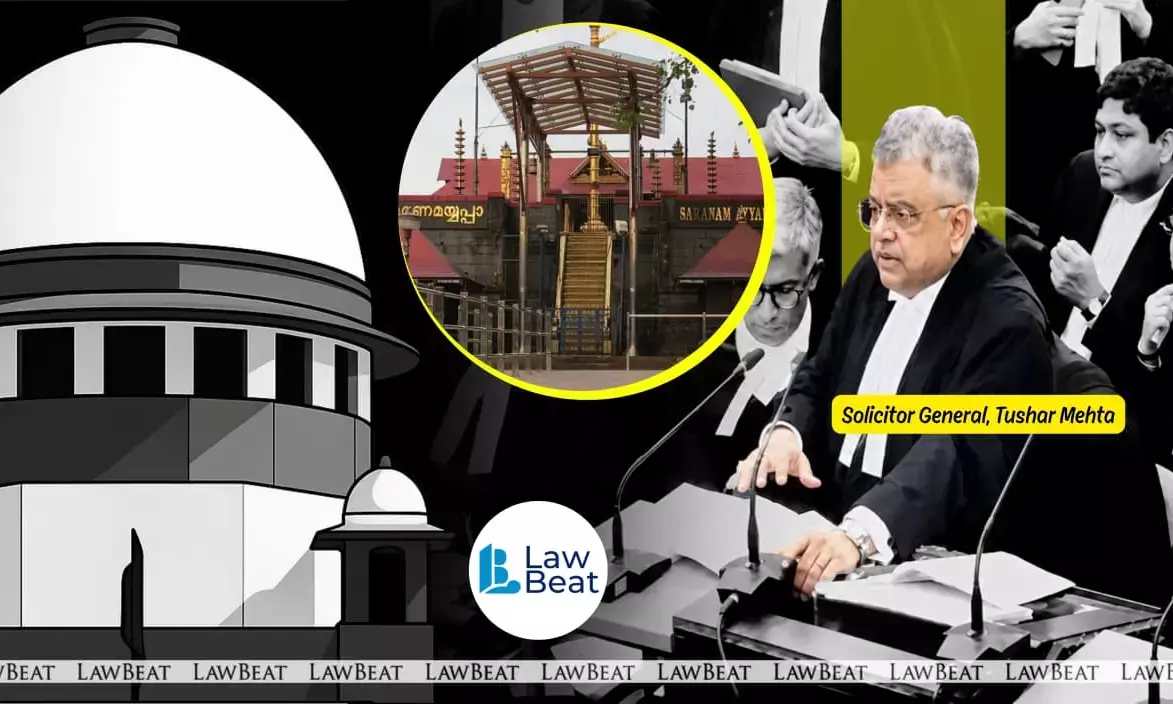
SG Tushar Mehta argued before Supreme Court's 9-judge bench hearing review petitions filed against its 2018 Sabarimala verdict.
Solicitor General Tushar Mehta today made his rejoinder submissions before a 9-judge bench hearing the Sabarimala reference case in which seven larger questions on the scope of religious freedoms are being considered.
SG Mehta vehemently argued against the court's intervention into matters of religion. He questioned Court can function as a reformer of religion. "My answer is no and the reason is the constitutional scheme entrusts the reform part to the legislature and there is a reason...when a particular practice requires reform or there is a social practise..Before passing of a law there is a detailed practise, what is law, I am in parliament, and each and every citizen of this country is present in parliament through its representative and when a law is passed, its acceptability is much more than a judicial verdict, I do not wish to compare this with Sabarimala..and therefore advisedly the Parliament has left reform to the State.." SG told court.
The Solicitor further argued that court cannot exercise the power of judicial review as a part of reform.
To this, Justice Amanullah said, "Just because court is labelled to be a reformist in nature, we should not hold our hands right..."
In response, SG Mehta stated, "That is the problem, what your lordships may perceive, I may not or some other bench may not percieve..so it is better to leave it to the legislature..."
Supreme Court was further told that Sabarimala judgment said Ayyappans is not a denomination and therefore it is not a good law.
"Ayyappans may be a section of some denomination, on what ground can they be denied these fundamental rights because there is a judicial definition evolved..It is a denomination according to me, but worst case scenario it is a section of a denomination..My case is Ayyappan is a separate independent denomination also, in the Indian scheme of internal plurality there can be an overlap between one denomination and another..For example, Vaishnavite is a denomination, Madhavacharya sect is also a denomination and bot follow substantially the same rituals, the policies may differ..", court was told.
A further submission was made by SG Mehta that court may sometimes be confronted with situations where the activity in question is an mixture of secular, economic and religious elements and in such situations, the Court should lean in favour of protecting religious freedom.
"When dealing with religion, the scrutiny under Article 14 or Article 21 cannot be applied in the conventional constitutional sense. Article 14 ordinarily examines arbitrariness, the object sought to be achieved, the nexus and so on. But in matters of religion, it may at times not be possible to identify any such object from a constitutional perspective. Yet it may still be a matter of faith or belief protected by the Preamble and by the Constitution. Scrutiny by the Court, in my respectful submission, cannot proceed only on the ordinary constitutional understanding of Article 14 or Article 21 or other rights. It has to proceed from the perspective of a person who follows the religion and possesses a belief system protected by the Constitution," SG added.
After five years of the review petitions being taken up last, the Supreme Court of India in March took up the batch of petitions challenging its September 2018 decision wherein a 5-judge Constitution Bench of the Supreme Court by a 4:1 majority had ruled that the traditional ban on women aged 10–50 years entering the Sabarimala temple was unconstitutional.
Notably, more than 50 review petitions have filed by devotees, religious groups, and organisations arguing that the Court interfered with essential religious practices as Lord Ayyappa devotees form a separate religious denomination. The issue dates back to 2006, when Indian Young Lawyers Association had filed a Writ Petition challenging the validity of Rule 3(b) of the Kerala Hindu Places of Public Worship (Authorisation of Entry) Rules, 1965 (1965 Rules) and sought a direction to permit female devotees between the ages of 10 to 50 years to enter the Sabarimala temple without any restrictions.
By a majority of 4:1, the Supreme Court allowed the Writ Petition on 28 September 2018 holding that the devotees of Lord Ayyappa did not constitute a separate religious denomination and therefore cannot claim the benefit of Article 26 of the Constitution of India. Supreme Court also concluded that exclusion of women between the ages of 10 to 50 years from entry into the temple is violative of Article 25 of the Constitution of India. Further, Rule 3 (b) of the Kerala Hindu Places of Public Worship (Authorisation of Entry) Rules, 1965 was declared as violative of Article 25 (1) to the Constitution of India and ultra vires Section 3 of Kerala Hindu Places of Public Worship (Authorisation of Entry) Act, 1965.
On 14 November 2019, a five judge Constitution Bench delivered a crucial order by a 3:2 Majority wherein it kept the Review petitions pending without overturning the 2018 judgment and referred larger constitutional questions to a 9-judge bench. The 9-judge bench led by former CJI SA Bobde held that no matter is beyond the jurisdiction of a superior Court of record unless it is expressly shown to be so, under the provisions of the Constitution and held that the review petitions were maintainable.
The Sabarimala review petitions is now one of the most important constitutional debates, balancing gender equality with religious freedom. Instead of immediately revising the 2018 verdict, the Supreme Court has chosen to examine wider questions affecting multiple faiths, making the case a landmark in constitutional and religious jurisprudence. Court has now expanded the issue beyond Sabarimala to include Muslim women’s entry into mosques, Parsi women’s religious rights and Dawoodi Bohra excommunication practices along with other similar issues.
Case Title: KANTARU RAJEEVARU Vs INDIAN YOUNG LAWYERS ASSOCIATION THR.ITS GENERAL SECRETARY MS. BHAKTI PASRIJA AND ORS.
Bench: CJI Surya Kant, Justices B V Nagarathna, MM Sundresh, Ahsanuddin Amanullah, Aravind Kumar, AG Masih, R Mahadevan, Prasanna B Varale and Joymalya Bagchi
Hearing Date: May 12, 2026