
Sabarimala Judgment Review: TDB Tells Supreme Court Restriction On Women's Entry An Essential Welfare Custom
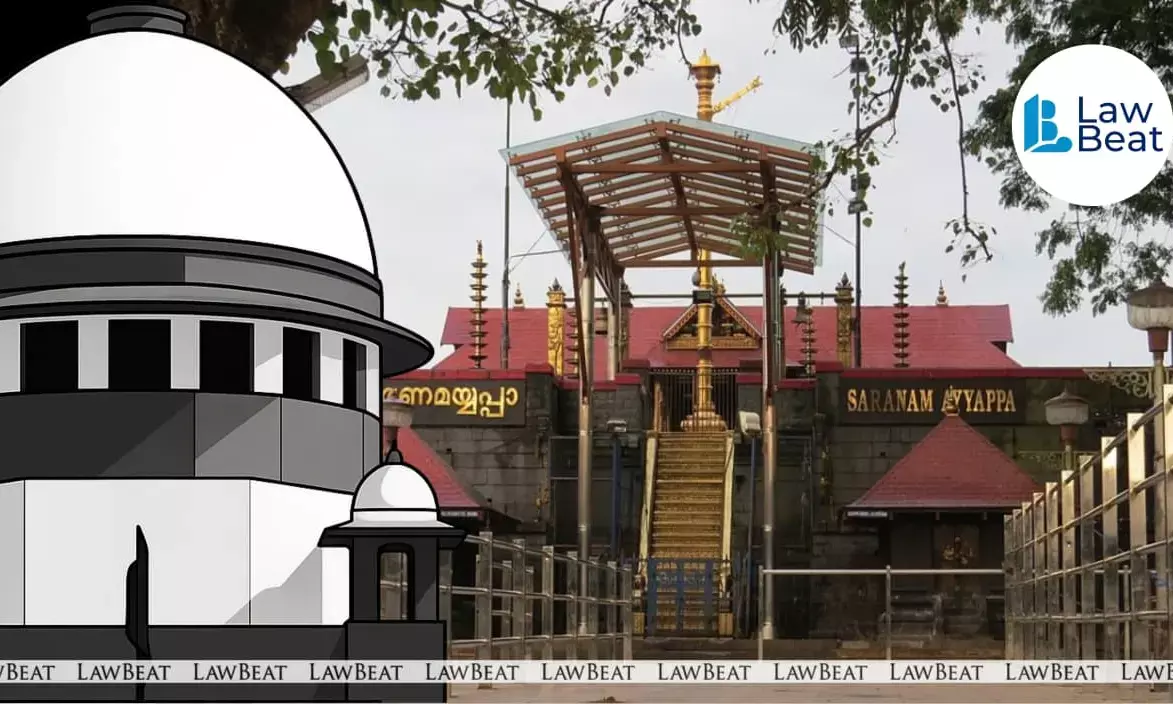
Supreme Court hears Sabarimala Review petitions filed against its 2018 verdict.
The Supreme court has been informed that for the Sabarimala Temple, the final authority on religious customs, rituals, and practices is the hereditary Thanthri of the Thazhamon family who has consistently affirmed, that the restriction on the entry of women is an ancient and essential custom for the welfare of the temple.
"The restriction at Sabarimala is not based on caste or any such "section" of Hindus. The temple is unique in its egalitarianism, welcoming people of all castes and even other religions. The restriction is based on age and is uniformly applicable to all women of that age group, irrespective of their caste, class, or section. It is directly linked to the unique 'Naishtika Brahmacharya' character of the deity, a matter of religious doctrine, not social discrimination," the written submissions filed before the Supreme Court on behalf of the Travancore Dewaswom Board states.
Reliance is also places on the Kerala Hindu Places of Public Worship (Authorisation of Entry) Act, 1965, enacted pursuant to Article 25 (2) (b), which contains a proviso to Section 3 which explicitly saves the right of a religious denomination to manage its own affairs in matters of religion. The said proviso is argued to protect practices observed in the Sabarimala Temple.
The Supreme Court is also apprised of historical facets involved in the instant issue and it is stated, "Sabarimala is a Temple of great antiquity dedicated to Lord Ayyappa, a deity depicting “a hyper masculine God born out of the union of two male Gods, Shiva and Mohini, where Mohini is Vishnu in a female form”. Although there are innumerable Ayyappa Temples in India (approx 1000), the Sabarimala Temple is supposed to depict “Naishtika Brahmacharya” viz. a perennial brahmachariya (celibate student); his great powers deriving specifically from his ascetic endeavours, in particular from abstention from sexual activities, a practice also followed by pilgrims before and during the pilgrimage to Sabarimala".
The argument on ‘gender discrimination’ being violative of Articles 14 and 15 of the Constitution, insofar as women are prohibited from entering into the Sabarimala Lord Ayyappaswamy Temple, the court has been told, "This ignores the fact that females below the age of 10 and above the age of 50 are permitted entry into the Temple. Females of reproductive age are not permitted. But, even in their case, no absolute prohibition exists, as each one of them, when she crosses the age of 50, would be entitled to enter into the Temple."
The classification is argued to be founded on an intelligible differentia which distinguishes women of that age group from both men and women of other age groups and makes that age group the basis of exclusion based upon inherent physiological characteristics which bear a nexus to the objects of abstinence, celibacy, purity and self denial, already summarized above. It is further submitted that the maintenance of the purity of the idol/deity in the form of a Naishtika Brahmacharya is also a paramount object which is sought to be achieved. Consequently, the differentia is not only intelligible, not only distinguishes the persons or things that are grouped together from others left out of the group, but the differentia also have a rationale relation to the object sought to be achieved.
Last month, after five years of the review petitions being taken up last, the Supreme Court of India today took up the batch of petitions challenging its September 2018 decision wherein a 5-judge Constitution Bench of the Supreme Court by a 4:1 majority had ruled that the traditional ban on women aged 10–50 years entering the Sabarimala temple was unconstitutional.
Notably, more than 50 review petitions have filed by devotees, religious groups, and organisations arguing that the Court interfered with essential religious practices as Lord Ayyappa devotees form a separate religious denomination.
A CJI Surya Kant led bench took up the petitions and has ordered that the same will be heard by a 9-judge bench starting April 7, 2026. "The nine judge bench shall begin hearing the review case on April 7, 2026 at 10.30 am. The review petitioners shall be heard from April 7 to 9, 2026. The parties opposing the review will be heard from April 17-16, 2026. Rejoinder submissions will be heard on April 21. Parties to adhere to the time schedule".
Importantly, Solicitor General Tushar Mehta, appearing for Centre told the bench also comprising Justices Joymalya Bagchi and Vipul Pancholi that the Centre will be arguing in support of the review petitioners.
The issue dates back to 2006, when Indian Young Lawyers Association had filed a Writ Petition challenging the validity of Rule 3(b) of the Kerala Hindu Places of Public Worship (Authorisation of Entry) Rules, 1965 (1965 Rules) and sought a direction to permit female devotees between the ages of 10 to 50 years to enter the Sabarimala temple without any restrictions.
By a majority of 4:1, the Supreme Court allowed the Writ Petition on 28 September 2018 holding that the devotees of Lord Ayyappa did not constitute a separate religious denomination and therefore cannot claim the benefit of Article 26 of the Constitution of India. Supreme Court also concluded that exclusion of women between the ages of 10 to 50 years from entry into the temple is violative of Article 25 of the Constitution of India. Further, Rule 3 (b) of the Kerala Hindu Places of Public Worship (Authorisation of Entry) Rules, 1965 was declared as violative of Article 25 (1) to the Constitution of India and ultra vires Section 3 of Kerala Hindu Places of Public Worship (Authorisation of Entry) Act, 1965.
On 14 November 2019, a five judge Constitution Bench delivered a crucial order by a 3:2 Majority wherein it kept the Review petitions pending without overturning the 2018 judgment and referred larger constitutional questions to a 9-judge bench. The 9-judge bench led by former CJI SA Bobde held that no matter is beyond the jurisdiction of a superior Court of record unless it is expressly shown to be so, under the provisions of the Constitution and held that the review petitions were maintainable.
The Sabarimala review petitions is now one of the most important constitutional debates, balancing gender equality with religious freedom. Instead of immediately revising the 2018 verdict, the Supreme Court has chosen to examine wider questions affecting multiple faiths, making the case a landmark in constitutional and religious jurisprudence. Court has now expanded the issue beyond Sabarimala to include Muslim women’s entry into mosques, Parsi women’s religious rights and Dawoodi Bohra excommunication practices along with other similar issues.
Case Title: KANTARU RAJEEVARU Vs INDIAN YOUNG LAWYERS ASSOCIATION THR.ITS GENERAL SECRETARY MS. BHAKTI PASRIJA AND ORS.