
SC: Contempt Power Not a Judge’s Armour; Sentence Remitted After Genuine Apology
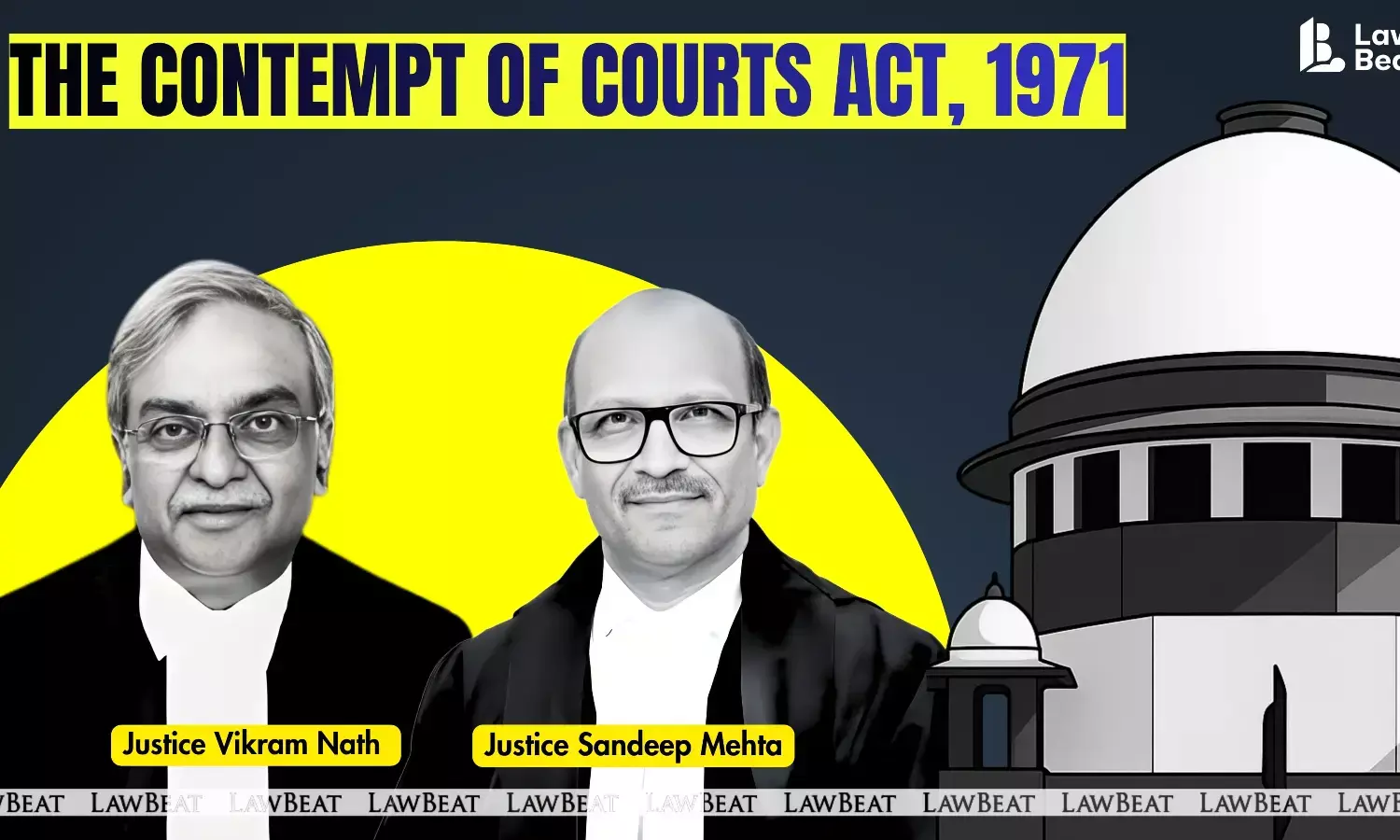
The Court says contempt may be made out but punishment must still conform to Section 12’s remedial safeguards.
The Supreme Court has set aside the Bombay High Court’s order sentencing a former director of a Navi Mumbai housing society to a week’s imprisonment for criminal contempt, holding that although the circular authored by her did satisfy the statutory ingredients of contempt, the High Court erred in refusing to consider the statutory scheme of the Contempt of Courts Act, 1971, in disregarding an unconditional apology tendered at the earliest stage.
The Court underscored that the contempt power is not intended to operate as a “personal armour for Judges” nor as a tool to suppress criticism, and that the Act itself embeds a calibrated remedial space enabling discharge or remission when genuine remorse is shown.
A Division Bench of Justices Vikram Nath and Sandeep Mehta delivered the judgment on 10.12.2025.
The Bench recorded that the High Court’s refusal to accept the apology was unsustainable in law, as the record disclosed no material suggesting absence of bona fides.
Observing that “mercy must remain an integral part of the judicial conscience,” the Court held that once a contemnor demonstrates sincere contrition, the statutory discretion must be exercised judiciously rather than as a matter of subjective perception.
The Court therefore remitted the sentence imposed by the High Court while maintaining that the act itself amounted to contempt, thereby drawing a clear distinction between adjudicating guilt and assessing the consequence.
The proceedings arose out of a suo-motu action initiated by the High Court following circulation of a 29.01.2025 note by the appellant, Vineeta Srinandan, during the pendency of a writ petition filed by Seawoods Estates Ltd. challenging Rule 20 of the Animal Birth Control Rules, 2023.
The circular issued without authorisation of the society’s board contained sweeping allegations that a “dog feeder’s mafia” enjoyed support within the judiciary, suggested that judges refused to look at evidence supplied by residents, and claimed that courts routinely defended dog feeders “ignoring the value of human life.”
These assertions, the High Court held, were calculated to scandalise the Court, interfere with ongoing proceedings, and lower the authority of the institution.
In response to the show cause notice issued on 07.02.2025, the appellant filed an affidavit admitting her error, stating that she acted under pressure from residents, recording her resignation from the Board, and tendering an unconditional apology.
Nonetheless, the High Court characterised the apology as formalistic and inadequate, convicted her of criminal contempt, and sentenced her to simple imprisonment for one week along with a nominal fine.
Before the Supreme Court, the central issue was not whether the circular amounted to contempt, the Court held that it clearly did but whether the High Court had properly applied Section 12 of the Contempt of Courts Act.
The Bench extracted the proviso and Explanation to Section 12 to emphasise that Parliament contemplated not merely punishment but also remission contingent on a bona fide apology, clarifying that even a qualified or conditional apology cannot be rejected if offered sincerely.
The Court described this statutory design as balancing the preservation of judicial authority with recognition of human fallibility, thereby preventing contempt from degenerating into an unduly punitive jurisdiction.
The Court was equally categorical in holding that the High Court had misapplied precedent.
It noted that authorities such as Rajendra Sail, Dr D.C. Saxena, Roshan Lal Ahuja and Perspective Publications were invoked without accounting for the factual distinctions central to their ratio.
In some of those cases no apology had been offered; in others the apology was withdrawn; and in one instance the allegations against the judiciary included imputations of bribery and disproportionate assets far more serious than the present case.
The Bench reiterated the rule restated in Royal Medical Trust v. Union of India and Dhanwanti Devi that the binding element of a judgment lies in its ratio and cannot be extracted from isolated expressions divorced from context, warning that uncritical reliance on broad observations may distort the scope of contempt jurisprudence.
In this backdrop, the Court found that the appellant had appeared at the first opportunity, admitted her lapse without qualification, and placed on record circumstances that, while not exculpatory, demonstrated immediate recognition of wrongdoing.
The High Court, it held, was therefore required to examine whether the apology satisfied statutory parameters rather than dismissing it on the basis of subjective impressions about its depth.
The absence of any contradictory material led the Top Court to conclude that the High Court failed to exercise its jurisdiction with the necessary circumspection. Allowing the appeal, the Court set aside the sentence imposed by the Bombay High Court and held that the ends of justice would be met by accepting the apology for the purposes of Section 12.
Case title: Vineeta Srinandan v. High Court of Judicature at Bombay (Suo Motu)
Judgment date: 10.12.2025
Bench: Justice Vikram Nath and Justice Sandeep Mehta