
Somnath Non-Veg Ban: Supreme Court Refuses To Stay Gujarat High Court Order, Asks It To Decide Appeals Within Two Months
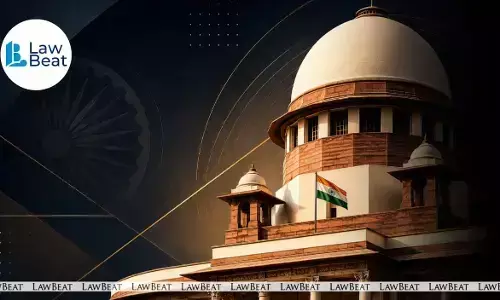
The Supreme Court declined to stay the Gujarat High Court's interim order keeping the non-vegetarian food ban near the Somnath temple in force, and requested the High Court to decide the appeals preferably within two months
The Supreme Court on Friday refused to stay a Gujarat High Court order that keeps the ban on non-vegetarian food within 500 metres of the Somnath temple in force, leaving eateries at Prabhas Patan unable to serve it during the festive season. The Court did, however, request the High Court to dispose of the pending appeals preferably within two months.
The Bench of Justice M.M. Sundresh and Justice P.B. Varale heard the plea filed by Aakib Aminbhai Khan, owner of M/s Taj Restaurant, one of the eateries affected by the ban. Senior Advocate Huzefa Ahmadi appeared for the petitioner.
Solicitor General Tushar Mehta appeared for the State of Gujarat.
On 10 August, the District Magistrate of Gir Somnath issued a notification under Section 33(1)(w)(ii) and Section 33(6) of the Gujarat Police Act, 1951. The notification banned the preparation, sale and storage of non-vegetarian food, including eggs, on the specified routes and areas at Prabhas Patan, Taluka Veraval. It covered every area within 500 metres of the temple.
The eateries challenged the notification before the Gujarat High Court. They said they had been lawfully running vegetarian and non-vegetarian hotels and restaurants in the area for the past 35 to 40 years.
On 30 October, a Single Judge of the High Court quashed the 10 August notification. The Single Judge held that it was ultra vires Article 19(1)(g) of the Constitution because it violated the fundamental right to carry on trade.
On the same day, a Division Bench of Acting Chief Justice Manash Ranjan Pathak and Justice Nirzar S. Desai stayed the Single Judge's order. As an interim measure, the Division Bench directed that the 10 August notification would remain in force until the matter was heard. It reasoned that many devotees were likely to visit during Deepavali and the Gujarati New Year. The eateries then approached the Supreme Court against that interim order.
Ahmadi told the Bench that the Single Judge had rightly held that the Gujarat Police Act confers no power to impose a permanent ban. He described permanent bans as very strange, and he relied on the Supreme Court's judgment in Bijoe Emmanuel to argue that the Constitution teaches tolerance.
"You can't force people to eat or not to eat. Dietary habits can't be regulated by law," he submitted.
Ahmadi also questioned the State's approach to food. "80% of this country is non-vegetarian. Why are we getting so hypersensitive that the State is passing such orders?" he asked.
Justice Sundresh asked what the urgency was for interim relief. Ahmadi replied that it was Diwali time for the restaurant owners, and that their business would suffer during the festive season.
"This is during Diwali, this is bread and butter and [you] are killing an enterprise. Mylords can stay, I have been operating for 40 years! If someone is eating non-vegetarian food within closed precincts, what is wrong?" he said.
The Solicitor General supported the ban on behalf of the State of Gujarat. "You can serve [non-veg] outside," he said.
After hearing brief arguments, the Bench declined to stay the High Court's order. It said that the High Court should make an endeavour to decide the appeal within two months.
Before the hearing ended, Justice Sundresh said orally that a balanced approach would probably have to be taken. "Probably, [they] need to take a middle path, neither here nor there. We don't want to say anything," he observed.
After passing the order, Justice Sundresh said that the nine-judge Bench's forthcoming judgment on the interpretation of Article 25, in the Sabarimala reference, would bear on the issue.
"Hopefully, by the time our judgment on Article 25 would also come, which will have a substantial bearing on this. Then, there might not be a need for such arguments then," he said.
Case Title: M/S Taj Restaurant Owner Aakib Aminbhai Khan v. State of Gujarat and Others.
Bench: Justice M.M. Sundresh and Justice P.B. Varale
Hearing Date: November 6, 2026